BYD's Yangwang U9 Xtreme recently reached a speed of 503.17 kilometers per hour (312.66 miles per hour) on a closed highway in Abu Dhabi, becoming the first mass-produced vehicle to exceed a speed of 500 kilometers per hour.
Both the International Automobile Federation (FIA, FIA) and Guinness World Records have recognized this achievement. For this all-electric supercar, this is its second record-breaking speed achievement in just over a year, and it has also broken its own previous record set.
From 496 kilometers per hour to 503 kilometers per hour
BYD announced this record on the X platform that morning, stating that U9 Xtreme "accomplished the impossible" and calling it "the fastest mass-produced car on Earth."
For this challenge, Abu Dhabi closed a 10-kilometer section of road located on Sheikh Zayed International Highway (E11) in the Al Dhafra region, providing the racing team with a 7-kilometer straight stretch. The German racing driver Marc Basseng who previously helped the team set a record is driving the car again this time.
The entire process took two days. According to the International Automobile Federation, Basseng reached a top speed of 490 kilometers per hour on the first day. After making adjustments to the tail fin, damping system, and tire pressure overnight, he managed to achieve a speed of 503.17 kilometers per hour during his second attempt on November 1st.
The previous record was 496.22 kilometers per hour (308 miles per hour), set at the ATP Papenburg test track in Germany in September 2025. That record surpassed the previous top mark of 490.48 kilometers per hour, set by the Bugatti Chiron Super Sport in 2019.
Just a few days ago, BYD released a video showing a U9 Xtreme vehicle hitting a guardrail at a speed of about 280 miles per hour during an earlier high-speed test. The driver was unharmed. BYD then conducted another test and managed to reach a speed of 457.89 kilometers per hour on the next attempt.
3000 horsepower, 1200 volts, limited to 30 units
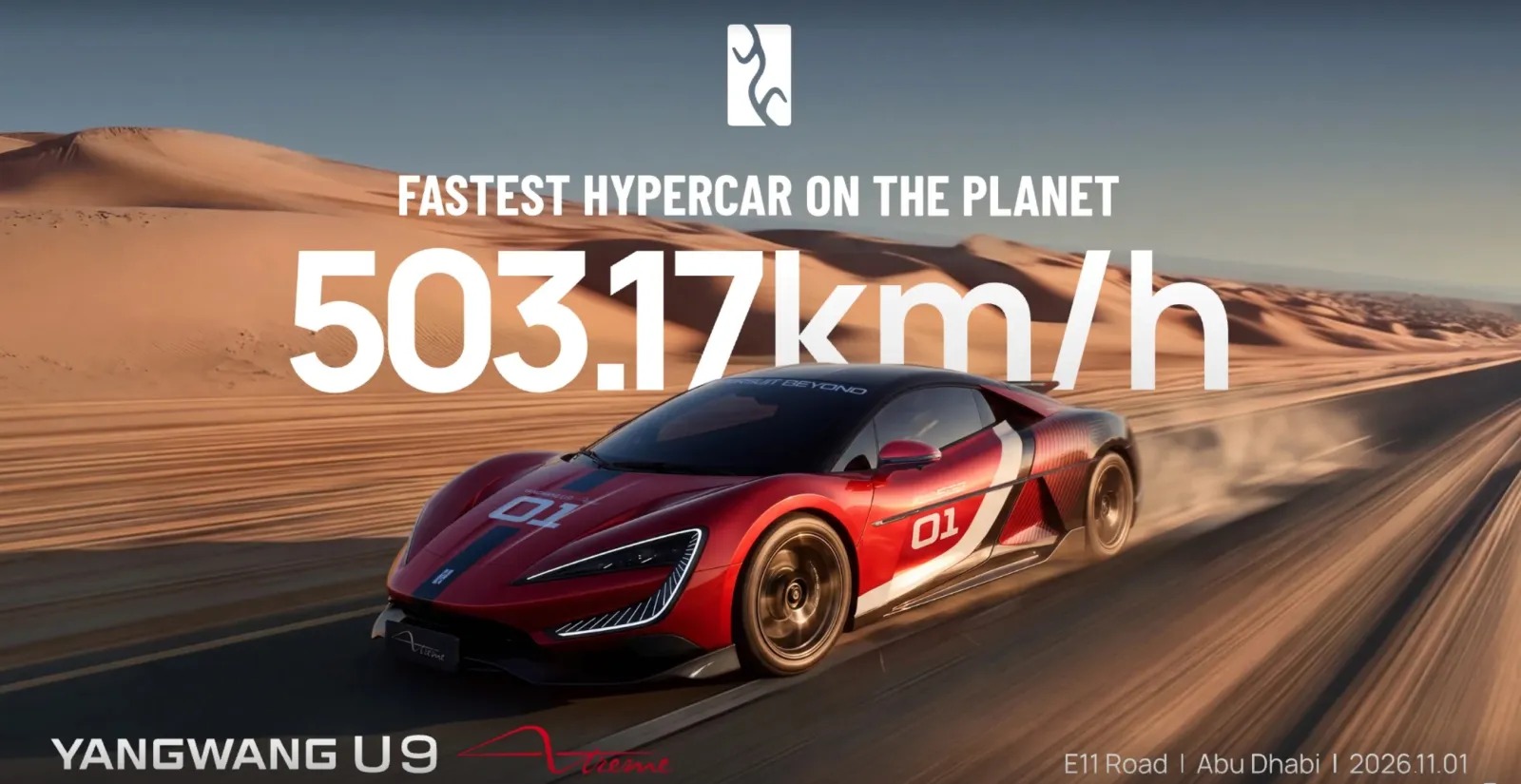
U9 Xtreme is a track-oriented version that looks up to U9, the latter being the flagship supercar under BYD's high-end brand, Yangwang. This vehicle is equipped with four motors, each with a rated power of 555 kilowatts, and can reach a maximum speed of 30,000 revolutions per minute, for a total output of 2,220 kilowatts.
This is equivalent to over 3,000 metric horsepower, or nearly 3,000 horsepower.
This vehicle adopts a 1200-volt architecture and is equipped with a track-level version of BYD's blade batteries. Its battery cells are made of lithium iron phosphate ( LFP ), which is the same chemical system used in BYD's cheapest urban cars.
For comparison, Rimac Nevera R set multiple world records for electric vehicles last year, with a top speed of 431.45 kilometers per hour. U9 Xtreme still holds the record for the fastest lap time of a mass-produced pure electric vehicle around the Nürburgring Nordring, with a time of 6 minutes and 59.157 seconds.
Only 30 units of this car were produced, and BYD has priced it at approximately $3 million per vehicle. Since BYD does not sell passenger cars in the United States, it is not expected to be seen on the U.S. market.
However, there are also notes and conditions attached to this record.
The biggest problem is that this is a one-way speed test result. The two Guinness World Records titles corresponding to this challenge – “Highest speed of a production car” and “Highest speed of a production electric vehicle” – are both clearly labeled as “one-way.” BYD claimed in its post that it had set four Guinness World Records, but in the FIA’s announcement, only the aforementioned two records were listed.
Traditionally, the record for the top speed of mass-produced vehicles is determined by taking the average of two tests in opposite directions, and these tests must be completed within one hour to account for the effects of wind direction and road slope. When Koenigsegg set a record of 447.19 kilometers per hour in 2017 with the Agera RS, they used this method.
Bugatti was also questioned for this in 2019. At that time, Chiron completed the test at a speed of 490 kilometers per hour in one direction, and a pre-production vehicle was used. Bugatti itself also stated at that time that that was not an official record.
In addition, this vehicle also uses custom semi-hot melt tires developed in collaboration with Giti Tire. It is not yet clear whether the vehicles to be delivered to the 30 customers in the future will be equipped with these tires.
Electrek Perspective
Putting aside these conditional notes, this matter is still quite astonishing.
A Chinese automaker known for producing small cars in cities with a population of around 10,000 people has now created the fastest mass-produced car in the world, and it's an electric vehicle. Not long ago, the general consensus in the industry was that electric vehicles could not maintain extremely high speeds for long periods, as the batteries and motors would overheat before the car could cover a significant distance on the road. However, BYD has managed to achieve a speed of 503 kilometers per hour using LFP battery cells. LFP battery cells.
However, Electrek indicates that they will assess BYD using the same standards as they would when evaluating Bugatti. Completing a one-way sprint on a highway with a 7-kilometer straight section is an outstanding demonstration, but it still doesn't qualify as an undisputed ultimate record, although it is still impressive.
Anyway, to be honest, this is more about marketing. No one is really going to drive one of these 30 cars at 500 kilometers per hour. But it did work: before the launch of the brand-new super-luxury sedan, it created an aura around the brand, and it also helped BYD make inroads into Europe, making the notion that “Chinese cars are just cheap replicas” seem outdated.
The real question now is whether Bugatti or Koenigsegg will respond with a two-way test at 500 kilometers per hour. Koenigsegg claims that Jesko Absolut is theoretically possible, but they have never actually attempted it. Could BYD become the company that ultimately prompts them to take on the challenge?
Author: Fred Lambert; Source: Electrek