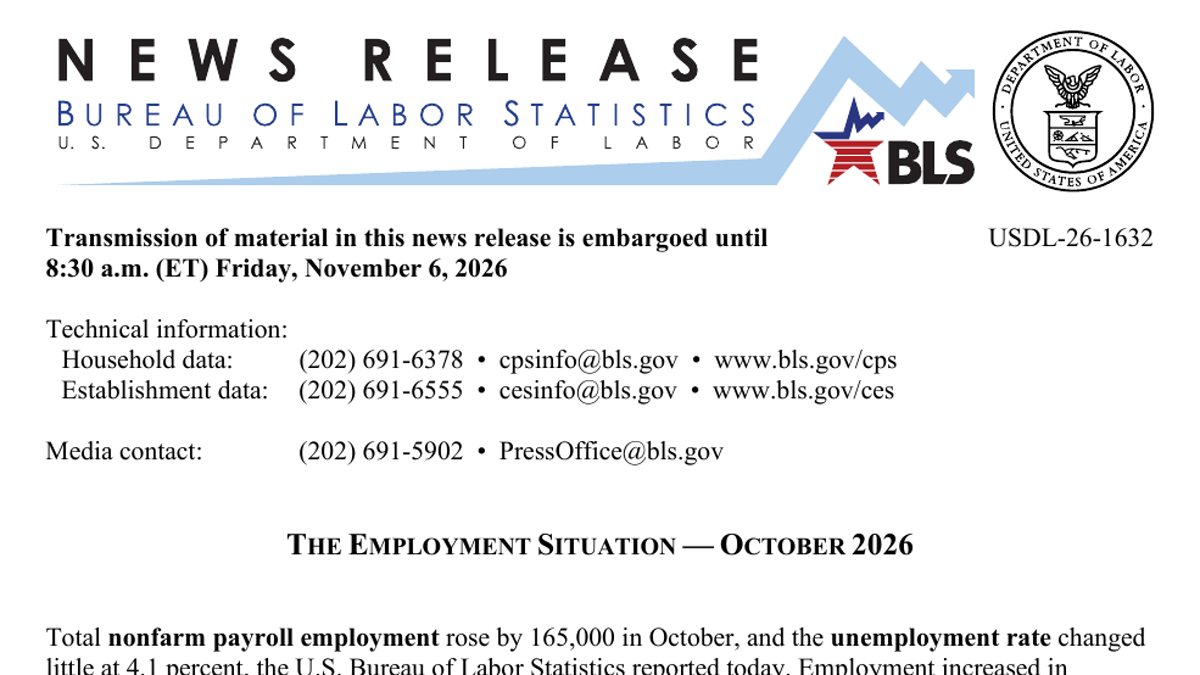


In October, non-farm employment in the United States increased by 165,000 people, significantly higher than the average monthly increase of 48,000 people over the past 12 months; the unemployment rate remained around 4.1%. Just looking at these two figures, it seems as if the labor market has accelerated again. However, in the full report released by the U.S. Bureau of Labor Statistics on November 6th, there are three less optimistic signals: the number of part-time workers has increased for economic reasons, the labor participation rate is still low, and although wage growth has been supported, it has not continued to rise. What the market really needs to judge is not whether "these data are good or bad," but whether the new jobs can be transformed into sustained income and broader employment opportunities.
New job positions are concentrated in a few industries.
Professional and commercial services added 70,000 employees in the month, with professional, scientific, and technical services adding 33,000 employees, and administrative support and waste management adding 28,000 employees. Healthcare added 42,000 employees, and transportation and warehousing added 25,000 employees. Manufacturing also added 19,000 employees. These major industries account for most of the new jobs created, indicating that companies are not expanding their workforce across all areas but are filling vacancies in specific fields such as service demand, healthcare, and logistics.
Centralization is not necessarily a bad thing. Improvements in professional services and manufacturing may indicate that corporate investments and orders have stabilized compared to earlier periods; healthcare employment is supported in the long term by population structure and service demand. However, if there are hardly any changes in major industries such as retail, information technology, finance, leisure hospitality, and government, then a growth of 165,000 jobs cannot be interpreted as a collective warming across all industries. For job seekers, it is more important to know which industries offer opportunities than to know the national total.
A low unemployment rate doesn't mean that everyone can more easily find a full-time job.
A household survey shows that the number of unemployed people is approximately 7.1 million, with an unemployment rate of 4.1%, which has remained within a narrow range of 4.1% to 4.3% since March. While on the surface things seem stable, the number of people working part-time due to economic reasons has increased by 339,000 to 4.8 million. These individuals wish to work full-time but are forced to take part-time jobs because of reduced working hours or an inability to find full-time positions.
The labor participation rate is 61.9%, and the employment rate is 59.3%; both have not changed significantly in that month. The lack of a noticeable increase in the participation rate indicates that the stability of the unemployment rate cannot be equated entirely with a strengthening labor supply. There are approximately 2 million people who are long-term unemployed, accounting for 27.6% of all unemployed individuals. When a market is able to create new jobs while also keeping more people in a state of involuntary part-time work or long-term unemployment, the most appropriate description for this situation is not "overheating" or "recession," but rather "differentiation."
Salaries are still growing, but there are no new signs of acceleration.
The average hourly wage for private non-farm employees increased by 14 cents to $38 this month, a 0.4% increase from the previous month and a 3.1% increase year-on-year. The average hourly wage for production and non-managerial positions rose to $32.75. Although the wage growth rate is still higher than in many historical periods, it did not surge as suddenly as the total employment volume. The average weekly working hours remained at 34.4 hours, with the manufacturing sector averaging 40.5 hours.
Wages and working hours together determine the labor income received by a family. If a company simply increases the number of employees while reducing the average working hours per person, the income growth may not necessarily increase accordingly; this month, the total working hours have remained stable, with no obvious decline at least. For the Federal Reserve, a year-on-year wage growth rate of 3.1% is not sufficient to indicate that inflation will get out of control again, nor is it low enough to immediately classify the labor market as in a recession.
The recent updates make the past two months look even better.
The number of new jobs created in August was revised upward by 53,000 to 186,000, and in September by 31,000 to 60,000, resulting in a total of 84,000 more jobs than previously estimated over the two months. The revision comes from more corporate reports and recalculations due to seasonal adjustments. This serves as a reminder to investors that the initial figures are not the final figures. The figure of 165,000 for October may also change in the future, so policy decisions should not be based solely on one set of numbers.
The combination of the recent upward revisions and this month's growth will reduce market concerns about a sudden economic slowdown, and may also make expectations for interest rate cuts more cautious. However, decisions regarding interest rates still need to take into account inflation, consumption, credit, and financial conditions. The employment report indicates that companies are still hiring, but it cannot alone answer whether demand will continue, nor can it prove that rising wages will be fully transmitted to prices.
A report that is "strong enough but not even"
The most important insight from this report is the breakdown of the 165,000 figure into categories such as job distribution, quality of part-time work, participation rate, and salary. The overall number is indeed higher than the average of the past year, and it even increased in the first two months; however, the concentration of recruitment, the rise in involuntary part-time jobs, and the high proportion of long-term unemployed indicate that the market has not yet returned to a state where everyone can easily find their ideal job.
For families, what truly matters is the demand in one's own industry and working hours; for businesses, it's whether wage costs and the difficulty of hiring are on the rise again; as for the market, it's whether subsequent data can prove that October was not just a temporary fluctuation. The U.S. labor market still has resilience, but this resilience is more like several load-bearing columns supporting the structure, rather than the entire building lifting simultaneously.