


Tech stocks faced selling pressure this week, and Goldman Sachs recently warned that the surge in AI debt is quietly accumulating pressure on the credit market.
In the 2026 U.S. congressional elections, Democrats achieved a comprehensive victory in both the Senate and House of Representatives as well as in multiple gubernatorial races. A large number of elected candidates pledged to limit data center construction and strengthen industry regulation, which has led to concerns in the market that investments in artificial intelligence infrastructure will be suppressed by policy. On Thursday (November 5th), the S&P 500 index tumbled 4.4% in a single day, and the Nasdaq 100 index plummeted by 6.4%, with a market value evaporating by over $3 trillion, marking the worst one-day decline for tech stocks since the start of the COVID-19 pandemic.
However, the sharp shock in the stock market may just be the prelude. Goldman Sachs' credit strategist Amanda Lynam warned in the latest report that AI debt supply is flooding into the market at a pace far exceeding anyone's expectations, and the risk of credit spreads widening further is "clearly on the rise" in the coming weeks.
Reports indicate that following the sharp decline in tech stocks, pressure is quietly building up in the credit market. As of the close on November 4th, the spread in U.S. investment-grade credit spreads had narrowed to just 4 basis points from their March highs, and the spread in high-yield bond yields was only 11 basis points from those March highs – and these figures were before the stock market crash on Thursday.
In just one week before the election results were announced, the five largest cloud computing providers – Alphabet, Amazon, Microsoft, Meta, and Oracle (collectively referred to as Hyperscaler) – completed a total of five bond issuances, with a combined scale of up to 67 billion US dollars, pushing the annual cumulative bond issuance to 296 billion US dollars. This figure has surpassed Goldman Sachs' forecast for the entire year of 2026, which was 250 billion US dollars. In other words, Goldman Sachs' forecast model is being surpassed by reality almost every 48 hours.
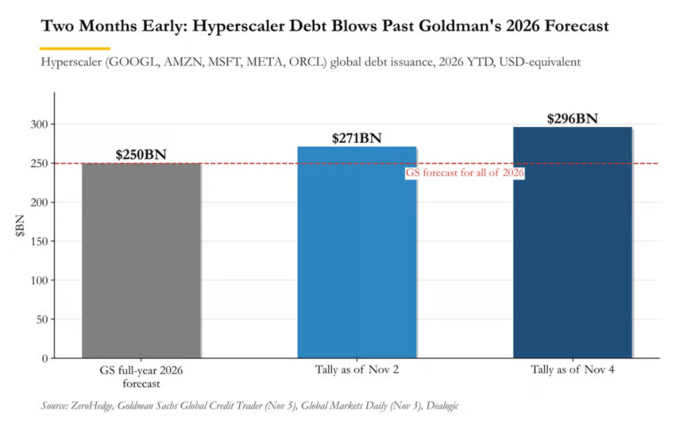
$67 billion a week, annual forecast calls for early scrapping
Goldman Sachs’ predictions are falling apart at an astonishing rate. A report released on Tuesday by Amanda Lynam showed that as of October 29th, the five largest cloud computing providers had completed three bond transactions totaling $41.7 billion, with the cumulative bond issuance for the year reaching $271 billion. Just two days later, two more transactions were finalized, adding another $25 billion to the total—equivalent to Goldman Sachs being “slapped in the face” every 48 hours.
The volume of a single transaction also shocked the market. Microsoft completed its first dollar-denominated bond issuance since 2017, with a scale of over $25 billion, effectively overturning Goldman Sachs' previous assessment that "Microsoft would not need to borrow money at least this quarter," which proved to be incorrect in less than a day. Oracle, on the other hand, exhausted its planned four-year financing "limit" in just one morning, just five days after announcing its financing plan.
Goldman Sachs provided two explanations for this phenomenon that exceeded expectations: firstly, the five largest cloud computing providers all experienced negative free cash flows in the third quarter of 2026, with capital expenditures exceeding operating cash inflows; secondly, some of these issuances were a form of "early locking in" of the financing plans originally scheduled for 2027. In Goldman Sachs' words, "borrowers are well aware that the issuance window may not always be open."
The debt issuance within the year has already equaled 36% of the capital expenditures of hyperscalers in cloud computing for the year 2026, which is higher than the initial assumption of 33% for debt financing by Goldman Sachs. Looking ahead to 2027, Goldman Sachs expects that the direct debt issuance of hyperscalers in cloud computing will reach $440 billion, plus about $300 billion in financing for investment-grade and high-yield projects. The total scale of related debt supply channels will approach $740 billion – and this does not include any emerging cloud computing providers, chip manufacturers, or utility companies.
Interest rate spreads under pressure, credit market "saturation" alarm sounds
Goldman Sachs clearly stated that between now and early December, the risk of credit spreads "clearly favors further widening." In the US dollar market, Goldman Sachs expects spreads to slightly exceed their March highs (93 basis points for investment-grade bonds and 335 basis points for high-yield bonds); in the euro market, the level seen in April 2025 is considered a reference for the near-term downside scenario (128 basis points for investment-grade bonds and 446 basis points for high-yield bonds).
Goldman Sachs' year-end targets imply a slight narrowing of the interest rate spread from the current level, but Lynam admits in the report that this mainly reflects the seasonal tightening that occurs when supply dries up in December, 'and the technical aspects of supply are particularly crucial this year.'
In terms of excess returns, this year the excess return of US investment-grade bonds over Treasury bonds was only 0.1%, for high-yield bonds it was 0.0%, and for euro high-yield bonds it was even -1.0%. After a record supply over ten months, credit investors gained almost nothing. This may also explain why Goldman Sachs has recently quietly abandoned its preference for investment-grade bonds over high-yield bonds, in favor of allocations to BBB grade over A-grade and AA grade bonds.
The pricing pressure of large transactions cannot be ignored either. Since the beginning of this year, there have been 27 transactions in the US dollar investment-grade market with a scale of over $10 billion each, totaling $501 billion, which is approximately 2.5 times the scale of similar transactions last year. Among these, 14 transactions, accounting for about 66% of the total amount (about $330 billion), are related to AI. The new premium associated with transactions related to AI ( new issue concession ) has averaged around 18 basis points so far in November, which is significantly higher than the less than 7 basis points for non- AI transactions, and also notably higher than the average of about 8 basis points for AI transactions since the beginning of 2025. In other words, borrowers with the highest global credit ratings are paying premiums close to those of junk bonds to complete their issuances, and each of these premiums further widens the secondary market curve.
Election Impact: Data Center Suspension Orders and the Last Line of Defense for Private Credit
At the policy level, Goldman Sachs economists believe that the results of this election are unlikely to change the federal regulatory framework for data centers and AI. Relevant legislation still requires support from both parties in the Senate and must pass a veto process. The main risks in the near term come at the local level: Democratic victories in state and local elections could lead to temporary suspensions of data center construction, potentially affecting about 45% of the planned data center capacity in the United States, with Texas alone accounting for 25% of that amount. Goldman Sachs economists expect these suspensions to be short-lived, and in the long run, related issues are expected to fade away.
However, the credit market is not willing to wait for the results to be revealed. Lynam indicates that the primary market for high-yield bonds may currently be in a 'price discovery phase,' and the market will pay close attention to the structural design of project financing transactions. 'The recent price trends have fully illustrated the importance of the quality of the power purchasers ( offtaker ).'
When there is congestion in the syndicated loan market, Goldman Sachs regards private capital as an alternative option. The private market currently manages a scale of $17 trillion (excluding the secondary market and fund of funds), with $4.6 trillion in funds available for investment. Since the beginning of 2025, it has completed over $225 billion in data center financings (excluding GPU and chip-backed transactions). However, Goldman Sachs also acknowledges that it is rather delicate to act as the "lender of last resort" for AI financings in a year when its own default rate has just reached a historic high.
The Race Between Monetization Clock and Saturation Clock
Goldman Sachs' analysis framework ultimately boils down to a race between two variables: The acceleration of monetization (AI) means less debt; whereas a delay in monetization combined with an increase in procurement commitments means more debt – "depending on market conditions."
The former, at its fastest, is a story from 2028, while the latter is advancing every 48 hours: bonds issued by hyperscalers in cloud computing, totaling $296 billion, have already been realized. The global debt related to AI has reached $687 billion. Next year, there are another $440 billion in direct issuances by hyperscalers in cloud computing, plus $300 billion in project financing awaiting implementation. Moreover, there are trillions of dollars in off-balance-sheet commitments that have not yet been included in debt statistics.
Goldman Sachs' baseline scenario is that the usual low supply season in December will provide some breathing room for their year-end spread targets. However, as Lynam mentions, between now and early December, the risk balance has clearly shifted in favor of wider spreads. The credit market was once the last asset class in AI trading that still offered a "doubtful advantage"; as excess returns have zeroed out and issuers are openly competing to lock in financing windows, this "doubtful advantage" is rapidly dissipating.
Off-balance-sheet liabilities: The trillion-dollar hidden concerns beneath the iceberg
What bond issuance data presents is merely the tip of the iceberg. In its report on Tuesday, Lynam conducted a systematic quantification of the off-balance-sheet obligations of ultra-large cloud computing providers for the first time:
- $1.7 trillion in operating and financing lease commitments, of which over 75% involve leases that have not yet commenced. According to leasing accounting standards, these obligations are not currently reflected on the balance sheets of either party;
- $1.9 trillion in other unconditional procurement commitments, covering third-party cloud capacity, servers, networks, power contracts, and construction projects. Of this amount, $685 billion is due to expire by the end of 2027, and these commitments do not include or may not involve any "backstop" obligations.
Goldman Sachs acknowledges that some of the aforementioned commitments have already been factored into the capital expenditures that the market generally expects, but it still considers them as additional cash usage—each commitment that cannot be covered by operating cash flows will ultimately be converted into bonds, loans, or equity financing. Goldman Sachs stated: "The delay in monetization and the growth in procurement commitments... are key risks that drive more debt issuance."
Global top-rated agencies have begun to issue warnings. Moody's pointed out on September 22 that the overall financial commitments of hyperscalers in cloud computing have increased eightfold since 2023, reaching $2.8 trillion. On October 15, Standard & Poor's warned that the "fault tolerance margin" of the AI financing ecosystem is narrowing, and that secured and new types of off-balance-sheet financing instruments may further expand and put pressure on ratings. In late October, Standard & Poor's downgraded the rating outlooks for Broadcom and Meta, citing off-balance-sheet obligations as a factor.
Goldman Sachs' conclusion is: 'Evidence of monetization before 2028 is crucial'; otherwise, the rating will face downward pressure. However, Goldman Sachs also points out that companies related to AI are generally in the higher tier of investment-grade ratings, and even if they experience multiple downgrades, it is unlikely that they will have their access to market financing channels cut off, comparing this to the gradual downgrade of the pharmaceutical industry's ratings ten years ago.
It is worth noting that Meta clearly states in its SEC document that the company "recognizes that timing is of paramount importance and needs to lock in capital before competitors deplete all available financing channels." When the issuer itself is actively competing in the bond market by showcasing its balance sheet, this balance sheet itself becomes a scarce resource.