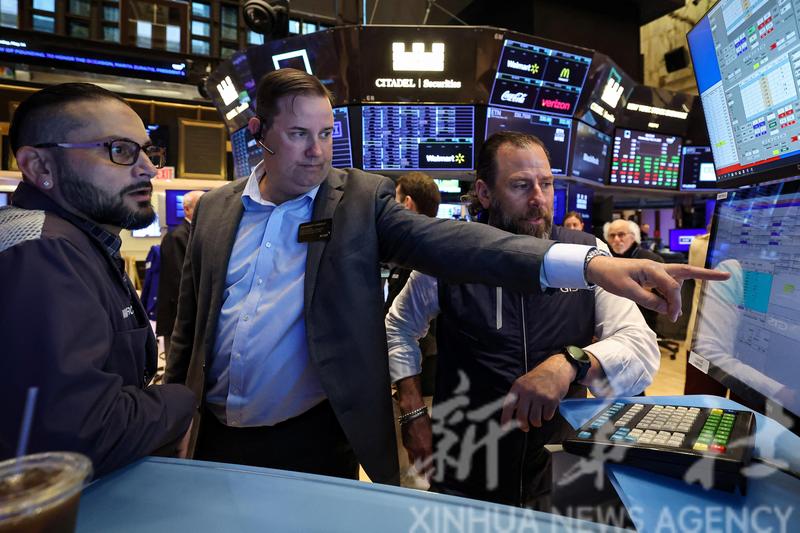
After experiencing waves of investment enthusiasm for artificial intelligence ( AI ), starting from October, investors once again had to digest the massive sell-off in the bullish market triggered by negative sentiment and concerns regarding AI stocks and technology stocks.
Last Friday (November 6th), some funds returned to the market, and U.S. stocks stopped their decline and rebounded. The S&P 500 index closed up 0.31%, the Nasdaq index rose by more than 1%, and the Philadelphia Semiconductor Index increased by over 4%. After this round of intense AI theme selling, valuations of U.S. tech stocks saw a rare reversal in nine years. Lerner ( Keith Lerner ), the chief investment officer of the wealth management firm Truist Wealth , wrote in the latest report that the forward price-earnings ratio of the tech sector of the S&P 500 index is about 17 times, which is lower than the market average of 18 times, a first since 2017. At its peak in October 2025, that valuation was as high as 32 times.
Louis LeVitre, Chief Global Market Strategist at Invesco ( Brian Levitt ), told CBN reporters that concerns regarding the investment boom surrounding AI did not begin with the mid-term elections in the United States. Investors are increasingly questioning the massive capital invested in AI infrastructure construction, especially given that interest rates have been on the rise for most of this year. The combination of these factors has had a significant impact. He frankly stated that AI construction is undergoing an adjustment, but this adjustment does not mean the end of the AI investment theme; it is merely a readjustment, not an end.
Even after the short-term market sentiment caused by the mid-term elections widened the decline and accelerated the rate of fall, some well-known Wall Street fund managers and analysts have begun to call for the moment has arrived to buy into technology stocks and AI stocks at lower prices.
AI Trading Impact: October US Stock Fund Average Return Rate -1.3%
After Intel and other tech stocks, as well as AI stocks, fell, the Nasdaq Composite Index recorded its worst month in over a year in October, and fund investors have not had a chance to catch their breath so far in November. Following the mid-term elections, the collapse of AI investments has become increasingly severe.
The latest fund performance statistics released by the London Stock Exchange on Friday last week show that the average total return of U.S. equity mutual funds or exchange-traded funds in October was -1.3%. This brings this year's overall gain to 9.9%, a figure that may seem strong as it does not yet reflect the recent market declines. International equity funds had a return of -1.6% in October, reducing this year's overall gain to 8.3%.
The CEO of the small business lending institution Cardiff, CEO Lourjin Dean Lyulkin, stated that amidst the conflicts in the Middle East, the Federal Reserve's interest rate hikes, and the weak September non-farm employment report, the market as a whole remained calm. However, this calmness was created by just a few of the largest stocks. Now, the selling off of technology leaders by investors has highlighted the downward trend of this "top-heavy" market.
Batters ( Mary Ann Bartels ), the chief investment strategist at wealth management firm Sanctuary Wealth, stated that the market could enter a correction, meaning it could fall 20% or more from the index's recent highs, which "is similar to the bear market correction after the mid-2018 elections." Currently, there are concerns in the market that since the Democrats control Congress, AI construction will slow down, leading to a more negative re-pricing of AI trades. However, they do not believe this marks the end of a long-term bull market.
This coincides with Levitt's views. Levitt told reporters that building data centers requires a large amount of capital, electricity, and increasingly expensive equipment. The rising cost of financing naturally raises the investment threshold for new projects. At the same time, to meet the market's expectations of a significant increase in computing power demand, semiconductor and storage chip companies have been actively expanding their investments. The demand remains strong. However, there is an important difference between the strong demand and the current need to purchase equipment immediately. Some segments of the semiconductor ecosystem may have expanded excessively in order to meet future demands. This midterm election in the United States seems to have accelerated the market's re-evaluation of this issue.
Investors are concerned that the Democratic Party's victory in the U.S. midterms could slow down the pace of data center construction. In 41 voting proposals related to data centers in 10 states across the United States, voters have shown a tendency to support restrictions on development or have rejected measures that would facilitate it, as seen in the results of proposals for which decisions have already been made.
"It indeed brings new uncertainties and may slow down the construction progress. However, compared to the results of the mid-term elections in the United States themselves, the rise in interest rates and the planned large-scale investments pose a more significant risk to the growth rate of AI expenditures," he said.
A group of well-known Wall Street investors suggest buying at low prices and increasing positions.
After this round of significant acceleration and adjustment, the trend of AI trading remains the key variable determining whether the S&P 500 index will rebound by the end of the year. The current consensus on Wall Street is that this sell-off is a sign that the recent adjustments are coming to an end, rather than a precursor to the end of a four-year bull market.
Levitt told reporters that the adjustments do not mean the end of the AI investment theme, and these changes will not alter their long-term perspective. "We still believe that the demand for computing power will continue to grow, and AI remains a strongly structural investment theme. What may change is the pace of capacity construction. This does not necessarily have a negative effect. Capital expenditures have already reached a fairly high level, and the market is increasingly concerned about financing, profitability, and whether terminal demand can quickly absorb the new capacity. A more steady and orderly construction pace may ultimately help the AI industry achieve healthier and more sustainable development."
The adjustment process in the market is rarely smooth sailing. When crowded trades start to get liquidated, especially involving hedge funds and other leveraged investors, the price declines can become disconnected from long-term fundamental changes. Selling-offs trigger more selling-offs, and adjustments often happen as expected. This seems to be one of the situations that investors are currently experiencing. However, he said, "We do not believe that the current market decline means the burst of a AI bubble, nor do we think it marks the end of a wave of investment enthusiasm. The valuation levels of the entire AI ecosystem have not reached the extreme levels seen during those famous speculative bubbles in history. On the contrary, we believe that this is one of the strongest-performing and most crowded themes in the market undergoing readjustment. The adjustment may continue. Companies that led the market in the past few years may not necessarily continue to lead the gains in the coming months. But as prices fall and valuations become more reasonable, long-term investment opportunities are improving."
Adni, a senior investment strategist on Wall Street and the founder of the investment consulting firm Yardeni Research, also characterized this decline as an "adjustment" rather than a bubble burst. He said, "We have experienced a AI bubble, and the bubble is slowly deflating, but deflation does not equate to a burst. A burst would mean a significant negative impact on the economy, and I don't think that will happen." He added that he previously predicted opportunities for buying at bottom levels after the election, and "now I am already seeing some quite good opportunities." Adni expects the S&P 500 index to reach a target of 7,900 points by the end of the year.
Robona ( Scott Rubner ), the head of equity and derivatives strategy at Goldman Sachs, wrote in a client report last week: "Investors have ample room to rebuild their risk exposure. As uncertainty diminishes and the market's largest buyer groups gradually return, the direction with the least resistance for U.S. stocks before the end of the year is still upward."
Morgan Stanley's chief U.S. equity strategist and a star Wall Street strategist for U.S. stocks, Wilson ( Mike Wilson ), clearly stated on November 7th: "The next two to three weeks are the time to increase exposure to U.S. stocks and add positions in them." He also maintained his target price of 8,000 points for the S&P 500 by the end of the year, which implies a potential increase of about 8.4% from Friday's closing price.
Star fund manager, the head of ARK Invest, and known as "Sister Wood" ( Cathie Wood ), has even increased her holdings against the trend. In an interview with the media on November 6th, she stated that the unease surrounding AI has persisted for most of this year. Investors have continuously questioned the capital expenditure scale of tech companies on AI, the speed at which they are spending money, as well as the trend of large-scale cloud computing enterprises ( hyperscalers ) shifting from extremely high positive free cash flows to negative free cash flows. At the same time, macroeconomic pressures are also intensifying. Conflicts in the Middle East have driven up global inflation, and interest rates and bond yields in the United States have risen significantly this year, leading to higher yields on corporate bonds as well.
However, she stated that the widespread concerns of investors not only did not shake her confidence but instead strengthened her belief in the continuation of a bull market. She mentioned that volatility is a normal part of the technological revolution process, characterized by "two steps forward and one step back," and she expects the stock market to continue to rise in 2027.
She also revealed that over the past week or so, she has continued to concentrate her positions in targets with the highest degree of confidence, such as increasing her holdings in core positions like SpaceX. She advised investors to also increase their holdings in high-confidence assets during downturns and to take appropriate profits during rebounds. Her flagship fund, ARK Innovation ETF, achieved a return of over 35% in 2025, far exceeding the 16.4% gain of the S&P 500 index and the 20.5% gain of the Nasdaq Composite Index during the same period.