

The Nasdaq 100 index has been declining for four consecutive weeks, and a multi-year trend line has become the market's last technical support, which is now facing a decisive test.
Peter Callahan, the chief expert in technology, media, and telecommunications at Goldman Sachs, clearly stated in the latest weekly report that the Nasdaq 100 index is retesting the key benchmark trend line that connects the lows of April 2025 and March 2026. The closing price last Thursday was around 26,630 points, which almost precisely fell on that line. On Friday, driven by a rebound in semiconductor stocks, the index closed at 26,990 points, only about 1% above the trend line and still more than 14% below the historical high of 31,361 points on October 6th. Callahan wrote that the importance of this level is indescribable.
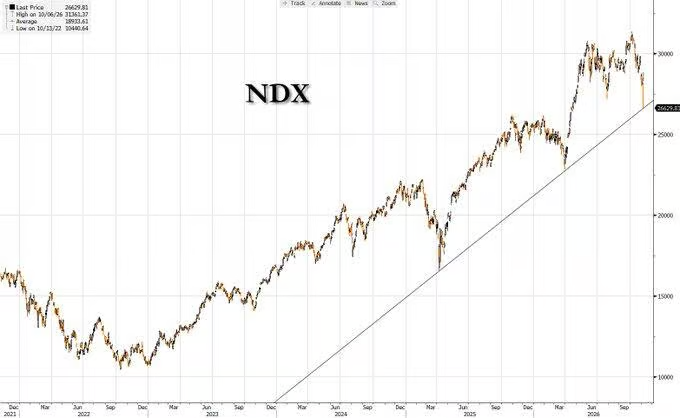
If the trend line is broken, according to the chart of Callahan, the next obvious support level is around 23,000 points, near the low point in March 2026, which represents a further decline of about 15% from the current level. At the same time, market extreme sentiment indicators have turned completely red – last Thursday saw the largest single-day volume of put options in the history of the Chicago Options Exchange, and Goldman Sachs' flagship semiconductor stock basket experienced a volatility spike to 93, the highest level since April of this year.
Four consecutive declines and panic selling at historical levels
The Nasdaq 100 index fell by about 5% last week, marking the fourth consecutive week of declines. The Philadelphia Semiconductor Index ( SOX ) has lost a total of 28% over the past 22 trading days. Callahan pointed out that this rate of decline is only comparable to a few other periods since 1997, including the bursting of the internet bubble, the global financial crisis in 2008, and the impact of the COVID-19 pandemic.
Callahan doesn't shy away from describing the current sentiment: 'It's hard to overemphasize the difficulties of the market' – despite the strong bottom-up data points such as memory pricing, computing power pricing, supply and demand visibility, and third-quarter profits. However, AI and the semiconductor sector have entered a 'rolling bear market' since this summer, with a cumulative decline of about 40% from their highs. At the same time, the macro uncertainties surrounding policy and congressional developments are 'difficult to model'.
In short, the fundamental data remains attractive, yet stock prices continue to decline. The market has already begun to price in scenarios that have not yet occurred in 2028 based on current stock prices.
Panic selling indicators are appearing frequently.
Callahan described last week's market liquidity in the weekly report as follows: record volumes of put options traded, a significant increase in ETF trading volume, volatility indicators showing 'panic' characteristics, a high degree of seller skew, and a technically severe oversold condition.
His interpretation is that the various indicators mentioned above can be said to help lay the groundwork for a subsequent technical rebound at the technical level – however, he added qualifiers such as “can be said” and “to some extent” to his wording. From the sellers’ perspective, this is almost tantamount to suggesting “not to have too high expectations.”
Bank of America strategist Michael Hartnett takes a more cautious stance. According to Bloomberg, he pointed out that SOX has currently fallen 17% below the 200-day moving average, while in the past since 1996, true buying opportunities have usually appeared when it falls 20% to 25% below the 200-day moving average, which means that "bottom-fishers" may have to endure more pain. Morgan Stanley's Nick Savone noted that last Thursday, SOX tumbled 12.2% in a single day, the second-largest one-day decline in the index's history, and the forward price-earnings ratio for the semiconductor sector has dropped to single digits for the first time in five years.
Selling pressure is more intense in the Asian AI supply chain. Callahan citing data on the flow of Asian funds shows that as of the week ending November 6, emerging Asia (excluding China) recorded a net outflow of $21.7 billion in foreign capital, the second largest single-week outflow on record. Taiwan, China (-$15.7 billion), and South Korea (-$8 billion) collectively bore almost all of the impact.
The largest single-week outflow in history occurred four weeks ago, with an outflow of up to $27.6 billion that week. If we extend the timeline, nine of the top ten largest single-week outflows in history happened in 2026, with the only exception being during the impact of the COVID-19 pandemic in March 2020.
Memory: Is a price-earnings ratio of 2 an opportunity or a trap?
Callahan specifically highlighted a “disturbing” chart in the weekly report: The three giants MU Micron, SK Hynix, and Samsung are currently trading at forward price-earnings ratios of 3.8 times, 2.2 times, and 2.6 times respectively. Meanwhile, the DRAM spot price index has risen more than tenfold since the end of 2024 and is still close to its historical highs.
The logic behind such a low valuation by the market is that investors believe current profits have reached their peak for this cycle, and they predict that as data center construction slows down in 2028, today's supply shortage will evolve into overcapacity tomorrow. In response to this, Callahan has only three words to comment: “Tough, right?”
TrendForce It is expected that in the fourth quarter, the contract price of DRAM will increase by about 20% month-on-month, which is lower than the 40% increase in the third quarter and the 80% increase in the second quarter. The upward trend of contract prices is beginning to slow down.
Safe assets have nowhere to hide.
In terms of the flow of hedging funds, Callahan observed that the consumer staples sector has attracted a lot of capital, but its valuations are already significantly high. The valuation premium of the S&P 500 Consumer Staples index over the S&P 500 index as a whole has risen to its highest level in over a decade, about 6 times the price-earnings ratio, while the long-term average is only around 1 time. Even more extreme is that the current 24-month forward price-earnings ratio of the Consumer Staples index is approximately twice that of the Semiconductor index – in other words, the valuations of toothpaste and cereals are twice those of the chips that power global data centers.
Within the large tech stocks, simulated semiconductors were once seen as a relatively safe haven. Texas Instruments ( TXN ) previously demonstrated a certain level of resilience, but last weekend it also fell below its support level. Meanwhile, Caterpillar ( CAT ) has seen its value nearly halve since its peak in June, dropping from around $1060 to $559.
Callahan, it won't take too long before investors start to pay attention to those assets that "may have already seen excessive gains." Goldman Sachs' Delta One team has taken short positions in the basket of consumer necessities, and holding swaps can generate positive returns.
Strong profits, yet the market turns a blind eye.
For bulls, perhaps the most disheartening signal comes from the profit figures themselves: the information technology sector continued to lead the market during the third-quarter earnings season. According to Goldman Sachs' portfolio strategy team, 80% of tech companies exceeded consensus expectations by at least one standard deviation (with a total of 62% of this in the S&P 500), and only 2% of the companies saw their profits revised downward. Similarly, 75% of tech companies exceeded their revenue expectations by one standard deviation, with no company experiencing a comparable degree of revenue reduction.
However, the market remains indifferent to this, and the reason is clear: investors have stopped paying for the profits that have already been realized and are now focusing on cashing in on expectations that may not come true by 2028. As Callahan says, this is a market that "reacts day by day," not a market that rewards expectations.
This week is rich in catalysts. The data released on Tuesday for CPI (with a core CPI forecast of +0.3% month-on-month) is seen as key to determining whether the Federal Reserve will raise interest rates in December. TSMC's monthly sales data and CoreWeave financial report will also be announced on the same day; the financial reports for Applied Materials and NVIDIA will be released on Thursday of this week and at the end of the month, respectively, both of which are potential turning points that the market is closely watching.