


Since Bitcoin reached a non-zero wallet count of 59.99 million US dollars in October, the number of wallets has decreased by approximately 108,700.
Coinbase Premium remains negative, indicating that demand for Bitcoin among American investors is weak.
Data from Santiment also shows that wallets holding more Bitcoin have recently accumulated an increase of over 14,200 BTC.
Chain analysis firm Santiment indicates that since October 16th, the number of non-empty BTC wallets has decreased by about 108,700, suggesting that retail Bitcoin traders are beginning to withdraw from the market.
A key question is whether the decline in retail investor confidence will further push down the price of Bitcoin as it becomes difficult for BTC to regain levels above $80,000.
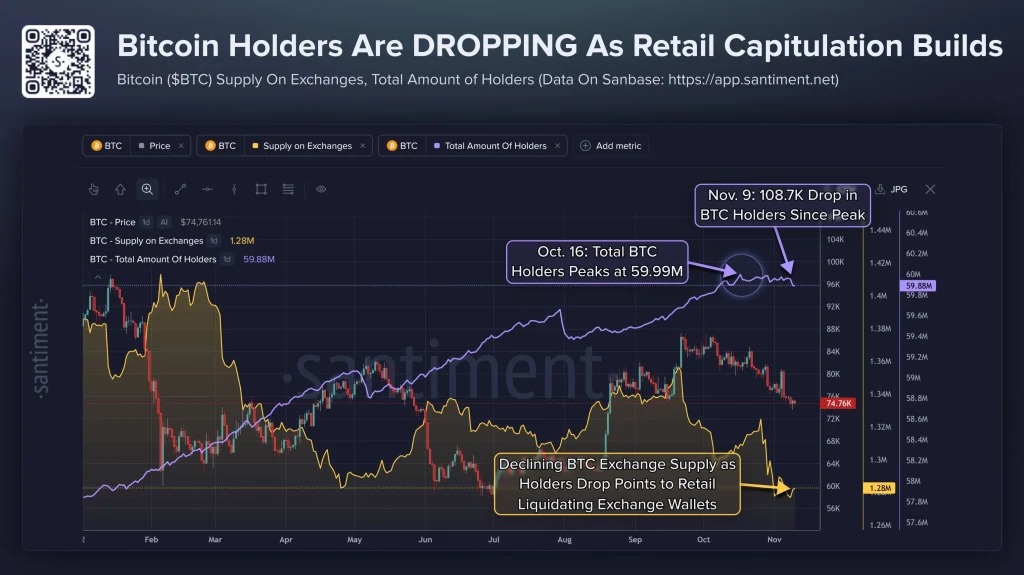
109,000 Bitcoin wallets lost, leading to a decline in retail investors' confidence
Last month, the number of non-empty Bitcoin wallets briefly approached 60 million. Since then, this number has decreased by about 108,700 to 59.88 million. During the same period, the price of Bitcoin also fell from $84,890 to around $74,547, indicating that the market has clearly weakened.
Santiment indicates that the decline in the number of wallets suggests that some retail holders are losing patience after several consecutive weeks of falling prices.
This is very important, as small wallets holding less than 0.1 of BTC account for about 5% to 7% of the total circulating supply of Bitcoin.
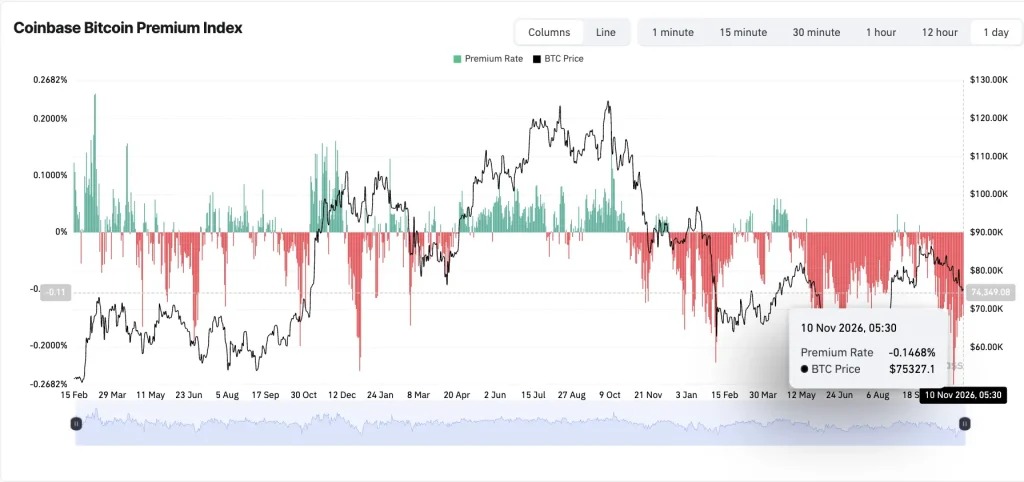
The weak demand for Bitcoin is also reflected in other data.
Coinbase Premium Index remains negative, and the accompanying chart shows that on November 10th, the reading was -0.1468%, indicating relatively weak demand from US exchanges.
Why retail traders are giving up on BTC
Currently, Bitcoin is facing multiple pressures. Since late October, the decline in AI stock has intensified market concerns, and there has also been a outflow of millions of dollars from Bitcoin ETF.
At the same time, the yield on U.S. Treasury bonds has risen, making safer investments more attractive. This has led to a decrease in funds flowing into riskier assets such as Bitcoin. When market panic intensifies, retail investors tend to back off rather than buying at lower prices.
In fact, data from Santiment also shows that the number of bitcoins held by exchanges has dropped to around 1.28 million BTC. This indicates that the decrease in the number of wallets is not solely due to investors transferring their coins to exchanges in preparation to sell; some investors may have already emptied their wallets.
Bitcoin "sharks" are buying on dips
Contrary to the retreat of retail investors, wallets holding 1 to 100 BTC are increasing their holdings of Bitcoin.
Santiment data shows that in the past two weeks, wallets holding 1 to 10 BTC purchased a total of 10,076 BTC, while wallets holding 10 to 100 BTC added an additional 4,131 BTC. Overall, these two types of wallets purchased more than 14,200 BTC when Bitcoin was trading around $75,000.
Bitcoin now needs buyers to prevent a decline.
The problem is that even a significant increase in holdings on the scale of sharks is not enough to drive a rebound in Bitcoin. BTC is still trading around $74,537, while the number of retail wallets continues to decline, and demand in the United States remains weak.
This makes the range of $72,000 to $75,000 a critical test. If BTC loses this area, the withdrawal of retail investors may continue.
If Bitcoin is able to maintain this range despite more wallets disappearing, it indicates that sellers will find it increasingly difficult to continue pressing down on prices.