

BNY began to provide XRP hosting services for institutions, but it has not been confirmed whether this will lead to new purchases.
XRP ETF still holds a considerable amount of assets, but investors have once again withdrawn their funds recently.
The continuously expanding financial cooperation of Ripple does not necessarily translate into the sustained accumulation of XRP.
BNY has decided to provide institutional custody for XRP, which means that this cryptocurrency has taken another step towards integration into traditional financial markets. However, a key question remains unanswered: just how much XRP will institutions be willing to buy additionally?
The assets managed or held in custody by this bank amount to approximately $63.4 trillion. On October 27th, BNY expanded its collaboration with Ripple by incorporating XRP and RLUSD into its digital asset custody platform.
BNY $63.4 trillion in managed assets does not equate to XRP demand
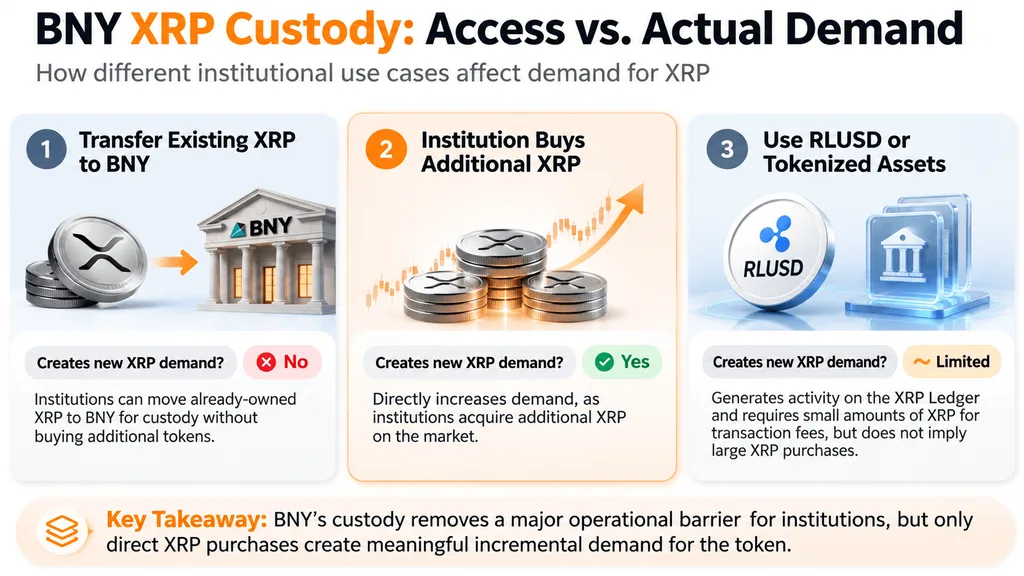
It is crucial to provide an explanation of the differences between hosting and purchasing cryptocurrencies.
BNY The existing digital asset infrastructure enables institutions to securely hold XRP within the existing financial service framework.
However, simply transferring previously purchased tokens from one custodian to BNY does not create new market demand. True new demand must come from institutions increasing their holdings of XRP, rather than merely changing the location where assets are stored.
In addition, the $63.4 trillion mentioned by BNY is merely the assets that are held or managed within its broader financial operations, and it is not funds that can be directly used for investing in XRP.
XRP ETF Capital flow provides more quantifiable market signals
Exchange-traded funds can reflect investors' interests more clearly, although this indicator is not perfect.
According to data based on SoSoValue, as of November 9th, the total net assets of US spot XRP ETF amounted to approximately $1.24 billion, with a cumulative net inflow of nearly $1.8 billion.
However, on November 9th, these funds recorded a net outflow of approximately $10.42 million, of which Bitwise accounted for about $9.4 million.
This reversal occurred after the weakening of capital flows earlier in ETF. It indicates that a more sophisticated institutional infrastructure has not been reliably transformed into new investments.
ETF Capital flow is also just one channel of measurement for demand. Institutions can directly hold XRP, or they can hold it through private arrangements or professional custodian institutions, and it will not appear in the statistics of exchange-traded funds.
Will RLUSD and tokenized finance drive more purchases of XRP?
Ripple and BNY are still exploring direct minting and redemption of RLUSD, broader tokenized asset custody, as well as conducting supply chain financing through C2FO.
These planned services may increase activity on XRP Ledger, but they do not necessarily require a corresponding scale of XRP purchases.
The continuously expanding RLUSD ecosystem supports settlement denominated in US dollars, while XRP remains the native asset used for transaction fees, reserves, and certain liquidity functions on that network.
Similarly, institutional tokenization fund activities can be expanded, but institutions do not need to purchase an amount of XRP equal to the value of the on-chain assets.
This difference also explains why, after Ripple expanded its bank partnerships, XRP still continued to decline prior to that.
Marcus Hale
Marcus Hale is a cryptocurrency and financial markets contributor who reports on Bitcoin, Ethereum, digital assets, regulation, ETF, and institutional adoption. His work focuses on developments that may impact the market, investor trends, as well as the broader forces that shape the crypto economy.