

Artificial intelligence computing power provider CoreWeave ( CRWV.O ) announced on Tuesday that its third-quarter performance exceeded Wall Street's expectations, and raised its full-year revenue forecast. The company also stated that it expects to achieve adjusted profitability in the first half of 2028, and disclosed its future financing needs and customer contract situation in an attempt to alleviate investors' concerns regarding its debt burden and the sustainability of business growth.
After the financial report was released, the stock price of CoreWeave rose by about 5% during after-hours trading on Tuesday. In the previous month, the company's stock price had fallen by more than 40% in total, and investors' concerns regarding the return on investment in artificial intelligence infrastructure, financing costs, and data center construction plans continued to increase.
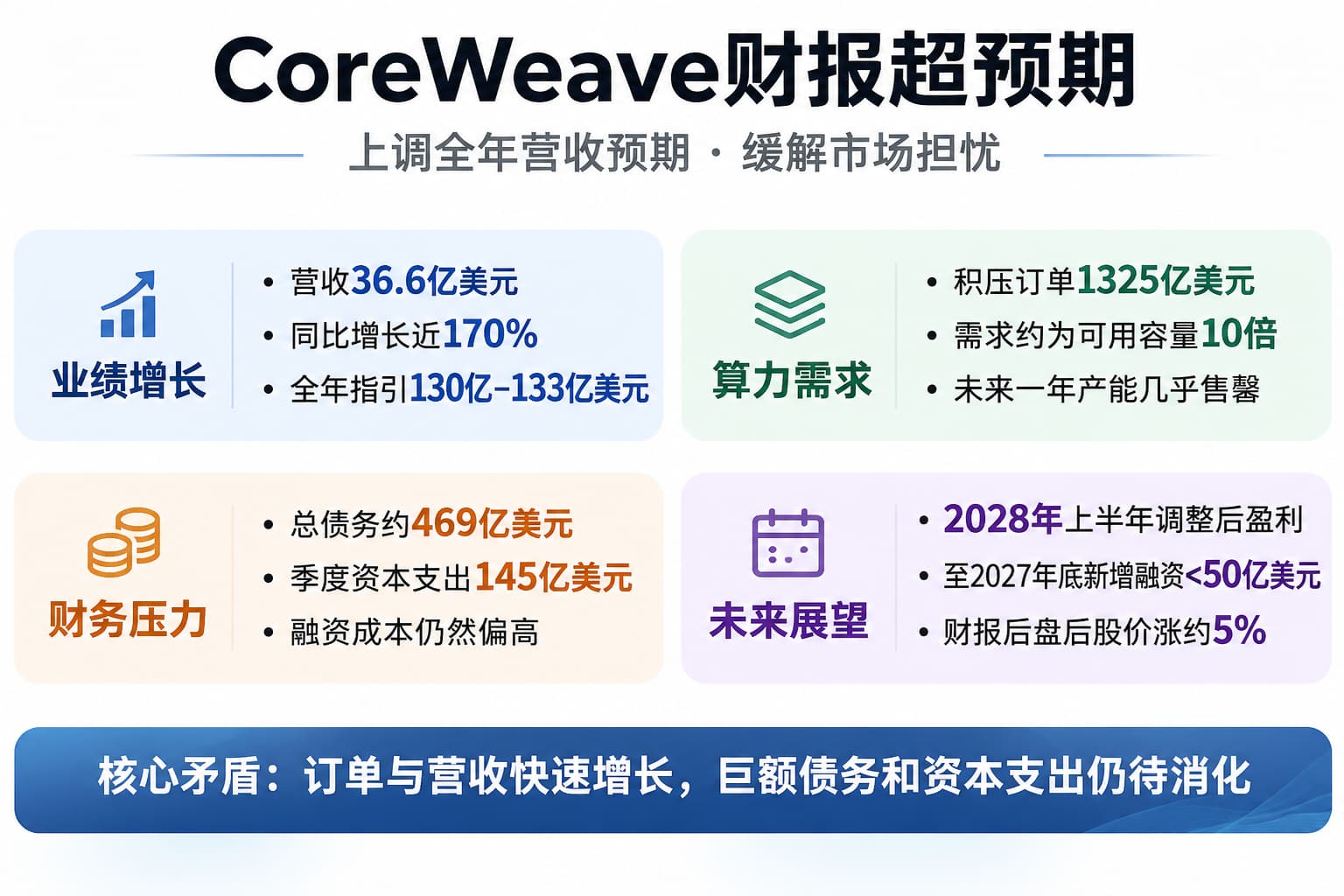
CoreWeave expects its annual revenue for 2026 to reach $13 billion to $13.3 billion, up from the previous forecast range of $12.4 billion to $13.2 billion. The latest guidance has raised the upper and lower limits of the annual revenue forecast, reflecting that the demand for artificial intelligence computing power continues to support the company's business expansion.
Third-quarter revenue surged by nearly 170%, with backlogs rising to $132.5 billion
CoreWeave reported nearly a 170% year-on-year increase in revenue for the third quarter, reaching $3.66 billion, which surpassed the market expectation of $3.55 billion as estimated by LSEG. Calculated using LSEG's criteria, the company incurred a loss of $0.95 per share, which is better than the analysts' forecast of a loss of $1.16 per share.
Bloomberg used a loss per share figure of $1.27, which is also better than the market expectation of $1.46 as estimated by them. There are differences in the loss per share figures disclosed by different institutions, but all indicate that CoreWeave performed better than market forecasts in the third quarter.
What attracts more attention from investors is the growth in customer orders. As of the end of September, the backlog of revenue orders for CoreWeave reached $132.5 billion, up from $104 billion at the end of June, an increase of $28.5 billion in a single quarter.
This backlog of orders represents an important source of future contract revenue for the company and also serves as the main basis for its pursuit of financing for large-scale data center construction.
CoreWeave CEO Michael Intalato ( Michael Intrator ) stated that the company will receive approximately $9 billion in customer prepayments and deposits over the next three months, which will provide financial support for infrastructure investments.
Intertato stated in its declaration that the company obtains customer contracts first before making corresponding investments. Since capital expenditures match the identified customer needs, lending institutions have a specific basis for financing, and customers usually also participate in supporting infrastructure construction.
According to CoreWeave, the computing power capacity for the next year has been almost fully sold out, and current customer demand is about 10 times the available capacity. The company needs to continue investing funds to build more data centers and deploy artificial intelligence chips in order to fulfill existing contracts.
Liabilities approach $46.9 billion, and financing pressure remains a focal point for the market.
While business is growing at a rapid pace, the capital expenditures of CoreWeave continue to rise.
In the third quarter, the company's capital expenditure reached $14.5 billion, up from $9.4 billion in the second quarter, an increase of $5.1 billion per quarter. The company has also raised its lower end estimate for annual capital expenditure for 2026 by $2 billion, with the latest forecasted expenditure ranging from $37 billion to $39 billion.
As of the end of September, CoreWeave had a total debt of approximately $46.9 billion. Its financing model relies heavily on borrowing to support the procurement of artificial intelligence chips and the construction of data centers; therefore, the scale of debt and the cost of funds have become core concerns for investors.
Previously, as concerns about the return on investment in artificial intelligence grew in the market, the price of CoreWeave bonds continued to come under pressure. As of Tuesday, the yield on its bonds, which mature in 2031 with a coupon rate of 9.75%, was around 15.5%, having previously risen to 16.7%.
An increase in bond yields means that companies may face higher financing costs when issuing new bonds through similar channels in the future, and it also draws more attention from the market to whether they can complete their established construction plans at a reasonable cost.
In response to this issue, CoreWeave stated that they will not enter the unsecured bond market for financing at the current yield level. The company believes that the cash flows generated from existing customer contracts are sufficient to repay the current debts, as well as to cover any additional borrowing required to fulfill the relevant contracts.
The company expects that the additional capital it will need to raise by the end of 2027 will be less than $5 billion. This financing requirement, in contrast to its continuously expanding capital expenditures, also makes the financing arrangements supported by contracts an important factor in assessing its financial condition.
CoreWeave also mentioned that it is expected to achieve adjusted profitability in the first half of 2028. However, this target is part of the company's future financial forecasts and cannot yet dispel market concerns regarding debt repayment capacity and cash flow.
NVIDIA's cooperative relationship remains stable, and the data center construction plan continues to advance.
CoreWeave is an important computing power provider in the field of artificial intelligence cloud computing, with customers including OpenAI, Microsoft, and Meta. The company generates revenue by purchasing high-performance GPU, building data centers, and leasing computing resources to its customers.
NVIDIA is not only an important chip supplier for CoreWeave, but also one of its investors. The stability of their cooperative relationship is directly related to the subsequent deployment of computing power for CoreWeave.
In an interview after the financial report was released, Intelatoh stated that NVIDIA has always been an important partner of CoreWeave. The two parties maintain close contact at multiple business levels, and there is no reason for the company to believe that this partnership will change.
Whether data center projects can proceed as planned is also of concern. Following the mid-term elections in the United States, some newly elected officials have proposed to strengthen regulation of data center construction, and the market fears that changes in relevant policies may affect project approval and construction progress.
In an interview with Reuters, Intertato stated that in the future, data center construction is expected to face more scrutiny. Enterprises will need to be more transparent about their resource usage and strengthen communication with local communities.
He believes that these requirements may affect the pace of project advancement, but it is not expected to force CoreWeave to make significant adjustments to the existing infrastructure construction methods, nor will they significantly change the construction costs.
Intertato also stated that the company will not accelerate its international expansion due to the election results. The related overseas business arrangements have been in preparation for about one and a half years and are part of the existing development plan.