


After the U.S. mid-term elections, Bitcoin briefly rose above $81,000, but then quickly fell back.
The hot inflation data in October brought new pressure, and Bitcoin subsequently fell below $74,000.
Historical data from mid-term elections indicates that Bitcoin may still recover after initially weakening.
After the U.S. midterms in November 2026, Bitcoin briefly rose above $81,000, but this rebound quickly faded. Although Bitcoin initially held its ground after the Democrats swept Congress, a sell-off in tech stocks quickly erased those gains. Since then, Bitcoin has fallen to $73,700, and traders have begun to focus on what the results of these elections mean for Bitcoin and cryptocurrencies as a whole.
Bitcoin Price Timeline After Selection
On the day of the U.S. mid-term elections, BTC was trading around $77,435, but the initial market reaction was not optimistic. As early results indicated that the Democrats were likely to control both the House of Representatives and the Senate, Bitcoin fell to around $75,649 at one point during the session.
The selling pressure did not last long. As the election results became clearer, traders began to buy back Bitcoin call options again, driving BTC to experience a rapid V-shaped rebound. The buying momentum pushed Bitcoin to a post-election high of $81,196.
However, this round of rebound may not have lasted.
By November 5th, as U.S. tech stocks faced significant selling pressure, Bitcoin fell back to around $75,942. Entering the weekend and continuing through November 9th, BTC continued to trade between $74,500 and $76,100.
Why is the rebound of Bitcoin after the mid-term elections fading?
For Bitcoin, the biggest problem is that the election eliminated one source of uncertainty, but it did not remove the overall pressure.
The Democratic majority in Congress may make it more difficult to advance major pro-crypto proposals, including a new round of efforts surrounding the CLARITY Act, as well as the establishment of a potential strategic Bitcoin reserve.
The election results may also affect the transition of Bitcoin miners to the field of artificial intelligence. According to CoinGeek, the new Democratic governors of Texas, Georgia, and New Mexico have pledged to suspend or halt data center projects. This could make it more difficult for miners to expand their artificial intelligence businesses.
However, Core Scientific plans to exit the mining business in the fourth quarter of 2026, while IREN expects mining to account for only a small portion of its business by 2027.
This puts Bitcoin in a difficult position. Now, the market's focus has shifted from the election results to whether Bitcoin can regain the prices it lost after the rebound.
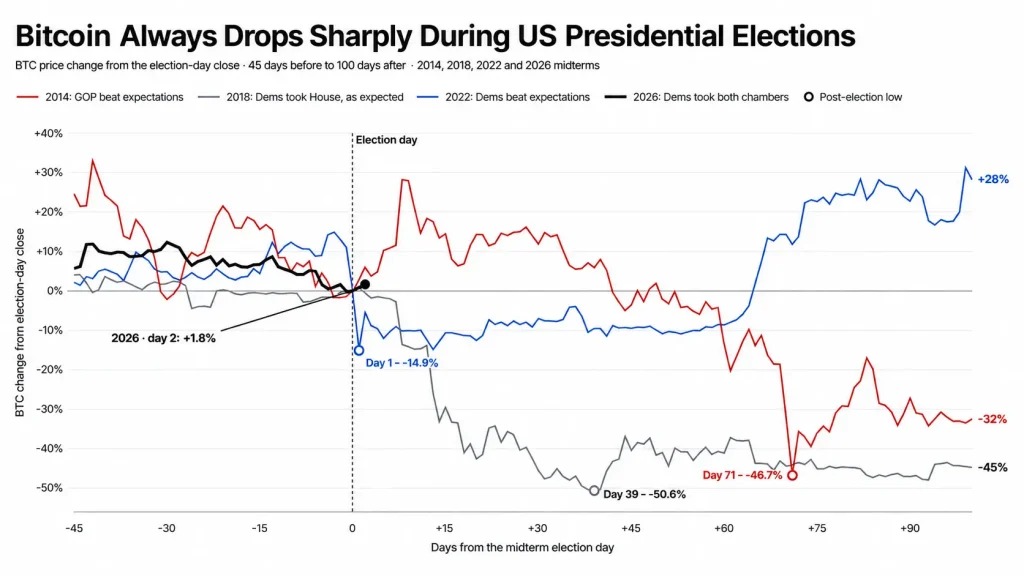
Mid-term election data from history indicates that Bitcoin may still experience a rebound.
This weak rebound does not necessarily mean that the post midterm election cycle for Bitcoin has ended. Coinpedia News reports that in the 12 months following the previous three U.S. midterms, Bitcoin saw increases. After the 2014 elections, BTC it rose by 24.5%; after 2018, it rose by 44.9%; and after 2022, it rose by 92.3%.
In previous cycles, it was usually observed that Bitcoin tended to form significant bottoms shortly after, rather than before, mid-term elections.
Historical data shows that after the 2014 elections, a decline in price occurred 71 days later; in 2018, it was 39 days after the elections; and in 2022, it happened 13 days after the elections. However, in 2026, Bitcoin reached a level of around $57,718 as early as July, before the elections in November.
This makes the current cycle different from the past ones.
For now, the rebound of Bitcoin after the election has lost its momentum. However, historical data shows that Bitcoin tends to hit bottom between 13 and 71 days after mid-term elections before beginning to recover. This means that the market's next move may not be clear in the initial days.