XRP Ledger plans to reset its two development networks on November 25th, following a failure on one of the full-history servers earlier in the day. This reset will permanently erase existing test accounts, transactions, balances, and other ledger data.
According to the official announcement on November 9th, Testnet and Devnet, which are operated by Ripple, will restart with a brand-new ledger history in order to improve infrastructure stability. Developers using these two environments will need to re-establish their test settings after the reset.
Why does XRP Ledger need to reset Testnet and Devnet?
Ripple operates Testnet and Devnet in order to provide developers with an environment to test blockchain applications without having to bear the risk of real funds.
Testnet usually mirrors the features that are already available on Mainnet, while Devnet allows developers to test proposed new features before they are widely enabled.
This November reset was due to a failure on a single, full-history server identified by Testnet. The server has crashed, and the network will not be able to recover unless it is restarted.
To prevent similar issues from occurring again, Ripple plans to increase the server storage capacity, although certain restrictions on retaining historical data will still be in place.
At the time of this maintenance, developers were preparing to advance the increasingly complex upgrade roadmap for XRPL, which includes 24 proposed and approved changes involving lending, token infrastructure, and other financial applications.
A reliable testing environment is very important, as new features must be evaluated before they are made available to real users.
What will happen to accounts, transactions, and the XRP balance?
This reset will delete all existing ledger data on Testnet and Devnet, including account settings, balances, decentralized exchange orders, automated market makers, and managed transactions.
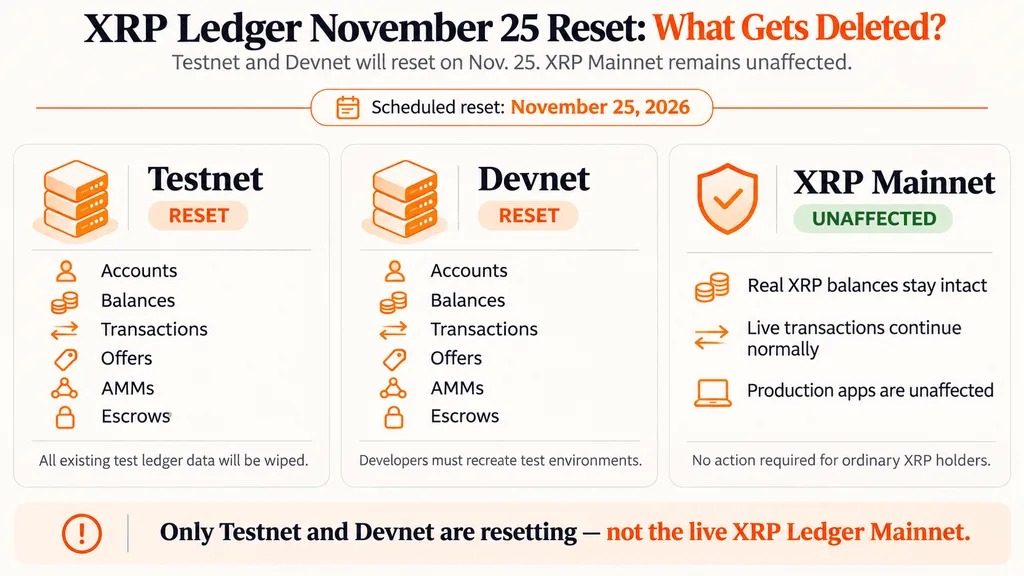
Developers must reapply for the test XRP through the network faucet and rebuild accounts or applications that rely on the deleted state.
The existing address can be used to obtain funds again, but a newly created market maker will usually be assigned a different account address.
This distinction is particularly important for developers who are working on developing the XRPL lending infrastructure, as testing may involve vaults, issued assets, and multiple interrelated transactions.
This reset will also restore the amendment status of Testnet to be consistent with that of Mainnet.
However, the important networks URL, network ID, and verifier settings will remain unchanged, thereby reducing the need to reconfigure existing connections.
Will XRP Mainnet be affected by the reset on November 25th?
This reset will not affect XRP Mainnet, Xahau, or Hooks Testnet.
The test XRP is separate from the real XRP; it has no monetary value. Therefore, deleting the test balance will not harm the cryptocurrency assets held by investors.
The planned maintenance is also different from the XRPL security upgrade that was announced earlier this year. Those upgrades were aimed at addressing protocol vulnerabilities.
These updates involve software security and verifier compatibility, while the reset on November 25th was to address issues with the development network infrastructure.
This difference is very important, as Ripple is preparing for further performance improvements in 2027, while developers are also continuously testing new financial applications.
The previous Batch transaction upgrade has already indicated that strict testing and approval by validators are necessary before new features are introduced in Mainnet.
Marcus Hale
Marcus Hale is an author who writes about topics such as Bitcoin, Ethereum, digital assets, regulation, ETF, and the adoption by institutions in the fields of cryptography and financial markets. His articles focus on factors that may impact market developments, investor trends, as well as the broader forces that shape the crypto economy.