U.S. stock markets rebounded on Wednesday (November 11), with NVIDIA, CoreWeave, and other artificial intelligence stocks rising after previous sell-offs driven by inflation. The S&P 500 index rose by about 0.9%, supported by renewed buying in semiconductors and AI infrastructure companies.
The Nasdaq Composite Index rose by about 1.4%, while the Dow Jones Industrial Average fell by 0.1%, indicating that the tech sector made a particularly significant contribution to this round of recovery. The previous day, inflation-driven selling pressured the market as consumer price data that exceeded expectations exacerbated concerns about the Federal Reserve's interest rate hikes.
Why did the S&P 500 rise today?
Despite the uncertainties in interest rate prospects, tech investors are shifting their focus to corporate earnings and the ongoing demand for AI infrastructure, driving the rebound of the S&P 500.
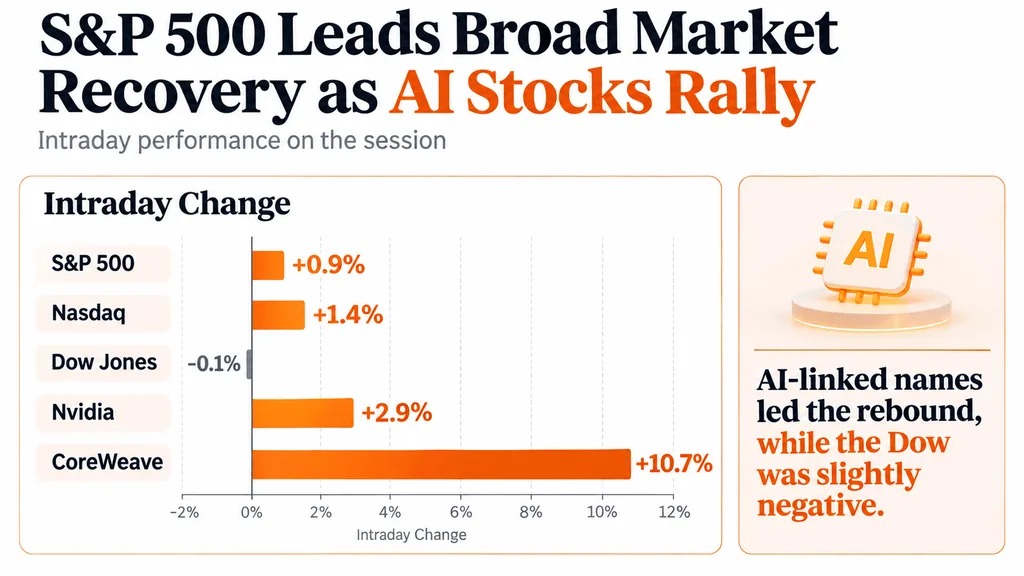
CoreWeave was one of the strongest-performing stocks on Wednesday, rising by about 10.7% after announcing quarterly earnings that exceeded expectations. The company's revenue for the third quarter was $3.66 billion, a year-on-year increase of 168%, and it raised its full-year revenue forecast to between $1.3 billion and $1.33 billion.
These results have enhanced the market's confidence in the demand for computing power related to AI. However, CoreWeave is expected to incur capital expenditures of between $37 billion and $39 billion throughout the year, which also highlights the extremely high costs associated with expanding its infrastructure. Its latest financial report has helped to boost sentiment in the tech stock market.
NVIDIA's stock price rose by about 2.9%, while Micron Technology and Broadcom both increased by approximately 5.6%. The rebound in the semiconductor sector occurred after NVIDIA recently faced pressure due to analysts' re-evaluation and concerns regarding the valuation of AI.
Inflation and U.S. Treasury yields threaten a rebound
Despite the rise on Wednesday, investors are still concerned that persistent inflation may keep interest rates high for a longer period than previously anticipated.
In October, consumer prices rose by 0.4% month-on-month, and core inflation increased by 0.3%. This inflation report pushed up U.S. Treasury yields, with the benchmark 10-year yield approaching 5% on the previous trading day.
Higher borrowing costs will put significant pressure on technology companies, especially those that need to finance the expansion of expensive infrastructure. Rising yields will also reduce the present value of future corporate profits, adding additional pressure to the valuation of growth stocks.
On Wednesday, the bond market was closed due to Veterans Day, while the U.S. stock market continued to trade.
Can the stock market rebound continue?
This rebound indicates that even though concerns regarding valuations and capital expenditures remain, as long as financial reports show that demand remains resilient, investors are still willing to buy into leading AI companies.
The semiconductor market has weakened recently, creating opportunities for selective rebounds, while the ongoing investment in infrastructure by AI also adds another layer of optimism.
At the same time, TSMC's AI investment plan indicates that major chip manufacturers are positioning themselves in markets driven by the demand from OpenAI, Anthropic, and other technology companies.
Whether the S&P 500 can maintain its rebound will depend in part on the economic data and corporate earnings reports to be released, as well as market expectations regarding Federal Reserve policies. Currently, AI related buying orders have helped offset broader market concerns, although Wednesday's gains were still mainly concentrated in technology stocks.
Adrian Cole
Adrian Cole has been engaged in financial market reporting for over 6 years, with a focus on cryptocurrencies, stocks, and macroeconomic trends. He tracks Bitcoin, major altcoins, U.S. stocks, interest rates, commodities, as well as data that drives market changes. Over the years, he has written hundreds of market updates and analysis articles, with an emphasis on price movements, investor sentiment, and the connections between traditional finance and digital assets.