




Key Points
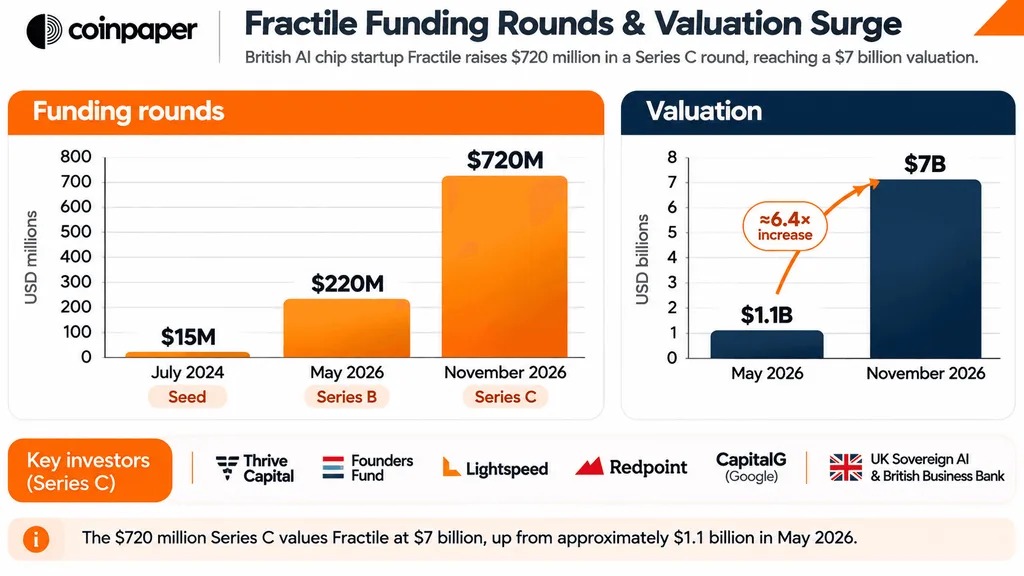
- Fractile raised $720 million in financing with a valuation of $7 billion
- Google and the UK government support this Nvidia challenger
- The first commercial AI chip is expected to be launched in 2027.
British AI chip startup Fractile has raised $720 million at a valuation of $7 billion, attracting investors related to Google, BlackRock, as well as support from the UK government. With the intensifying competition in developing alternative Nvidia artificial intelligence processors, this financing has drawn significant attention.
This round of Series C financing, completed on November 11th, was co-led by Thrive Capital, Founders Fund, Lightspeed, and Redpoint. Alphabet's subsidiaries CapitalG, DST Global, Balderton, as well as several other investors, also participated in this financing round.
A statement from the UK government confirmed that its sovereign AI fund and British commercial banks were involved in the investment, stating that this financing is part of the UK's strategy to develop domestic semiconductor capabilities.
The $720 million financing of Fractile aims to challenge Nvidia's dominant position in the AI chip industry
Fractile was established in 2022 and is founded by Walter Goodwin. It is currently developing a processor specifically for AI inference. AI inference refers to the process of generating responses after model training is completed.
Unlike traditional AI accelerators, the architecture of Fractile places dynamic random access memory directly above the computing components, in an attempt to reduce the latency caused by data transfer between memory and computing units.
The company believes that as reasoning models and autonomous agents generate longer outputs, memory bandwidth is increasingly becoming a factor that limits the performance of AI.
This technology may ultimately challenge the dominant position of Nvidia in the field of reasoning in AI, but its commercial performance has not yet been verified.
As this financing arrives, Google is also expanding its exposure to alternative AI chip developers, which includes the recent disclosure of a 548 million dollar stake in Qualcomm.
Other companies are also seeking similar opportunities by customizing AI accelerators, as cloud service providers are looking for more specialized computing hardware.
Google and the British government support the expansion of Fractile
Investors in Fractile include large technology funds as well as British public institutions, reflecting the growing market demand for alternative solutions from foreign semiconductor suppliers.
The UK government stated that this investment will help the company expand its engineering operations in London and Bristol, while also enhancing the UK's own AI infrastructure.
At the same time, this round of financing also occurs during the period when Nvidia continues to invest in the research and development of AI chips. Rapid innovation remains the key for it to maintain its competitive advantage.
However, Fractile still faces significant implementation challenges.
The company expects to launch its first commercial chip in 2027, which means that its current valuation largely reflects investors' expectations rather than actual product revenue that has already been generated.
Fractile can challenge Nvidia in the field of reasoning of AI?
Fractile is entering a highly competitive market, which consists of both established semiconductor companies and emerging developers such as Groq and Etched.
Fractile must demonstrate that its architecture can bring meaningful improvements in terms of speed, energy consumption, and cost in real-world scenarios.
This financing also reflects a broader wave of investment in AI infrastructure, with a large amount of capital flowing towards companies whose technologies have not yet reached commercial scale.