





A new CCN report finds that as skill integration reshapes cybersecurity work, entry-level opportunities are decreasing.
Ottawa, Canada, November 12, 2026 / PRNewswire / -- The Canadian Cybersecurity Network ( Canadian Cybersecurity Network , referred to as CCN ) released its third-quarter 2026 "Labor Force Intelligence Report", which pointed out a clear contradiction in Canada's cybersecurity labor market.
In the third quarter, there were 728 cybersecurity recruitment positions, which is a 9.8% increase from the second quarter and a 64.7% increase compared to the same period in 2025.
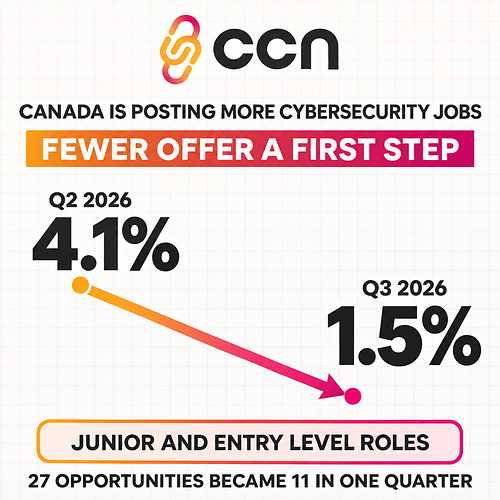
However, the proportion of junior and entry-level positions decreased from 4.1% in the second quarter to just 1.5% in the third quarter. Approximately 27 opportunities were reduced to just 11 within one quarter.
Fran, the founder and CEO of a Canadian cybersecurity network, stated: "If we require every candidate to have experience before taking up a position, Canada will never be able to solve the shortage of cybersecurity talent. We are increasing recruitment in the field of cybersecurity, yet at the same time, we are removing the first step for people to enter this profession. If companies continue to compete among experienced professionals without creating opportunities to train new talent, then the shortage problem will not be solved; instead, it will become institutionalized."
The report indicates that there may be multiple factors contributing to this decline. Employers are consolidating responsibilities in areas such as network security, privacy, governance, cloud, data, artificial intelligence, and business operations into fewer positions. Artificial intelligence tools are taking over some of the more basic tasks, and security teams, now streamlined, tend to prefer candidates who can contribute immediately.
This reflects what CCN refers to as a broader transformation – the integration of skills.
Organizations are increasingly in need of talent who can work across technologies, security, risk, regulation, operations, and business strategies. Today, cybersecurity professionals may also need to understand artificial intelligence systems, communicate with senior management, assess privacy impacts, and link technical decisions to business outcomes.
AI Bilingual capabilities are becoming an important part of this integration. It refers to the ability to work proficiently between cybersecurity and artificial intelligence, including understanding how AI changes threats, operations, identities, governance, and the way people make decisions.
Guay indicates: "The integration of AI bilingual capabilities and skills will define the next generation of work patterns. However, Canada cannot on one hand demand a broader range of capabilities and on the other hand eliminate jobs that allow people to develop these abilities. Employers must become active builders of talent, rather than merely consumers of experience."
These changes will also be further discussed in "Fusion Economy" ( The Convergence Economy ). This is the flagship report planned to be released by CCN Intelligence in January 2027. The report will examine how technology, security, business, policy, and risk will converge, and how such changes will alter the ways organizations compete, recruit, and make decisions.
This third-quarter report was compiled by Steve McMichael after conducting a detailed analysis based on data from Canadian Cybersecurity Jobs.
CCN calls on employers, educational institutions, and governments to expand opportunities for paid internships, apprenticeships, structured entry-level positions, mentoring programs, and work-integrated learning. Employers should also re-evaluate experience requirements to avoid unnecessarily excluding capable candidates.
CCN indicates that media organizations are welcome to contact us for interviews, consultations regarding data issues, or to obtain comments on topics such as cybersecurity recruitment, skill integration, AI bilingual capabilities, and the constantly changing talent needs of Canadian enterprises.
Read the "Labor Force Intelligence Report" for the third quarter of 2026
Read the accompanying analysis for CCN.
Regarding Canadian Cybersecurity Network
The Canadian Cybersecurity Network is a national community with over 47,000 members, connecting leaders, practitioners, and organizations committed to strengthening Canada's digital future. Through CCN Intelligence and CCN, it integrates credible signals, expert perspectives, and community insights to help Canadian leaders make better technical and business decisions.
Media contact: Francois Guay, founder and CEO of Canadian Cybersecurity Network, 236 983 7300, [ email protected ]
Message source: Canadian Cybersecurity Network