On Thursday, NVIDIA's stock price tumbled due to management turmoil, and at the same time, market expectations for a resolution to the Middle East situation cooled down.
The three major stock indices showed mixed movements: the Dow Jones rose by 0.11%, the S&P 500 index fell by 0.76%, and the Nasdaq index dropped by 1.40%.
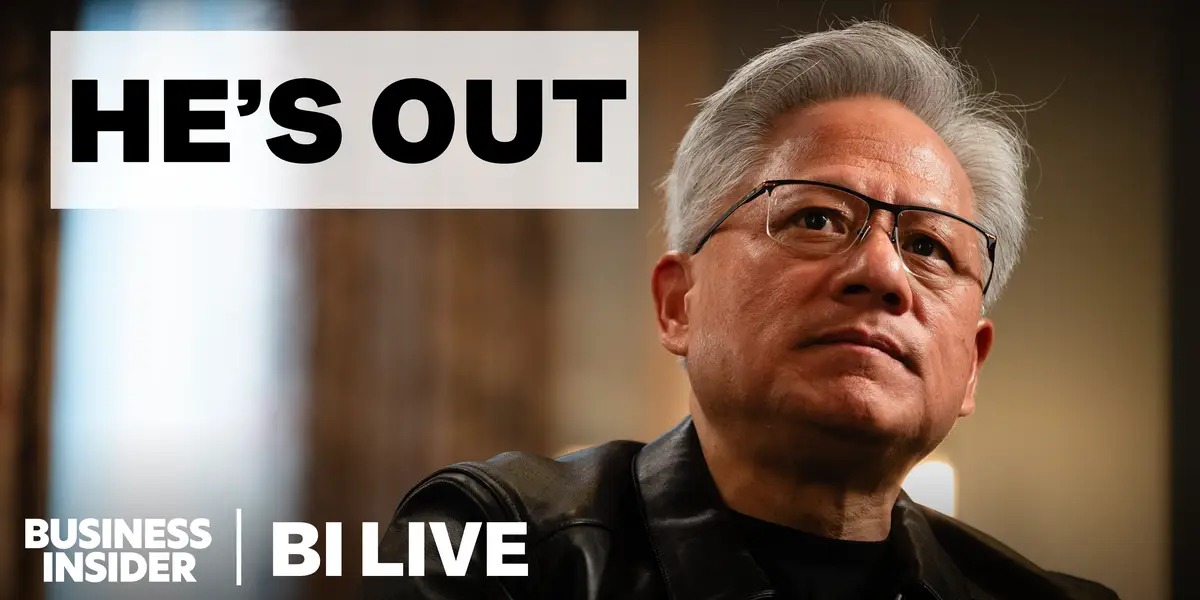
After NVIDIA announced that Jensen Huang had resigned and appointed Chief Financial Officer Colette Kress as the interim CEO, the stock price fell by more than 13%.
Funds flowed to other chip companies, and both AMD and Broadcom's stock prices rose by about 2%.
However, the remaining AI core stocks in the sector weakened along with NVIDIA: Oracle, a software company, saw its stock price fall by 4%. Neocloud tumbled 20% before the market opened; although the company's third-quarter financial results were better than expected, the performance guidance provided fell short of market expectations.
In addition to the pressure brought by the AI sector, oil prices have risen due to Trump's statement that "we don't need to reach an agreement with Iran; that has already become a thing of the past." U.S. WTI crude oil futures rose by more than 1%, breaking through $87 per barrel; international benchmark Brent crude oil futures also increased by over 1%, reaching $94 per barrel.
Energy stocks Chevron and ExxonMobil both rose by about 1%; individual stocks in the healthcare sector, such as Eli Lilly, gained more than 1%.
The major backdrop for these market fluctuations is the accumulation of macro risks.
Samer Sammana, head of global equities and physical assets at Wells Fargo Investment Institute, stated: "We should remain cautious regarding the market rebound. There are several marginal factors that are changing: stubborn inflation, the possibility of further interest rate hikes by the Federal Reserve, rising long-term interest rates, a shift in the political landscape in Washington, and increasing calls for regulation in the fields of artificial intelligence and data centers."
Pay attention to the speeches of Federal Reserve officials.
Although NVIDIA is likely to be a major factor affecting market sentiment around Thursday, traders will also closely monitor the speeches of about six Federal Reserve officials to gauge their views on inflation and future interest rate paths. On Tuesday, after Federal Reserve governor Christopher Waller (Christopher Waller) made clearly hawkish remarks, U.S. Treasuries came under selling pressure. Currently, the market has fully priced in the expectation of a Fed interest rate hike next month and believes that there is a high likelihood of another hike in January next year.
Natixis CIB Strategist Emilie Tetard stated that as risks emerge in multiple sectors of the market simultaneously, it is difficult for investors to determine where the true safe havens are. She pointed out that if the impacts are mainly concentrated in the artificial intelligence industry, accompanied by a large outflow of capital from the United States, "bonds could be a decent option for hedging risks."
She added, "If interest rates continue to rise, the dollar could also become a safe-haven asset. But it's currently difficult to determine which scenario will ultimately occur."
US dollar remains stable at high levels
The US dollar exchange rate remained relatively stable. It briefly rose to 103.083 overnight, reaching its highest level since April 2025. KBC Bank analysts stated in a report that the recent rapid appreciation trend of the US dollar may not have yet ended. The analysts pointed out that the euro has fallen below the important technical support level of 1.1111 US dollars. The recent strength of the US dollar is mainly driven by the increasing market expectations for a Fed interest rate hike in December.
Currently, Bitcoin has fallen by 1.1% to $73,499, with a cumulative decline of 16% since the beginning of the year; in contrast, spot gold has seen a cumulative decline of 7% this year. Alex Saunders, the head of asset allocation at Citigroup, stated that since Bitcoin still has a high correlation with the stock market, it has not yet truly fulfilled the role of "digital gold." He said, "The problem with the investment logic of digital gold is that Bitcoin still has a very high correlation with the stock market."
Saunders added that in the next five to ten years, Bitcoin should gradually transform into a hard asset and become a tool to hedge against the risk of government-issued currency devaluation. However, this market can be considered truly mature only when the correlation between Bitcoin and gold significantly increases, while the correlation with the stock market substantially declines.
The U.S. Treasury bill spot market resumed trading after the Veterans Day holiday, with short-term U.S. bond prices falling. According to Tradeweb data, the yield on 2-year U.S. Treasury bonds rose by 3.4 basis points to 4.760%; the yield on 10-year U.S. Treasury bonds rose by 0.1 basis points to 4.989%.
The yield on 10-year German government bonds fell by 2 basis points to 3.294%; the yield on 10-year British government bonds fell by 1.6 basis points to 5.209%.
Focus on PPI
Earlier this week, after U.S. inflation data came in higher than expected, investors turned their attention to the Producer Price Index ( PPI ) to be released on Friday. Meanwhile, the initial public offering ( IPO ) of artificial intelligence company Anthropic PBC is entering its final stages, and NVIDIA will also release its financial report next week.
However, there are still several weeks before the Federal Reserve announces its interest rate decision on December 9th, and the market conditions may still change.
According to LSEG data, the money market currently expects that there is a 91% probability of the Federal Reserve raising interest rates by 25 basis points at its December policy meeting, and a 9% probability of raising them by 50 basis points. Macquarie Group's global foreign exchange and interest rate strategist, Thierry Wizman, stated in a report: "It still seems like there is a long time before the December Federal Open Market Committee (FOMC) meeting, and during this period, enough changes could occur to prompt the Federal Reserve to ultimately abandon raising interest rates altogether, although the current baseline expectation should still be a 25-basis-point increase."
He pointed out that various factors could prevent the Federal Reserve from raising interest rates in December, or at least reduce the likelihood of a one-time increase of 50 basis points.
These factors include the possibility of another government shutdown by the U.S. government, market expectations for a peace agreement between the United States and Iran driving down international oil prices further, and if the prospects for the artificial intelligence industry continue to deteriorate, there could be a new round of selling off in U.S. stocks.
Deutsche Bank: The Fed may raise interest rates three more times in the future
After U.S. inflation data in October exceeded expectations, Deutsche Bank quickly shifted to a more hawkish policy forecast, predicting that the Federal Reserve will raise interest rates three times in a row at its upcoming meetings, changing its previous judgment to pause actions in January next year. Deutsche Bank previously expected the Fed to raise interest rates by 25 basis points in December and March next year, with a pause at the meeting in January in between.
However, the latest forecasts have incorporated a rate hike in January next year into the baseline scenario, with the Federal Reserve expected to raise interest rates by 25 basis points in December, January, and March of next year. This means that the target range for the federal funds rate will rise from the current 3.75%–4.00% to 4.50%–4.75%.
Before the inflation data was released, Federal Reserve governor Jerome Powell stated that if price pressures further accelerate, the Fed should consider raising interest rates by 50 basis points in December, rather than the usual 25 basis point adjustment.
Deutsche Bank believes that Waller's statement has opened up room for discussion on more substantial interest rate hikes. The bank does not rule out the possibility of the Federal Reserve raising interest rates by 50 basis points at once in December, but emphasizes that this is not a fundamental forecast.
The most intractable part of inflation in the United States may lie outside of energy.
As the linkage between oil prices and U.S. Treasury yields that formed after the outbreak of the Iran war has collapsed, investors are facing a new market reality: even if the war ends and energy prices return to normal, U.S. inflation may not necessarily cool down significantly, and the pressure for the Federal Reserve to tighten monetary policy could continue.
For most of 2026, Wall Street generally believed that rising oil prices would drive up inflation expectations, which in turn would lead to higher yields on U.S. Treasury bonds. Rising energy costs would not only directly increase consumer prices but might also prompt the Federal Reserve to maintain high interest rates for a longer period. As a result, investors sold U.S. Treasuries or demanded higher yields to compensate for the risk. However, this trading logic has recently changed.
This week, international oil prices fell to their lowest level in over two months. At the same time, U.S. Treasury yields soared significantly, as the latest economic data may prompt the Federal Reserve to take more aggressive interest rate hike actions. This means that even if oil prices continue to fall, as long as the U.S. economy remains strong, inflationary pressures could still drive U.S. Treasury yields higher.
Responsible Editor: Guo Mingyu