

Jensen Huang's sudden departure not only ended an era for NVIDIA but also shook the financing foundation upon which the entire AI ecosystem relies.
Over the past three years, under the leadership of Jensen Huang, NVIDIA has played the role of a "central bank" in AI, weaving a circular financing network worth over $500 billion through equity investments, credit guarantees, and lease agreements, continuously providing funding for this industry that continues to burn money. Now, due to a scandal involving an extramarital affair, Jensen Huang has stepped down from his position. The person who has taken over is the same Chief Financial Officer Colette Kress that he had previously publicly humiliated, calling him a "frightened deer" and claiming that he only knew how to handle finance.
According to The Wall Street Journal, it was Kress who actively reduced NVIDIA's guarantee for its data center in Ohio, OpenAI, from the initial negotiation amount of $250 billion to approximately $105 billion; it was also she who repeatedly questioned how to price the guarantee and how to calculate the investment return during the rapid expansion of the financing guarantee project.
In the eyes of the market, this new leader has made NVIDIA's balance sheet more secure, but it has plunged all the companies that rely on NVIDIA's future support into greater uncertainty. Goldman Sachs analyst James Schneider pointed out that the existing commitments are likely to be fulfilled, but "without Jensen Huang's vision, network, and ability to bring people together, it will be more difficult to carry out another round of multi-party ecosystem investments of the same scale."
A circular financing network worth over $500 billion
To understand the impact of Jensen Huang's resignation, one must first comprehend the scale of the financing machine he built.
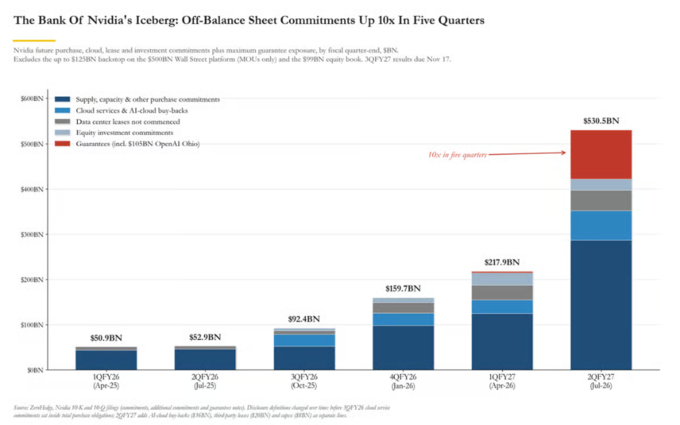
According to NVIDIA's 10-Q report dated July 26, the total scale of the company's contingent liabilities and commitments has reached $530.5 billion. This figure does not yet include transactions signed after July, nor does it account for the $500 billion target scale of the AI computing financing platform announced by Jensen Huang in August, for which NVIDIA has committed to providing up to $125 billion, which is 25% of the total.
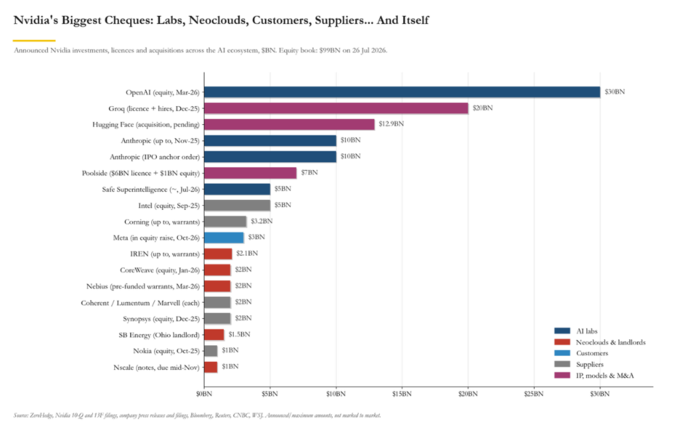
The mechanism remains almost unchanged: NVIDIA buys equity or provides guarantees, and the beneficiaries commit to purchasing NVIDIA hardware. The funds flow back in the form of GPU orders. Safe Superintelligence has not yet launched any products, but has already secured large-scale computing power commitments based on the Vera Rubin architecture; Meta added orders for Vera Rubin, Spectrum-X, and BlueField-4; Nebius and IREN signed a 5GW deployment agreement—money flows out in the form of equity and comes back in the form of revenue.
The Ohio data center project represents the most extreme manifestation of this logic. According to The Wall Street Journal, NVIDIA ultimately provided a guarantee of $105 billion in lease credit to OpenAI, with the option to add an additional 3.8GW of computing power. According to NVIDIA's own CFO statements, each generation of infrastructure deployed in the Ohio campus is equivalent to about 1.5 million GPU, which corresponds to NVIDIA's revenue of approximately $150 billion to $200 billion. In other words, NVIDIA uses a guarantee of $105 billion to exchange for up to $200 billion in chip sales, and this cycle repeats over a period of 20 years.
Bloomberg cited a warning from Panmure Liberum stating that "NVIDIA's bank" serves as a moat for the chip company, but it is also a source of credit risk – limited free cash flow is being committed on a large scale to an industry that is still striving to achieve commercial profitability.
Jensen Huang personally pressed the brake, but Kress had already been the one holding the reins behind the scenes.
Jensen Huang himself had already noticed the potential risks of this expansion before resigning.
According to The Wall Street Journal, in August of this year, he gathered top financial executives in his office and bluntly stated that NVIDIA was in "trouble": the company was negotiating guarantees with a large number of enterprises that were unable to pay for the chips. Some of these transactions were led by his son-in-law, who was promoted to vice president in January of this year and is involved with the issuance of N-token Caprez. Caprez and another vice president, Raj Mirpuri, had promised potential partners in the spring that NVIDIA could arrange credit support within weeks, on the condition that they agree to share a certain percentage of their revenue. Dozens of companies then lined up to wait.
At this meeting, Jensen Huang also interrupted the report of Kress on the spot, calling her a "frightened deer" and stating that she was merely a "reporting type of CFO" and not someone capable of participating in strategic decision-making. At the same time, he described the real crisis the company was facing: large cloud computing service providers were accelerating their shift to alternative chips and reducing their dependence on NVIDIA, while the large quantities of wafers and memory that NVIDIA had committed to purchasing were coming "like an avalanche." According to NVIDIA's financial reports, these supply commitments surged from approximately $58 billion to about $279 billion in just three months.
Just before Jensen Huang issued an "avalanche warning," the braking action was quietly initiated by Kress.
According to The Wall Street Journal, it was she who reduced NVIDIA's guarantee for the OpenAI Ohio project from the initial negotiation amount of $250 billion to the final amount of $105 billion, and she continuously questioned the pricing logic and return calculations of the guarantee project internally. In late August, NVIDIA announced a suspension of certain revenue-sharing credit support transactions, requiring that all new transactions must be reviewed by the executive team and the board of directors. In October, during a meeting with several major customers in Berlin, Jensen Huang used a story about a Japanese ramen chef as an analogy to send a clear message to the cloud computing company executives present: "It's not you who determine the value of my products."
$500 billion financing platform: made a grand debut, with zero transactions
In August this year, Jensen Huang, dressed in his iconic leather jacket, announced this financing platform amidst a crowd of executives from six of the world's top global asset management firms. The aim is to transform GPU into an asset class that financial institutions can invest in – similar to the securitization of real estate or toll roads, converting rapidly depreciating hardware into guaranteed infrastructure assets.
However, according to Bloomberg, the platform has not yet executed a single transaction to date. The preliminary intent memorandums signed by six institutions with NVIDIA have not yet resulted in final agreements.
One of the obstacles is the guarantee ratio. NVIDIA currently offers a maximum residual value support of 25% of the transaction size, while its competitor Broadcom provided approximately 86% of the guarantee for a $35 billion debt transaction in May of this year Anthropic, and will provide about 72.5% of the guarantee for another $63 billion transaction. Faced with such a significant disparity, some customers and Wall Street partners have pressured NVIDIA to increase the guarantee ratio. According to Bloomberg, the platform may not announce its first transaction until January next year at the earliest – assuming that Jensen Huang's departure does not affect the related process.
Raymond James, the person in charge of global private equity capital consulting, stated to CNBC that the management change provided a natural "pause button" for all parties involved to re-examine the terms of the deal. She does not believe that capital will withdraw as a result, but she warned, "They may demand higher returns for this uncertainty." She also predicted that the inquiries from lenders will spread throughout the entire AI infrastructure trading market: who is actually bearing the risks within these structures?
Kress Taking over: Tightened hands, a complex situation
From the "reporting type" CFO that Jensen Huang despised, to NVIDIA's first female interim CEO in its history, the succession of Kress is full of drama. People familiar with NVIDIA's investment decisions say that Kress had previously raised objections to several deals strongly advocated by Jensen Huang and is not expected to advance new deals at a pace close to Jensen Huang's.
Goldman Sachs analyst James Schneider pointed out after lowering NVIDIA's target price that NVIDIA will fulfill all its announced commitments, but the next round of large-scale multi-party ecosystem investments will be more difficult to advance due to the lack of Jensen Huang's personal resources and influence. Goldman Sachs also specifically noted that NVIDIA's stock has been trading at a discount, partly because of market concerns that once NVIDIA or its competitors stop providing financing, the growth of AI's infrastructure will slow down sharply.
UBS analyst Tim Arcuri listed "financing" as the top among the three core impacts of Jensen Huang's resignation in his report, and estimated that a large portion of NVIDIA's quarterly free cash flow of $50 to $60 billion is flowing back to customers, suppliers, and emerging cloud computing providers. Even a temporary pause could result in more than $50 billion being withdrawn from the AI ecosystem – at a time when interest rates are rising and credit market liquidity is tightening.
Analyst Sebastien Naji believes that the existing contracts will continue to be in effect after the replacement of CEO, but what is at risk is the next round of transactions, as well as NVIDIA's ability to defend its market share in 2027 and beyond. With Jensen Huang leaving or being subject to investigations, competitors such as Broadcom and AMD may gain more market space.
Confirmed and Uncertain: Which Transactions Will Be Impacted
Currently, the outside world believes that investments that have signed legally binding contracts are not expected to be affected. NVIDIA plans to invest $5 billion in Safe Superintelligence, as well as a transaction to invest approximately $2.5 billion in Thinking Machines Lab established by Mira Murati. Both contracts were signed several months ago and are expected to be implemented as scheduled.
Those more significantly impacted are the deals that are still in the negotiation phase. NVIDIA plans to invest $10 billion in the upcoming IPO, but whether this can continue is still uncertain; previously, NVIDIA had provided a $105 billion guarantee for data center leasing to Anthropic. The agreement to provide over $5 billion in credit guarantees for Nscale is still not signed as of the end of October. Australian cloud computing company Firmus is seeking at least $2 billion in private financing after withdrawing from IPO; NVIDIA had previously participated in the negotiations, but the outcome is yet to be determined. Humanoid robot company Figure AI is reportedly discussing an additional $1 billion investment with NVIDIA, but there is no recent update on the progress.
Saxo Chief Investment Strategist Charu Chanana pointed out that the real risk is not the breakdown of individual partnerships, but rather that with high debt levels, circular financing, and widespread doubts about returns, Jensen Huang's departure could trigger a re-pricing of the overall risk premium in the AI ecosystem – "This is not yet a financing crisis, but it could become a catalyst for a broader re-pricing of risks."
Kress will host NVIDIA's third-quarter financial report conference call on November 17th. At that time, analysts will inevitably ask her how she views the commitment of $500 billion and whether NVIDIA will continue to play the role of "AI's central bank." This will be the most direct test for the market to see if that revolving financing machine can continue to operate after Jensen Huang's departure.