


Merlin, Inc. (Nasdaq ticker: MRLN) After releasing its third-quarter results for 2026 on November 12, the stock price soared 54% after the market closed, reaching $1.49. On the surface, this financial report seems quite impressive, but the story is far more complex than just a sudden sharp increase in the stock price.
This independent airline reported a net profit of $73.8 million for GAAP, which is a significant turnaround from a loss of $26.7 million in the same period last year. However, there is a rather important note behind this profit: it includes a non-cash gain of $103.6 million related to changes in the fair value of warrant liabilities. Excluding this accounting gain, the company's operating performance is not so impressive.
Performance indicates that the operational level is still under pressure.
Merlin reported revenue of $3.46 million in the third quarter, which is higher than the $1.92 million in the same period last year. Although this increase is significant, the company is still far from achieving profitability at the operational level.
After the adjustment, the EBITDA loss amounted to 24.1 million US dollars, an expansion from the 13.6 million US dollar loss in the third quarter of 2025. However, compared to the 27.8 million US dollar loss in the second quarter of 2026, the loss has narrowed.
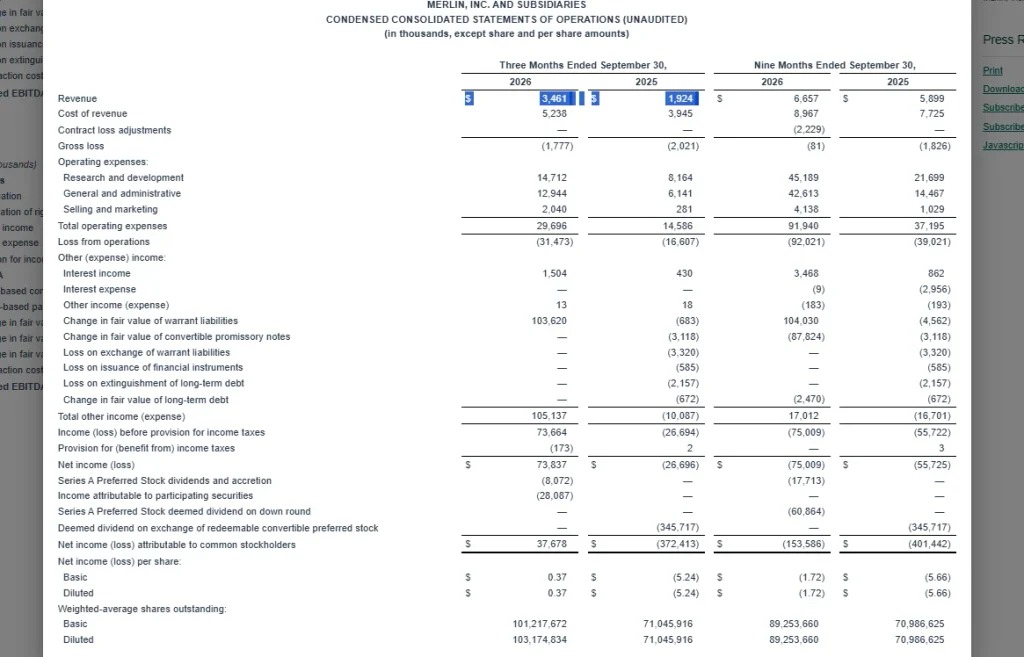
Operating expenses also increased significantly. Research and development costs amounted to 14.7 million US dollars, while management and administrative expenses totaled 12.9 million US dollars. The company recorded a operating loss of approximately 31.5 million US dollars.
Obviously, this accounting profit should not be mistaken for a real improvement at the operational level.
National defense contracts have provided substantial support to Merlin.
The main reason for the bullish outlook comes from contract progress. Merlin has received a task order worth $8.9 million from the U.S. Special Operations Command (USSOCOM), to advance the next phase of its C-130J autonomous flight project. This project will take the aircraft's autonomy plan to the integration stage.
In addition, the U.S. Africa Command (AFR Token Issuance M) chose Merlin to sign a contract worth $500,000 to support a demonstration of autonomous casualty evacuation based on Cessna 208B Grand Caravan.
According to an optimistic post on X, the integration process for C-130J may take about six months, followed by ground and flight tests. These advancements bring tangible contract opportunities, but successful execution remains crucial.
Merlin Can the stock price continue its upward trend?
As of the end of September, Merlin held a total of $161.6 million in cash, cash equivalents, and short-term investments, compared to $183.9 million at the end of June. The company has no debt.
Management currently plans to significantly reduce operating expenses in 2027 below the level of 2026 and to focus expenditures on projects that have already received financial support and have clearer revenue prospects. The company stated that its goal is to sustain operations until 2029 without further financing.
At the same time, the bullish sentiment on X is also heating up. A trader has set a target price of $2.80 after the stock price soared, citing reasons such as breaking through the daily resistance level, increased trading volume, and the stock price once again standing above the moving average. However, this is just a personal trading judgment and not a company guideline.
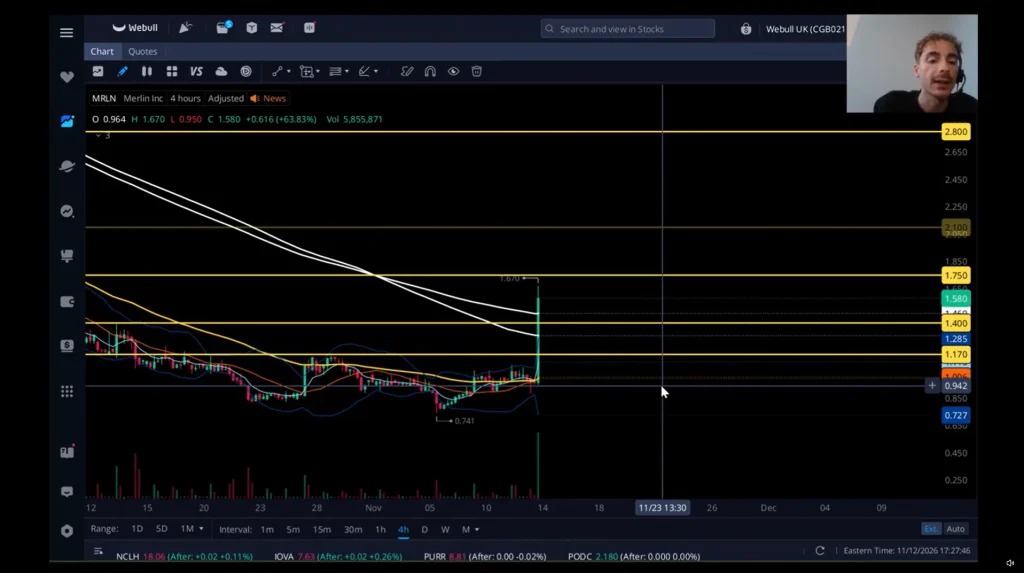
For the stock price of Merlin, the real test lies not in whether traders can drive the next round of gains, but in whether defense contracts can be converted into revenue, and whether operational losses and cash consumption can be controlled.