Key Points
- Gemini Trading volume plummeted by 73% year-on-year
- Despite the expansion of credit card business, quarterly revenue still declined by 19%.
- With the reduction in operating costs, net losses narrowed by 63%
The cryptocurrency exchange Gemini Space Station ( NASDAQ : GEMI ), founded by Tyler Winklevoss and Cameron Winklevoss, reported a 73% plunge in quarterly spot trading volume and a 19% decline in revenue, indicating that its core exchange business remains weak.
According to the financial report released by the company on November 12, revenue in the third quarter decreased from $50.6 million in the same period of the previous year to $40.9 million, while trading volume fell from $1.64 billion to $4.5 billion.
Gemini Trading volume plummeted by 73%, exchange revenue nearly halved
The exchange revenue of Gemini decreased by 47% year-on-year to $13.4 million, mainly reflecting the weak activity in retail cryptocurrency trading.
Total transaction revenue decreased by 40% to $15.9 million, however, the volume of transactions increased by 18% compared to $3.8 billion in the second quarter.
This improvement on a quarter-on-quarter basis was supported by the trading activities of institution Zcash and the expansion of its associated market-making business. In the quarterly spot trading volume, approximately $1.2 billion, accounting for 26%, involved transactions between external customers and Gemini market makers.
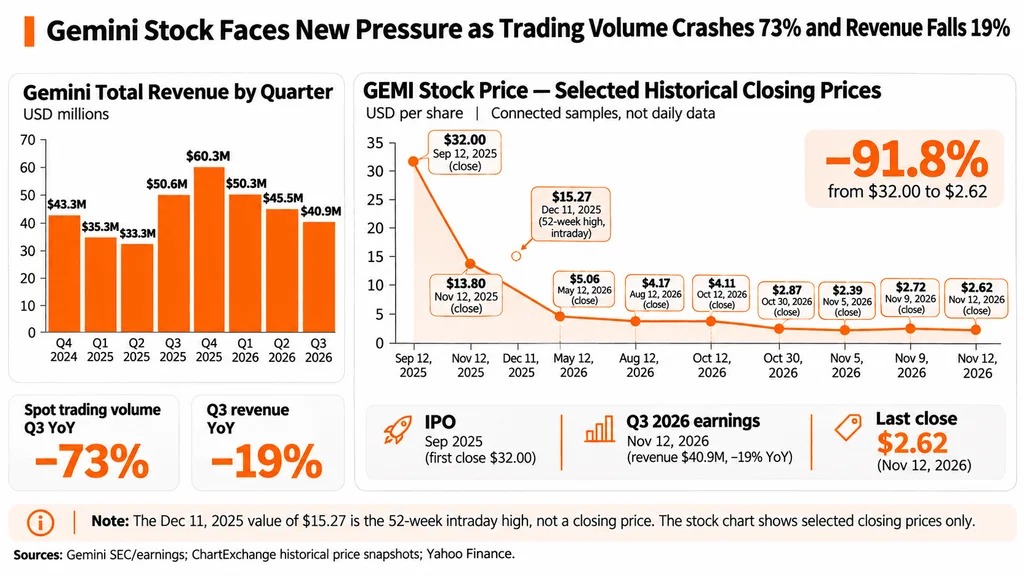
These data highlight the challenges faced by Gemini: amidst declining investor participation and falling valuations of cryptocurrencies, listed crypto exchanges are under pressure.
Gemini Losses Narrow by 63%, Credit Card Business Expands
Gemini The net loss narrowed from $159.5 million in the same period last year to $58.6 million, while operating expenses decreased by 30% to $119.9 million.
Management stated that the narrowing of losses is mainly attributed to a decrease in salaries and marketing costs, which is part of the company's ongoing restructuring efforts. Previously, this restructuring had led to Gemini layoffs and departures of senior executives.
The company's credit card business performed quite impressively, with revenue increasing by 82% year-on-year to reach $15.5 million.
However, the amount written off on credit cards reached $11.5 million, compared to $3.4 million in the previous quarter, reflecting losses related to a previous fraud incident.
Service revenue and interest income totaled 23.3 million US dollars, accounting for 59% of net revenue.
These results indicate that Gemini's dependence on exchange fees is declining, although its overall business has not yet achieved profitability.
GEMI What will happen to the stock next?
Gemini is increasingly positioning itself as a regulated financial infrastructure provider, rather than just a cryptocurrency exchange.
The forecast market generated $800,000 in revenue this quarter, representing a 52% quarter-on-quarter increase, although this business scale is still relatively small.
The company previously obtained a clearinghouse license from the U.S. Commodity Futures Trading Commission (CFTC), which enabled it to expand its infrastructure for derivatives and event contracts.
Gemini is also advancing distribution partnerships, which includes a preliminary agreement reached with Apex Fintech Solutions, but this agreement has not yet been finalized.
However, regulatory controversies related to predictive markets may still pose obstacles to expansion.
As of the end of September, the company held $194.1 million in cash and cash equivalents, while the platform's asset size was $13.4 billion, which is lower than the $21.3 billion from the same period last year.
Investors will currently assess whether ongoing cost control improvements and newer business segments can compensate for the decline in transaction revenue.
Maya Bennett is a financial journalist whose reporting covers cryptocurrency, stocks, and a broader range of market trends. Her areas of focus include Bitcoin, major digital assets, the stock market, monetary policy, and economic developments that affect investor sentiment.