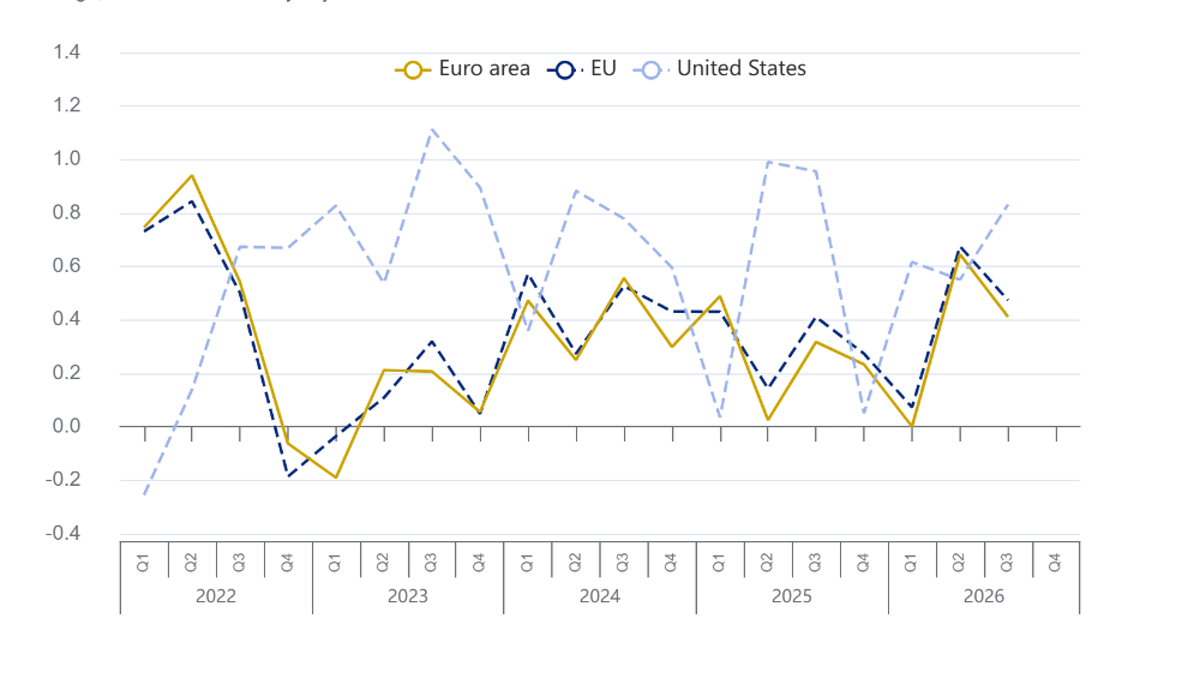


In the second quarter of 2026, the EU economy experienced a seemingly ideal combination: GDP a year-on-year growth of 0.8%, while greenhouse gas emissions decreased by 0.5%. On November 13th, it was announced that the adjusted quarterly economic activity greenhouse gas emissions were estimated at 833 million tons of carbon dioxide equivalent, which is lower than the 837 million tons in the first quarter. Emissions decreased in 18 member states, with 16 of them also achieving GDP growth or stability.
This indicates that economic expansion does not necessarily lead to increased emissions in every quarter, but it is not yet sufficient to prove that a long-term and comprehensive decoupling has been achieved. On a year-on-year basis, emissions still increased by 1.4% in the second quarter, with GDP growing by 1.5%. There is both a short-term improvement from quarter to quarter and an annual increase; different benchmarks will lead to different perceptions.
The power and household sectors contributed to the main decline.
Eurostat Upon breakdown, electricity, gas, steam, and air conditioning supply sectors contributed a negative 0.44 percentage point to the total emissions change, households contributed a negative 0.22 percentage point, while transportation and warehousing contributed a negative 0.01 percentage point. On the contrary, the manufacturing sector contributed a positive 0.05 percentage point, and other economic activities, mainly the service industry, contributed a combined positive 0.14 percentage point.
This means that the decline this season is not due to all industries reducing emissions simultaneously. The reduction in energy supply structure and household energy consumption has offset the increase in manufacturing and some service activities. If the power system uses more low-carbon energy, other industries may also reduce indirect emissions through cleaner electricity, even if they maintain their output; if the decline is mainly due to milder weather or temporary changes in demand, there could be a rebound in the next quarter.
Seasonally adjusted data is used to compare adjacent quarters and tries to eliminate the impact of seasons as much as possible, but it does not account for changes in energy prices, weather, industrial cycles, and policies. The figure of 833 million tons is an estimate and not a detailed count of emissions from each individual enterprise. When analyzing long-term trends, it is also necessary to consider annual inventories, energy structures, and industry production levels.
18 countries have seen declines, and the national paths are not consistent.
Estonia saw a month-on-month decrease in emissions of 15.5%, Latvia by 10.6%, and Finland by 7.6%, making them the three countries with the largest reductions. Malta experienced a growth of 4.8%, Ireland by 1.0%, and Romania by 0.8%. These significant changes may be due to the national energy structure, the base level of emissions, and a few high-emission industries, and cannot be directly translated into a ranking of policy effectiveness.
Eight countries with increasing emissions also achieved GDP growth. Among the 18 countries with declining emissions, 16 experienced GDP growth or stability. This set of data supports the conclusion that "growth and emissions can be decoupled in the short term," but it does not explain how each country managed to achieve this. If an economy shifts from manufacturing to services, domestic emissions will decrease, but emissions associated with imported goods may increase.
Eurostat adopts the framework of environmental economic accounting, allocating international transportation emissions according to the country of residence of the emission-producing entities. This approach is not entirely consistent with the listing rules of the United Nations Framework Convention on Climate Change and the Paris Agreement. Therefore, this quarterly data is suitable for comparison with other economic indicators such as GDP and employment, and cannot be directly used to replace the official climate target lists of various countries.
To truly achieve decoupling, it is necessary to see whether the intensity and total amount can continue to decline.
This season, GDP has seen a 0.8% increase and a 0.5% decrease in emissions, which indicates an improvement in the emission intensity per unit of economic output. For businesses and policymakers, this is a positive sign: energy substitution and efficiency improvements may allow growth to come at a lower carbon cost. However, climate goals focus on cumulative and absolute emissions, and a decrease in intensity does not mean that the total emissions will automatically decrease at the target rate.
A year-on-year increase in emissions of 1.4% reminds us that a single-quarter improvement may just be a fluctuation. To confirm a structural decoupling, it is necessary to see growth in GDP for several consecutive quarters and years, along with a decrease in total emissions, and to be able to explain that this decrease comes from cleaner energy, efficiency, and technology, rather than the relocation of production capacity or temporary shutdowns.
For investors, industry-specific breakdowns are more useful than overall figures. Emissions reductions in the power sector can change energy costs and asset risks, while increasing emissions in manufacturing suggest that equipment updates, fuel substitutions, and exposure to carbon prices are still necessary. If companies disclose only the average reduction figures for the European Union, they may be obscuring the opposite trends in their own industries.
The most reliable conclusion from this data is that the European Union achieved a combination of “economic growth and a decrease in emissions on a quarter-on-quarter basis” in the second quarter, with most member states showing similar improvements. This provides evidence for decoupling, but it is not conclusive proof of the end goal. The next steps will involve checking whether year-on-year comparisons can also show a negative trend, whether the contribution of energy supply can continue, and whether growth in manufacturing and services has also begun to lead to actual emission reductions.