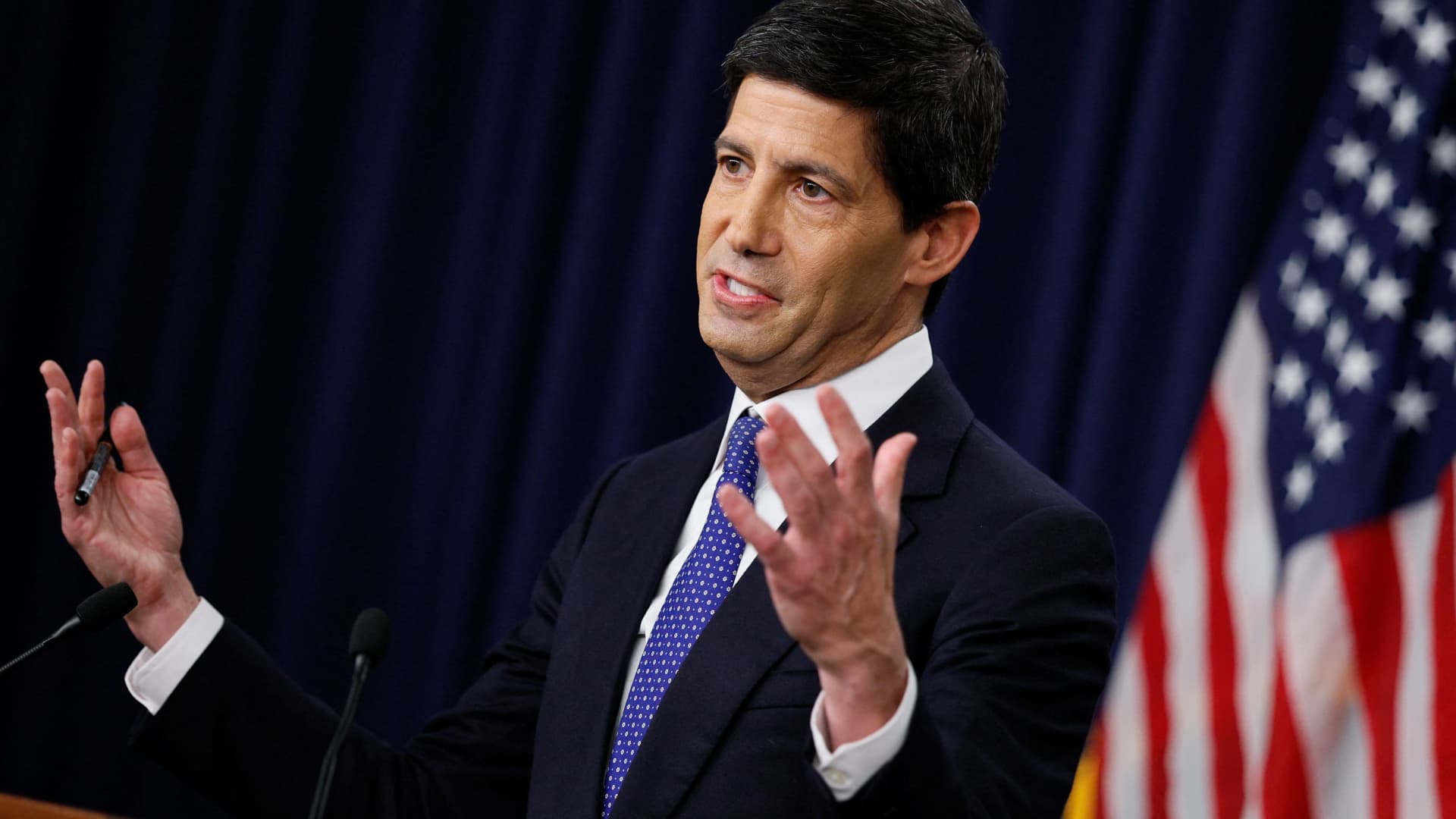


The sharp fluctuations in the market over the past week, as well as the dramatic changes surrounding Nvidia, have highlighted the dilemma faced by Federal Reserve Chairman Kevin Warsh.
Last Friday, as the stock market declined, the probability of the Federal Reserve raising interest rates also decreased. By Monday, with Jensen Huang returning to the office, a strong rebound restored market confidence, leading to the belief that the Federal Reserve would raise interest rates twice more.
From one perspective, ignoring the daily market fluctuations and focusing on the long term is precisely at the core of a key change that Warsh hopes to see driven by the Federal Reserve. On the other hand, he also made it clear that the market is better at forecasting, and he prefers to use market indicators rather than predictions to guide policy.
However, these indicators may fluctuate significantly.
Taking the benchmark Goldman Sachs Financial Conditions Index as an example, last week, the market declined and credit spreads widened, sending a signal to the Federal Reserve (Fed) to at least relax some of its tightening policies. Some Fed commentators even called for completely removing interest rate hikes from the agenda. On Monday, the index fell by 22 basis points, almost reversing half of the tightening that occurred last week, and interest rate hikes in December and January were put back on the agenda.
The message conveyed by Warsh in his words and actions is that the market should transcend such fluctuations. Last week, he traveled to San Francisco and patiently presided over a three-hour meeting to discuss the prospects of artificial intelligence and its potential economic impacts. He also posed a series of questions to economists and technology leaders regarding the risks and potential benefits of AI to the economy. This meeting was part of the AI working group he convened, which is one of five groups studying different aspects of Federal Reserve policy.
In his opening remarks, he said: "These groups are intended to broaden our thinking and invite for more in-depth discussions... far beyond fleeting data points [or] daily market fluctuations. Our working groups represent an intellectual investment, aimed at helping us better prepare for the next policy shift and the future beyond that."
Comparing this desire for “intellectual investment” with the press conference held by Warsh after the Federal Reserve’s interest rate decision, the difference is quite evident. He shortened the press conference to half an hour and often spent most of the time avoiding questions from reporters about the Fed’s next steps, which is also part of his general aversion to providing forward guidance. At the press conference in June, he quoted former Secretary of State George Schultz as saying, “Press conferences are useful. But when you hold a press conference, you need to make sure you have important things to say.” Under the system where Warsh is reluctant to provide forward guidance, there is much less content to discuss than in the past.
The following are some of the views on monetary policy that Warsh seems to hold, as currently known:
- Most predictions, especially those from economic models and Wall Street economists, are poor. Not only are they inaccurate, but they can also harm policy-making, as they lead to wrong policies and may lock the predictors into expected outcomes.
- The quality of the large amount of data used in these models is also very poor, including outdated inflation indices, expenditure data simulated from surveys, and fragile measures of output.
- The best predictions come from market expectations, which are based on indicators such as inflation compensation, credit spreads, stock indices, and U.S. Treasury bond interest rates – these are just some of the indicators he knows he will pay attention to.
- The Federal Reserve and Wall Street spend too much time thinking about the next meeting or the one after that, and too little time discussing the broader economic forces that will shape the economy and guide interest rates in a year or two.
- Inflation is not the result of tariffs, oil prices, or large-scale AI construction, but rather the outcome of policies set by central banks in response to these developments.
- The current inflation is most likely the result of policies implemented nine to a year ago, and these inflation figures themselves are already outdated.
- The solution is to have the Federal Reserve speak less, make fewer decisions, and engage in more discussion.
In a sense, Warsh seems to want to implement monetary policy in the same way he did when he worked for Duquesne Family and office as a legendary investor for Stan Druckenmiller. There, he evaluated startups, many of which were initially just vague ideas in the minds of tech geeks, to see if they had the potential to become profitable years later. Measured by market value, these investments would show huge negative figures on the profit and loss statements of that day. In the longer run, some would go bankrupt, while others would bring considerable returns.
Warsh's attention to AI highlights his dilemma: he wishes to formulate policies in a different, more forward-looking manner that relies more on the market, but the prospects for AI are, as he himself acknowledges, rapidly changing and highly uncertain. The market may already be re-evaluating the potential profit margins that AI can bring, as well as how much capital will be invested in building AI. The pace of adoption of technology is uncertain, as is its economic impact on inflation and growth.
Warsh pays special attention to one possibility in San Francisco: namely, that the so-called “China Shock” could impact employment in the US service sector. This notion draws parallels from the history at the beginning of this century when Chinese imports severely hit American manufacturing. If such a scenario unfolds, widespread unemployment might prompt the Federal Reserve to lower interest rates over time; however, the currently rapid advancement of AI construction seems to be triggering inflation and putting upward pressure on interest rates. Therefore, the same economic development could convey different messages to the Chairman of the Federal Reserve.
It has long been established in monetary policy literature that current interest rate levels affect the economy through what is known as a 'long and variable lag.' This means that policies set today will have an impact on the economy at some point next year. The goal of policy is to set them according to where one expects the economy to be positioned next year.
Most economic forecasts, including those of the Federal Reserve itself, come with a wide range of error margins. However, market pricing also has a wide margin of error. The question is, which market signals are worth paying attention to, and how long do these signals need to persist in order to truly guide policy? The situation with Nvidia indicates that markets can be quite short-sighted when conveying long-term signals.