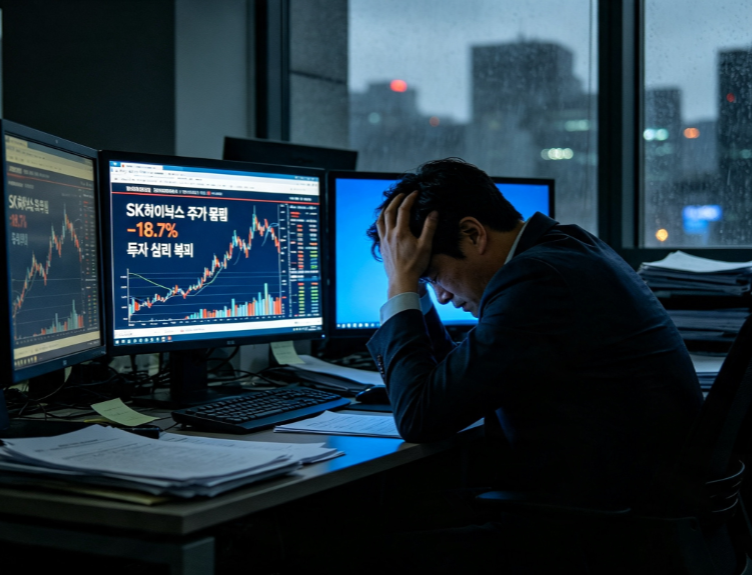
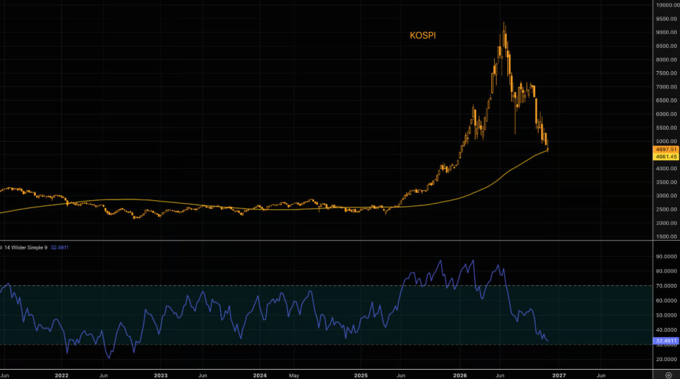
The South Korean stock market has once again entered a liquidation mode. The KOSPI index tumbled overnight, closing at its lowest level since the start of this round of AI market adjustments. Both Samsung Electronics and SK Hynix have fallen below key support levels and confirmed a "death cross," indicating a comprehensive deterioration in technical conditions. Meanwhile, hedge funds are withdrawing from the South Korean market at a pace not seen in over a decade. However, Goldman Sachs' valuation framework suggests that current stock prices already imply an extreme scenario where profit forecasts have been lowered by 70%.
Goldman Sachs data shows that the net leverage ratio of long-short hedge funds in Asia plummeted by 47.4 percentage points to 10% within a month, reaching the lowest level in more than a decade of data for the bank. The net allocation ratio to the Korean market has dropped to 2.3%, placing it in the 11th percentile of the past year, with South Korea and Taiwan, China continuing to dominate selling activities across Asia.
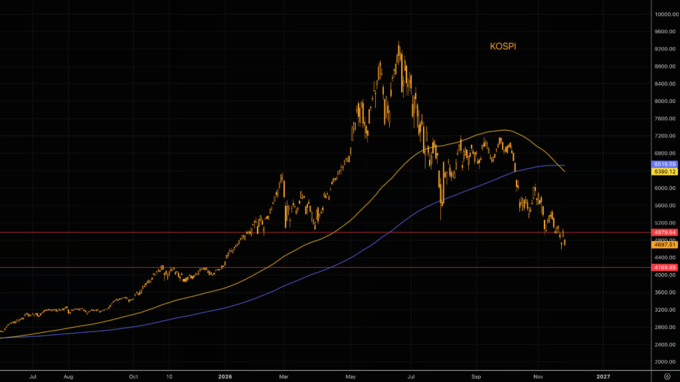
Technically, KOSPI no longer has significant support below 4200 points, and the major bearish crossover formed by the 100-day and 200-day moving averages has been established. SK Hynix has seen two consecutive large negative candles, and the death cross indicated last week has now fully taken effect. The first meaningful support level is approaching, but a more crucial barrier is around 800,000 Korean won. Samsung Electronics has fallen below its main support level, closing at its lowest point since March, with the next effective support level far below that, also showing a death cross.
However, Goldman Sachs believes that the fundamental risk-return ratio is becoming “increasingly interesting.” According to the bank’s scenario analysis, even if future earnings forecasts are lowered by 70%, they would still correspond to a modest positive return under the current valuation framework. Korean semiconductor stocks currently have a price-to-book ratio of about 0.7 times their book value for 2028, which is at a historical low. Goldman Sachs points out that similar valuation levels have historically coincided with the bottom of the semiconductor cycle and considerable prospective returns.
Comprehensive technical failure
KOSPI tumbled again overnight, closing at a new low since the start of the AI market adjustment. Momentum indicators have deteriorated severely, and key technical levels have been continuously lost. The index lacks meaningful support below the 4200 point range, with a significant negative crossover between the 100-day and 200-day moving averages.
The weekly chart RSI has fallen to its lowest level since October 2022, and the index is approaching the 100-week moving average. The trends of Samsung Electronics and SK Hynix are equally poor: the former has broken below a major support level and closed at its lowest point since March, while the latter has seen a complete death cross after two consecutive negative candles.
Volatility is unusually calm.
Despite a sharp overnight drop of KOSPI, volatility has remained relatively modest. The market may be entering a phase where investors are directly selling their long positions rather than seeking hedging.
On the other hand, the “panic index” of KOSPI has already accounted for an average daily fluctuation of about 3.75%, which is considered a very high level for an index. Volatility focuses on the magnitude of fluctuations rather than the direction; therefore, even if the index continues to decline, volatility may remain stable.
Hedge fund positions suffer a “catastrophic loss”
Hedge funds continue to sell Korean assets, with their net allocation dropping to 2.3%, which is in the 11th percentile of the past year. Korea and Taiwan, China, continue to dominate the selling pressure in Asia.
It is worth noting that, looking back over the past five years, South Korea's exposure remains relatively high. The extent of position resets has been severe, but it may not have been completed yet. In Asia, the net leverage ratio of long-short hedge funds decreased by 47.4 percentage points within a month to 10%, which is the lowest level in more than a decade of data from Goldman Sachs. The bank described this level as "extreme."
Valuation has taken into account disaster scenarios.
South Korean semiconductor stocks are trading at valuations that are in line with a “non-conventional profit reset.” Goldman Sachs’ scenario analysis shows that even if future profit forecasts are lowered by 70%, they would still correspond to a modest positive return under its valuation framework, indicating that the market has already factored in a significant amount of adversity.
South Korean semiconductor stocks are currently at about 0.7 times their book value in 2028, which is at a historical low. Goldman Sachs notes that valuation levels similar to this have often coincided with the bottom of the semiconductor cycle and attractive prospective returns in the past. They can get even cheaper, but this opportunity is becoming increasingly worth paying attention to.
$130 billion in buyback support
Goldman Sachs expects that the scale of stock repurchases in South Korea will exceed $130 billion by 2027. Corporate buying power may become an increasingly important force against foreign selling pressure, and once the wave of liquidations subsides, this could become a significant structural advantage.
The technical aspects are still poor, but the risk-reward ratio on the fundamental side is becoming increasingly attractive. Being cheap in itself is not a catalyst, but some price misalignments are becoming increasingly difficult to ignore.