Key Points
- Trump proposes new tariffs against 14 trading partners
- Tech stocks continued to weaken, with the Nasdaq falling by 3.31%.
- The annual PCE inflation rate in the United States rose to 3.8% in October.
U.S. stock markets tumbled significantly on Wednesday (November 25) following President Trump's administration's proposal to impose new tariffs on 14 major trading partners, reigniting global trade tensions at a time when Wall Street is already under pressure due to the accelerated selling of artificial intelligence stocks.
At the opening, the S&P 500 index fell by 1.95% to 7,060.33 points; the Nasdaq Composite Index fell by 3.31% to 22,948.48 points; the Dow Jones Industrial Average fell by 1.10% to 49,469.86 points.
These declines could erase Monday's historic stock market rebound. At that time, NVIDIA CEO Jensen Huang was reinstated, which briefly boosted market confidence in tech stocks.
Trump points the finger at China, European, and Asian trading partners
This proposed tariff was introduced following an eight-month Section 301 investigation by the United States Trade Representative's Office into foreign industrial policies and overcapacity in manufacturing.
China faces the prospect of additional tariffs of 20%, while the government intends to respect the tariff ceilings previously agreed upon with several other trading partners.
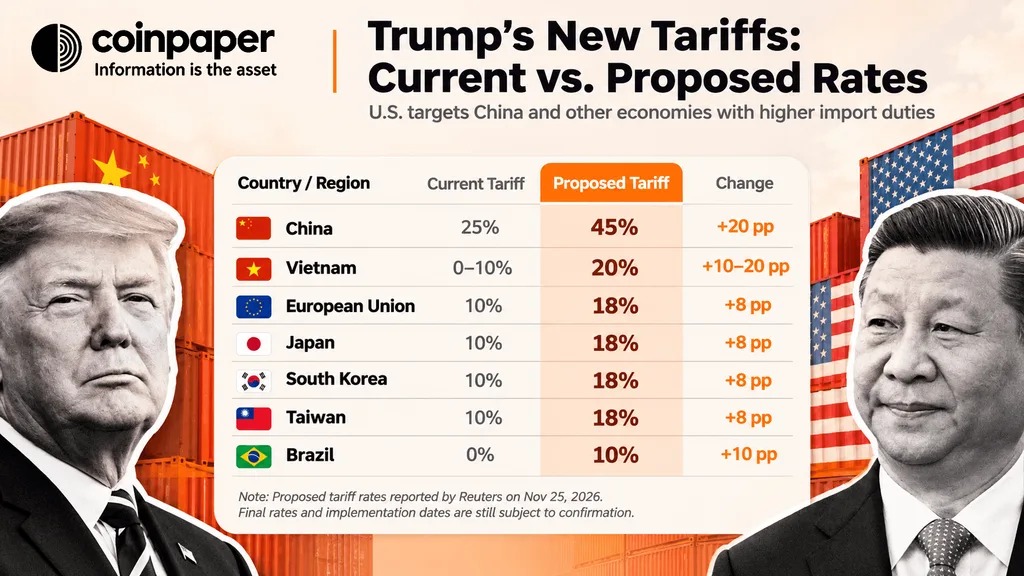
The new tariffs still need to go through public consultation and hearings, which means that the implementation date may be postponed to January 2027.
This timing is particularly challenging for the stock market. Higher import tariffs could push up manufacturing costs, disrupt international supply chains, and squeeze corporate profit margins as investors reassess the overly high valuations of stocks.
As concerns about spending on artificial intelligence infrastructure in the market intersect with renewed uncertainties in international trade, technology companies are particularly vulnerable.
Before the opening of Wall Street, the weakness in Asian markets had already spread. South Korea's KOSPI index tumbled by about 6%, and storage chip manufacturer SK Hynix fell by 11%.
Semiconductor companies operate through a highly integrated global supply chain, involving American chip designers, Taiwanese wafer foundries, Japanese equipment manufacturers, and Korean memory chip producers.
Although the proposed tariffs may not necessarily apply uniformly to every type of semiconductor product, ongoing trade uncertainties could complicate investment decisions across the entire industry.
Due to NASDAQ's higher concentration of technology and growth companies, it is more susceptible to the impact of declining valuations in artificial intelligence compared to the more diversified Dow Jones Index.
U.S. inflation rises to 3.8%, putting pressure on the Federal Reserve
Excluding food and energy, the core PCE inflation rate rose to 3.3%. Both of these indicators increased by 0.3% month-on-month.
Persistent inflation makes the outlook for the Federal Reserve's monetary policy more complex, especially in the context of additional tariffs that may put upward pressure on consumer prices.
Higher yields on U.S. Treasury bonds may further challenge the valuations of growth stocks by increasing borrowing costs and reducing the present value of future expected returns.
Author
Maya Bennett is a financial journalist with experience reporting on cryptocurrencies, stocks, and broader market trends. Her areas of focus include Bitcoin, major digital assets, the stock market, monetary policy, and economic developments that influence investor sentiment. She is adept at transforming rapidly changing market news into clear and concise reports.