JPMorgan says crypto flows drop to $11 billion in Q1, about one-third of first quarter last year
摸鱼大佬ks
04-04 03:37
Ai Focus
Earlier this year, JPMorgan expected flows to rise further in 2026 after a record inflow of nearly $130 billion in 2025.
Helpful
No.Help

Crypto flows dropped sharply in the first quarter of 2026, according to estimates by JPMorgan analysts, who had expected flows to increase this year.

Overall digital asset flows stood at around $11 billion in Q1 2026, which is about one-third of the level seen in the same period last year, said the JPMorgan analysts led by Managing Director Nikolaos Panigirtzoglou in a report. This implies an annualized pace of around $44 billion, they said, much lower than 2025's record $130 billion inflows.

The analysts estimate total digital asset flows by combining crypto fund flows, CME futures activity, crypto VC funding, and corporate treasury purchases, including bitcoin buying by Michael Saylor’s Strategy.
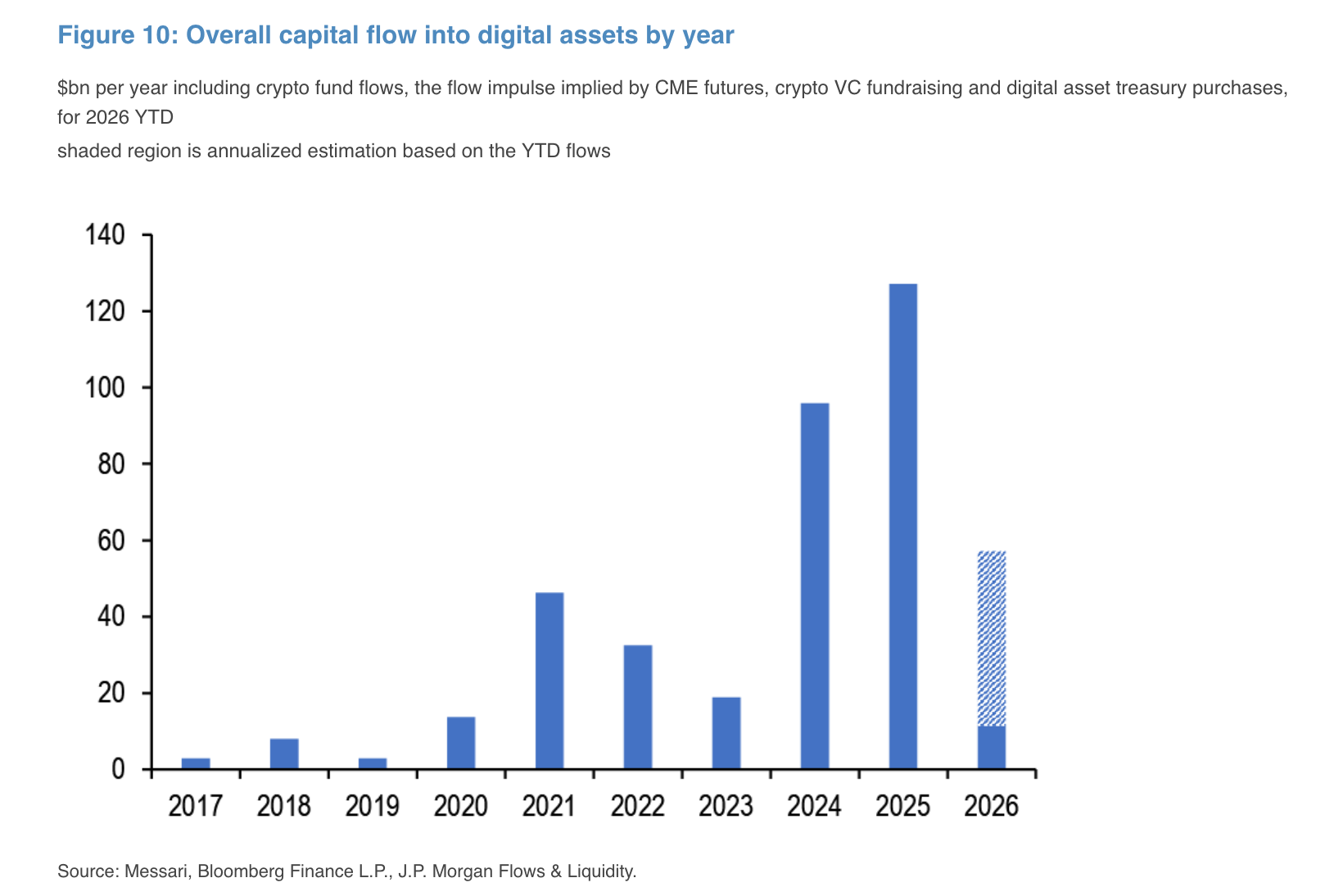
In the first quarter of this year, most inflows came from corporate treasury bitcoin purchases, mostly by Strategy and crypto VC funding rather than investors, either retail or institutional, the analysts said.

CME futures positioning weakened in Q1 compared to 2024 and 2025, suggesting institutional demand through futures turned negative so far this year, the analysts noted. Spot bitcoin and Ethereum ETFs also saw outflows during the quarter, mostly in January, while bitcoin ETFs saw some inflows in March.

Corporate treasury buys were one of the main drivers, but more uneven than last year, the analysts said. A small group of buyers, including Strategy, continued to buy bitcoin, while some smaller companies sold holdings to fund buybacks, the analysts added.

"In Q1’26 [Strategy’s] bitcoin purchases were funded primarily through equity issuance," the analysts wrote. "Further, the company indicated an intention to keep using a mix of common stock and perpetual preferred stock to support ongoing bitcoin accumulation, while other corporate treasuries retain a rather defensive stance."

Meanwhile, bitcoin miners became net sellers in Q1. Some listed mining firms sold bitcoin or used it as collateral to improve liquidity, fund capital expenditure, or manage liabilities. In some cases, these moves were linked to a shift toward artificial intelligence, the analysts said, adding that overall selling by miners was mainly due to tighter financing conditions and financial discipline, "rather than broad-based distress liquidation."

Crypto VC funding remained strong in Q1, tracking an annualized pace higher than the previous two years. However, deal count and investor participation declined, with funding more concentrated in fewer, larger rounds led by established firms.

"In all, our estimate of the overall digital asset flow slowed considerably in the first quarter of the year tracking an annualised pace that is close to a third of that seen last year. Moreover, investor flows, either retail or institutional, have been small or even negative YTD with the bulk of the digital asset flow in Q1’26 stemming from [Strategy’s] bitcoin purchases and concentrated crypto VC funding," the analysts concluded.


Tip
$0
Like
0
Save
0
Views 517
WalletJYS reminds readers to view blockchain rationally, stay aware of risks, and beware of virtual token issuance and speculation. All content on this site represents market information or related viewpoints only and does not constitute any form of investment advice. If you find sensitive content, please click“Report”,and we will handle it promptly。
Submit
Comment 0
Hot
Latest
No comments yet. Be the first!
Related
The Democratic Party in the U.S. House of Representatives plans to introduce a new crypto bill to expand the powers of SEC and add ethical restrictions related to Trump
According to crypto journalist Eleanor Terrett, Democrats in the U.S. House of Representatives are discussing proposing a broader crypto market structure bill during the new congressional session that begins on January 3, 2027. The proposal is likely to be based on the "Crypto Investors and Consumers Rights Act" previously proposed by Representative Maxine Waters, which would expand the regulatory authority of SEC over crypto transactions and market activities, and include ethical restrictions on crypto-related activities for Trump and other federal officials.
Coinpedia
·2026-11-05 04:28:22
8
Discussion on the Crypto Market Structure Act brings the regulatory role of SEC back onto the Democratic agenda
Democratic members of the U.S. House of Representatives have begun discussing a bill on the structure of the crypto market for the next Congress, considering granting greater regulatory powers to SEC, and reactivating the investor protection provisions proposed by Representative Maxine Waters. The discussions also include ethical regulations to limit federal officials such as Trump from engaging in crypto activities.
crypto.news
·2026-11-05 04:07:10
20
Circle Boosts Third-Qtr Performance Thanks to the Pre-sale of ARC Tokens
Circle's third-quarter performance was driven by the pre-sale of ARC tokens, securing $182 million in revenue, which offset the impact of low interest rates on USDC reserve earnings. The company stated that it will continue to rely on payment fees and staking rewards to diversify its revenue sources in the future.
Cointelegraph
·2026-11-05 03:57:46
25
Waymo Confirms Splitting Cooperation with Uber Starting from January 2028
Waymo and Co-CEO Tekedra Mawakana told Bloomberg News that the company will begin to separate its cooperation with Uber from January 2028 in the Austin and Atlanta markets, and will provide ride-hailing services directly through its own mobile app. Uber stated that, as long as both parties agree, they still plan to continue integrating Waymo's autonomous taxis into their app.
TechCrunch
·2026-11-05 03:57:44
26
Germany's electric vehicle market share reaches a record 37%, with pure electric vehicle sales exceeding the combined total of gasoline and diesel vehicles
According to data released today by the German Federal Motor Transport Authority (KBA), electric vehicles accounted for 37% of the new car market in Germany in October, setting a record with 94,086 pure electric cars sold, representing a year-on-year increase of 79.5%. Driven by subsidies, sales of pure electric vehicles in Germany in the first 10 months have already exceeded industry forecasts for the entire year of 2026, and Tesla, BYD, as well as several Chinese brands, have also seen significant growth in sales.
The Block
·2026-11-05 03:57:41
25
View More