Foreign media reports indicate that Wall Street institutions are continuing to adopt blockchain settlement networks. Canton Network, backed by DTCC and JPMorgan Chase, generated approximately $60.8 million in fees over the past 30 days, demonstrating a continued rise in institutional usage. However, despite the increasing network activity, the price of the CC token has not yet shown a clear response.
Increased costs failed to drive a price breakthrough
The report noted that CC has recently been fluctuating within a relatively narrow range. On the daily chart, the price previously rebounded from around $0.1497, an area considered a major support level during the current consolidation phase. Meanwhile, the Relative Strength Index (RSI) has entered oversold territory.
Typically, oversold readings indicate that selling pressure may be weakening; if this coincides with key support levels, the market often begins to focus on rebound signals. However, as of now, CC has not yet made a decisive breakout, and the gap between price performance and fundamental improvements persists.
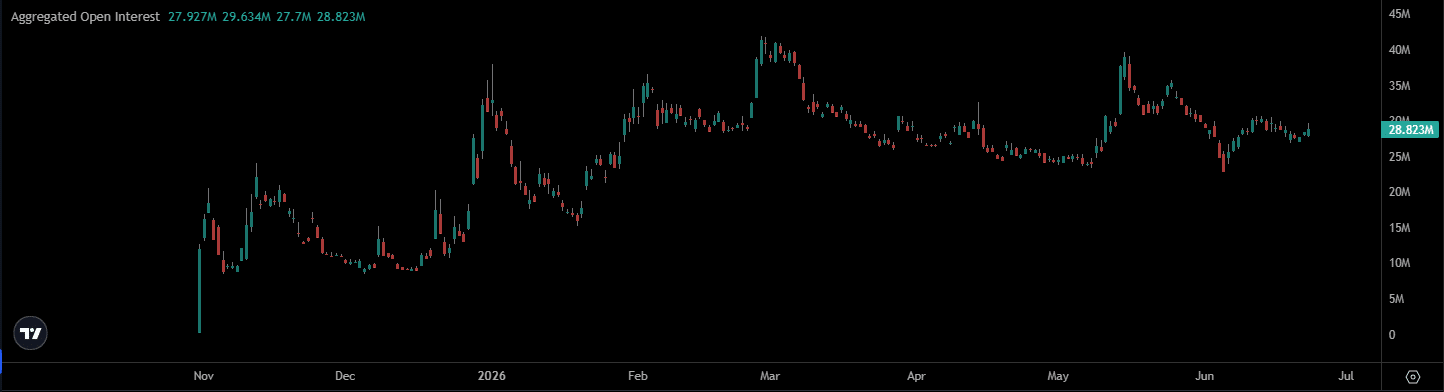
Open interest rose to $29 million.
The article argues that the misalignment between network usage and token price is more concerning. The continued increase in fees indicates higher usage frequency from institutional participants, but this change has not yet been fully reflected in the price.
- Network costs over the past 30 days totaled approximately $60.8 million.
- CC consolidates near key support level.
- Open interest rose to $29 million in 24 hours.
An increase in open interest typically indicates increased market participation. Based on this, the article concludes that institutional demand may be accumulating, but the price response remains slow.
The market is focused on whether the flag pattern can be broken.
From a chart pattern perspective, CC is currently still within a flag pattern consolidation range. This type of pattern is usually considered a continuation pattern, so market focus is on whether it can break out of the current range upwards.
If subsequent buying follows and internet usage continues to increase, the divergence between fundamentals and price may narrow. Conversely, if prices remain within the current range, it suggests that institutional adoption of growth has not yet translated into broader market pricing.