After the Aster buyback and burn mechanism was launched, Aster's stock price surged and then fell back.
CoinDesk
06-18 19:09
Ai Focus
Aster used 99% of its daily transaction fees to buy back ASTER tokens and burned an equivalent amount of them. The token price initially rose by more than 10%, but subsequently fell back due to the hawkish comments from the Federal Reserve.
Helpful
No.Help

Following Aster's adjustment to its token mechanism, the decentralized perpetual contract platform ASTER initially surged, but the upward momentum failed to sustain. Influenced by a combination of positive protocol developments and hawkish signals from the Federal Reserve, the token experienced significant two-way volatility within 24 hours.

99% of daily transaction fees are used for repurchase.

Aster has announced a new automatic buyback program, committing to using 99% of its daily transaction fees to buy back ASTER tokens. According to the disclosure, the tokens obtained from the buyback will not re-enter the market but will be distributed to veASTER holders.

veASTER is a non-transferable governance and reward token earned by locking ASTER. Holders receive a share of platform fees, governance voting rights, and trading fee discounts on Aster DEX.

Repurchase and destruction

Aster also stated that each buyback will trigger an equivalent burn of tokens from the protocol reserve to further reduce circulating supply. The burns will be performed bi-weekly until the total supply drops to 3 billion tokens.

Currently, the total supply of ASTER is approximately 7.82 billion tokens. This means that the new mechanism not only directly links platform revenue to token incentives but also incorporates supply reduction arrangements into a fixed process.

The old linear release mode has ended.

This adjustment also means that Aster is exiting its previous linear release model. Under the old model, tokens were automatically released into the market according to a schedule, without adjustment based on changes in demand. This arrangement ended in January 2026.

The agreement states that the new mechanism will directly convert the platform's own trading activities into token buybacks and on-chain settlement rewards, and emphasizes that the process will not rely on discretionary reserve allocation.

After rising, it gave back its gains.

Fueled by news of the new mechanism, ASTER rose more than 10% on Wednesday, reaching $0.80, its highest level since January. However, as the Federal Reserve released hawkish signals and the dollar strengthened, risk assets as a whole came under pressure, and ASTER subsequently retreated.

As of press time, ASTER was trading at approximately $0.68, down about 5% on the day. This indicates that while the positive impact of the single agreement may provide a short-term boost to sentiment, price performance remains easily suppressed when macroeconomic pressures dominate the market.

Tip
$0
Like
2
Save
2
Views 377
WalletJYS reminds readers to view blockchain rationally, stay aware of risks, and beware of virtual token issuance and speculation. All content on this site represents market information or related viewpoints only and does not constitute any form of investment advice. If you find sensitive content, please click“Report”,and we will handle it promptly。
Submit
Comment 0
Hot
Latest
No comments yet. Be the first!
Related
AI Financing Wave Faces Market Tests; Meta, Google, Intel's Additional Issuances Result in Collective Losses for Subscribers
Amid the boom in infrastructure investment in AI, Meta, Alphabet and Intel recently raised funds through stock offerings. However, the stock prices of these three companies subsequently fell, resulting in widespread losses for investors who participated in the subscriptions. The market is still re-evaluating the investment returns and financing pressures of AI. On Friday, Standard & Poor's downgraded its rating outlook for Meta to negative.
Wallstreetcn
·2026-10-31 08:31:37
14
Hon Hai's "Ecosystem Empowerment Token Factory" AI Initiative Debuts at Hon Hai Technology Day 2026
At the 7th Hon Hai Technology Day 2026, Hon Hai Technology Group (Foxconn) showcased its "_Token Factory_" solutions for the next-generation AI infrastructure, 321 exhibits, and its vertical integration capabilities from components to system integration. For the first time, the company also focused on its long-term partners. Additionally, Hon Hai Technology displayed applications in _NVIDIA DSX POD, _AI supercomputing and cloud operations, humanoid robots, precision manufacturing, as well as _AI security-related technologies.
PR Newswire
·2026-10-31 08:09:07
16
Applebee Exposes Customers' Personal Data by Leaving Database Passwords in the Application
TechCrunch reports that a security vulnerability has been fixed in Applebee. Previously, a researcher discovered the internal database password in its mobile application, which allowed access to the personal information of registered customers. Dine Brands stated that an investigation has been launched, and so far, no evidence of unauthorized access has been found.
TechCrunch
·2026-10-31 07:53:16
18
Temporary Halloween costume inspiration for tech enthusiasts
TechCrunch has listed a set of temporary Halloween costumes suitable for tech enthusiasts, including "recursive self-improvement," seemingly harmless but actually risky AI proxies, people taking photos of others with Meta glasses, Mark Zuckerberg style T-shirts, AI usage quota notifications, PHP vulnerabilities, and Bryan Johnson, among others.
TechCrunch
·2026-10-31 07:53:13
16
BNB tested support in October 2026, with weakening momentum
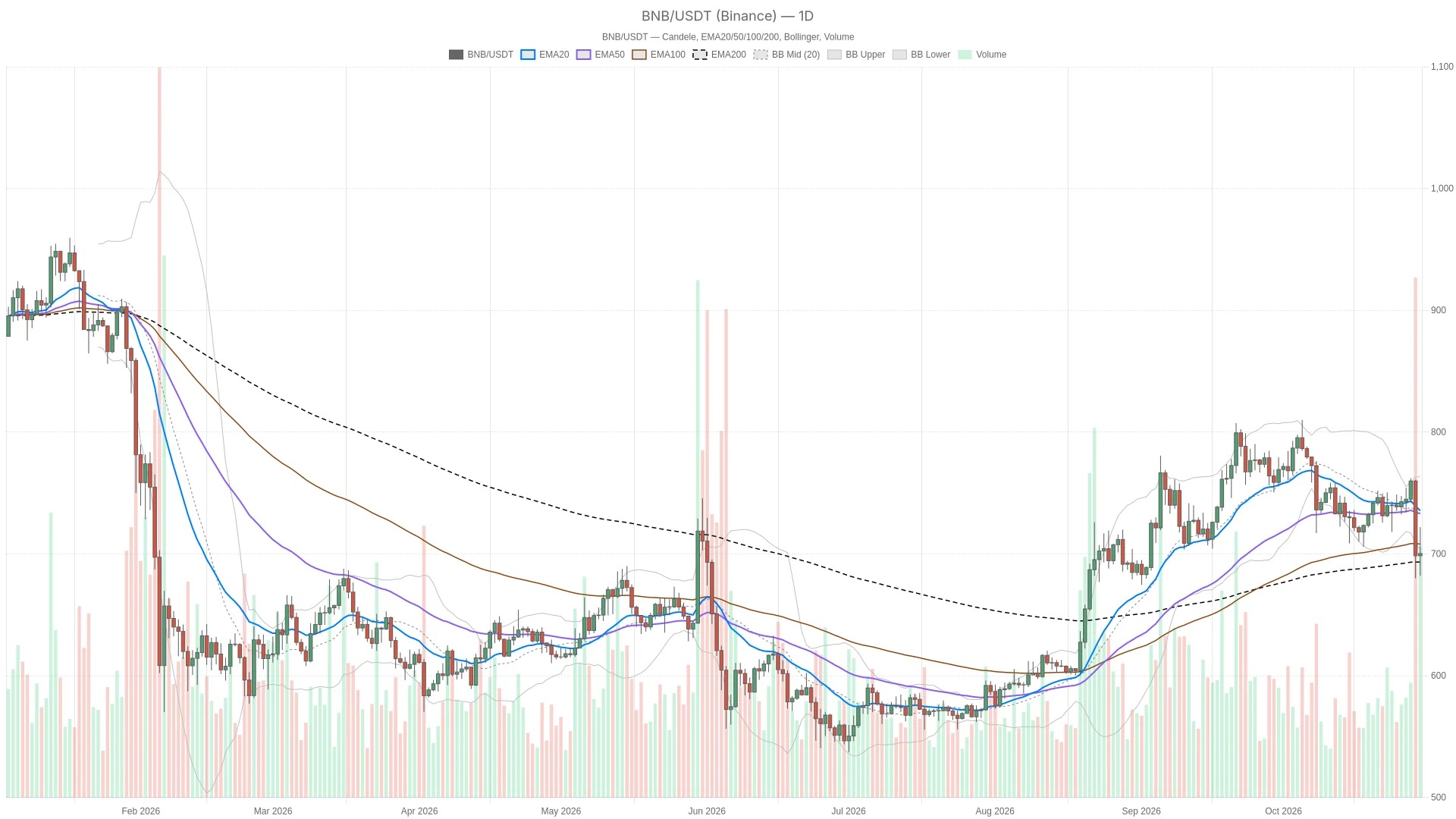
As of October 30, 2026, BNB traded at $700.30 on Binance. The daily chart still remains above EMA200, but below EMA20 and EMA50. The hourly chart indicates a bearish trend. The article suggests that although there are signs of a rebound at the 15-minute level, they are not sufficient to reverse the broader weak trend.
The Cryptonomist
·2026-10-31 07:53:11
18
View More