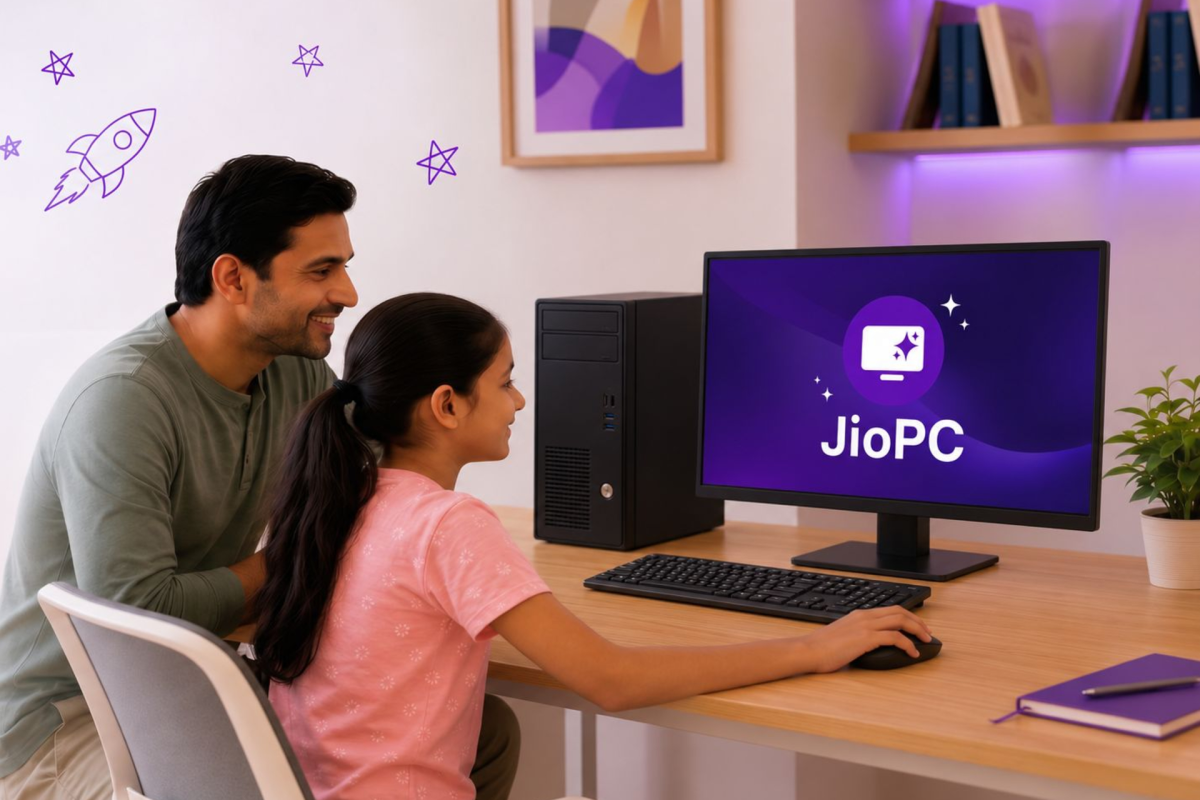


Reliance, owned by Mukesh Ambani, India's richest man, is pushing its cloud computing business to a broader market. Previously, it was only available to its own broadband users, but now it has been made available for separate subscription by all internet users in India, with the aim of turning old computers into terminals capable of running modern applications.
Cloud virtual computers now available for subscription
The JioPC model is not about selling new devices, but rather transferring a virtual computer from the Jio cloud to the user's existing computer. According to the plan published by Jio, the service can provide up to 8 virtual CPU, 16GB of memory, and 1TB of storage space. The company claims that even with an old computer that has been in use for 8 years, it is still possible to obtain the computing power required to run the new generation of AI applications.
Subscription prices are aimed at a low-threshold market.
The pricing offered by Jio is clearly aimed at price-sensitive users. The starting price for a two-month package is 1000 Indian rupees; for the 12-month package, the version with 8GB of memory and 500GB of storage costs 4000 Indian rupees, while the version with 16GB of memory and 1TB of storage costs 5000 Indian rupees.
This means that Jio is attempting to change “buying a computer” to “purchasing computing power on demand.” For families, students, and small businesses that are not willing to frequently replace their equipment, this model can reduce initial hardware costs and allow old devices to be used for a longer period of time.
The extended device replacement cycle presents opportunities.
TechCrunch cites IDC data stating that by 2025, the number of PC in India has exceeded 65 million units, of which about 34 million are consumer-grade devices and approximately 31 million are commercial devices. By the end of 2026, this number is expected to approach 69 million units.
Meanwhile, the replacement cycle in India PC is extending. IDC analysts indicate that consumers and small to medium-sized enterprises typically replace their computers every 5 to 6 years, which is longer than the 4 to 5 years in 2022; the replacement cycle for businesses has also lengthened from about 3 years to around 4 years. Jio believes that if computing power and storage are transferred to data centers, the lifespan of old computers can be further extended.
Network dependence remains the main limitation.
However, this type of service may not necessarily replace traditional PC. Market researchers believe that JioPC is more likely to form a parallel market, mainly targeting people with limited budgets who would not have purchased a new AI computer in the first place, rather than completely replacing local devices.
The obstacles are also clear. Firstly, JioPC relies on a stable network connection; a disconnection or network fluctuations can directly affect the user experience, which is particularly crucial in small and medium-sized cities and towns. Secondly, Indian users are accustomed to owning their own hardware rather than continuously paying subscription fees over the long term. Moreover, since refurbished computers are already competitive in the low-price market, users can still purchase devices at a lower cost.
In addition, Jio defines it as a “AI-ready” computer, which also proposes a different approach to the traditional definition of the current AI PC. The report mentions that Jio has not disclosed in detail the underlying hardware configuration that supports this cloud service, and the publicly available parameters do not mention any dedicated AI accelerators used for local generative AI tasks. For Jio, the real test will be whether users are willing to regard cloud computing power as a daily tool, rather than a temporary alternative.