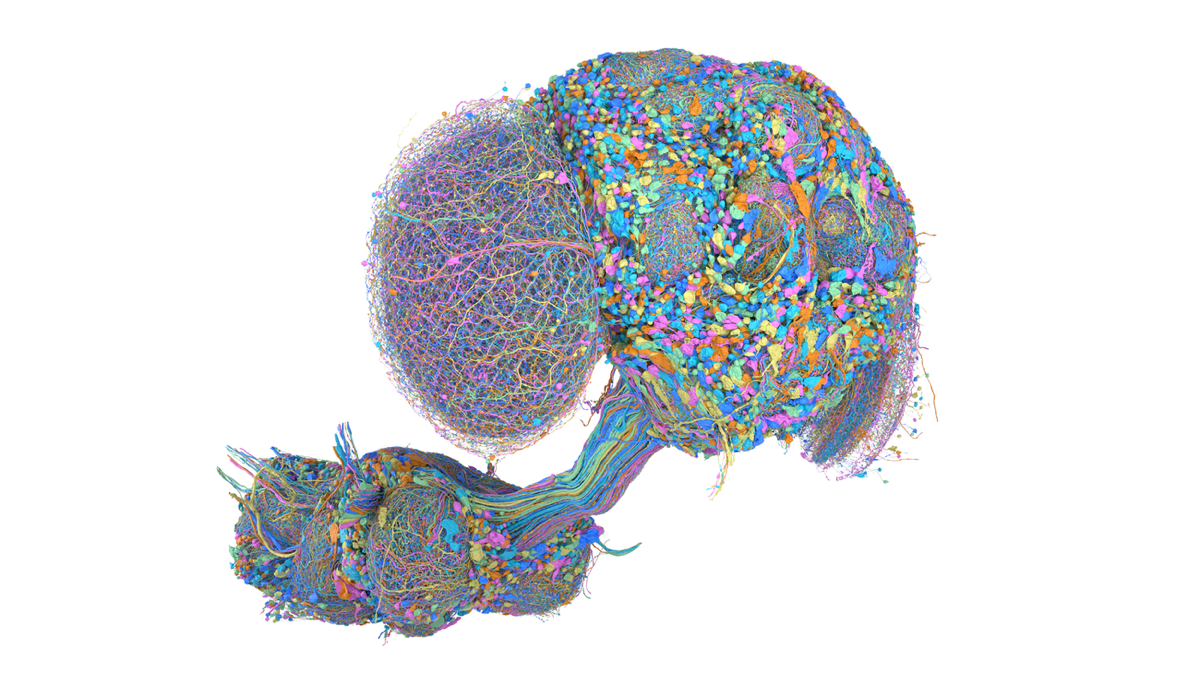





On September 3, the Google Research and HHMI Janelia research parks, along with several scientific research institutions, announced a multi-year achievement: the research team completed a comprehensive map of the connections between the brain and central nervous system of adult male fruit flies, covering over 166,000 neurons and identifying approximately 11,700 different types of neurons. This is not just an ordinary brain image; rather, it is a three-dimensional resource that details the connections between nerve cells, allowing researchers to trace the signal pathways behind visual, gustatory, motor, and social behaviors.
The reason this work is closely related to AI is that the raw materials come from a large number of extremely thin tissue sections and microscopic images. It would be almost impossible to handle such a scale by manually identifying, piecing together, and annotating each image one by one. Computer vision and machine learning are used to reconstruct millions of two-dimensional images into three-dimensional neural structures, which are then corrected, classified, and interpreted by human experts. AI is responsible for large-scale reconstruction and auxiliary annotation, rather than automatically drawing all biological conclusions for scientists.
From slices to queryable neural pathways
Connectomics is not concerned with what a particular brain region is roughly doing, but rather which neurons are connected to each other and along what pathways signals may be transmitted. Although fruit flies are very small in size, they possess complex behaviors such as vision, olfaction, movement, courtship, and learning, which has made them an important model in neuroscience for a long time. The research team has previously published a complete brain map of adult female fruit flies; this time, the male map has been added, allowing researchers for the first time to systematically compare the similarities and differences between the sexes on a whole-brain scale.
The visualization published by Google demonstrates the pathway from sensory organs to motor neurons. The compound eyes and mouthparts of fruit flies receive external stimuli, and the signals are transmitted to the neurons that control movements through intermediate neurons. This complete circuit diagram allows researchers to formulate hypotheses based on the data first, and then verify them through genetic or behavioral experiments, without having to start from scratch in searching for candidate cells. It's more like a map of urban roads: the map doesn't tell researchers why each car sets off, but it can indicate which intersections they might pass through.
Most neurons in male and female fruit flies are similar, but some cells are present only in one sex, while others are present in both sexes but connect to different neighbors. The research team suggests that these differences are related to sensory processing, taste perception, and courtship behavior. Three concurrent studies used mapping analyses to examine the visual system, taste perception, and social behavior, indicating that the database has moved from the stage of "completing the maps" to the stage of "using the maps for research."
The numerical scale also needs to be accurately understood. Exceeding 166,000 neurons and nearly 11,700 types of cells refers to this dataset of the central nervous system of fruit flies, but it does not mean that researchers have already explained the function of each connection. The existence of connections does not imply that the same intensity of signal will always be transmitted; the state of the animal, its experiences, and neuromodulators can still alter the operation of the network. A structural diagram is infrastructure, not the final answer.
AI What is amplified is the observational ability of scientists.
In the past, electron microscopes were capable of producing images with sufficient detail, but data processing became a bottleneck. AI has expanded tasks such as identifying repeated boundaries, tracking across slices, and preliminary classification to an unprecedented scale, allowing experts to focus their time on error correction and scientific interpretation. This is a typical example of human-computer collaboration: the model provides high-throughput preliminary results, while humans ensure the reliability of the connections through domain knowledge.
This method could be extended to more complex animals in the future, but the scale would increase dramatically. The 166,000 neurons in fruit flies already require extensive computing and manual verification, and the number of neurons in the mouse brain is several orders of magnitude higher. Larger samples would also present issues with storage, accumulation of algorithmic errors, and individual differences between subjects. Therefore, while the complete brain map of fruit flies is an important milestone, it cannot be directly equated with the imminent completion of a complete map of the human brain.
The value of open data lies in enabling laboratories around the world to share a common foundation. Researchers can overlay their own behavioral experiments, gene expression data, and neural activity data onto the same interconnected network, thereby reducing the need for duplicate plotting. For the AI research itself, these real biological networks also present new structural questions: how do simple neurons form stable behaviors, and how do networks make rapid decisions under limited resources?
The map also provides common coordinates that are repeatable. In the past, different laboratories might use different names and local slices to describe similar neurons, making it difficult to align the results; a complete dataset allows papers to refer to the same cell type and connection locations. If subsequent studies discover segmentation errors, they can be corrected in the public resource, rather than allowing these errors to remain hidden within a single paper for a long time. The value of such infrastructure is often not reflected in a single press release, but it can determine whether experiments in the coming years can be mutually verified.
In medical applications, it is necessary to maintain a certain distance. Fruit flies can help in discovering general patterns of neural circuits, but they are not miniatures of humans; the human brain is much more complex in terms of the number of cells, development, language, and social behavior. To directly apply findings from fruit flies to human disease therapies would cross the boundaries of evidence-based science. A more realistic approach is to first use fruit flies to quickly screen for mechanisms, and then to verify these findings progressively in more complex models and clinical studies.
The significance of this achievement does not lie in claiming that “AI has cracked the brain,” but rather in transforming images that could not be processed individually in the past into scientific resources that are searchable, comparable, and verifiable. The real breakthrough is the change in the research process: machines expand the scale of observation, while humans are responsible for defining problems and verifying explanations. As the accompanying papers and data are reused by more experiments, this full-brain map of male fruit flies will gradually demonstrate its long-term value to neuroscience.