





U.S. stock markets fell in the early trading on Tuesday. Investors returned to the market after the Labor Day holiday and were faced with higher U.S. Treasury yields, renewed concerns about inflation, and a series of key economic data that will be released this week. The Dow Jones Industrial Average saw the most significant decline, while the S&P 500 Index and the Nasdaq Composite managed to resist the drop relatively well.
The Dow Jones index led the decline.
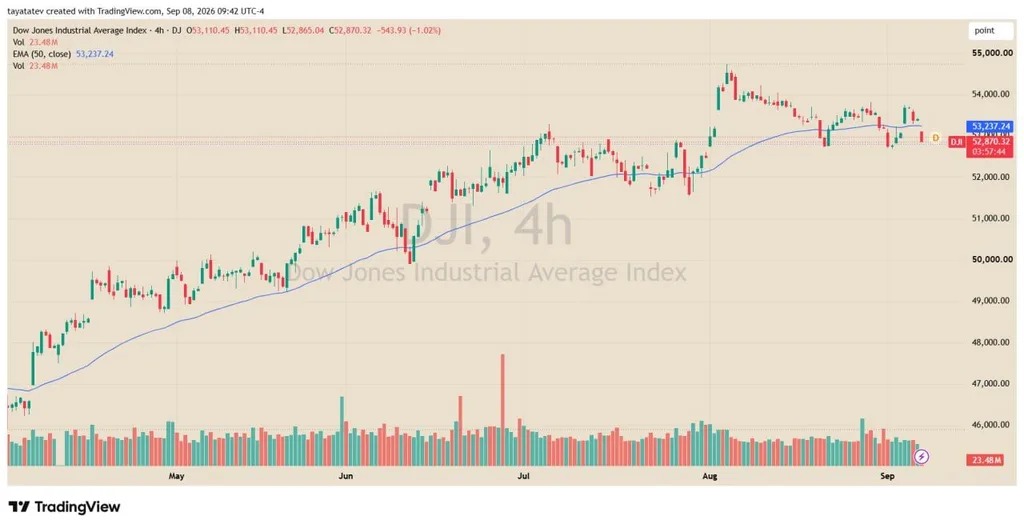
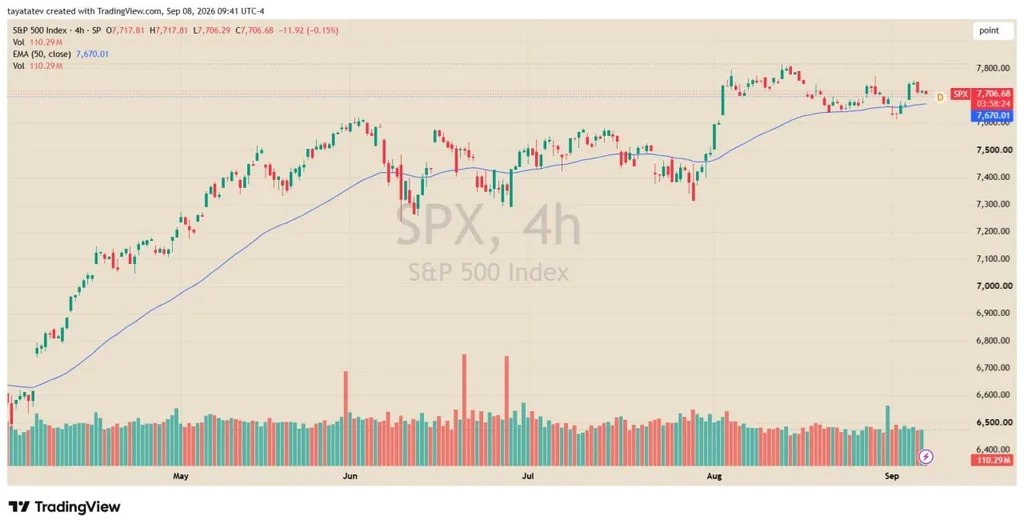
As of around 9:45 a.m. on Tuesday Eastern Time, the Dow Jones Industrial Average fell by about 540 points to around 52,870, a decrease of about 1%. The S&P 500 Index was at around 7,707 points, down by about 0.2%; the Nasdaq Composite Index was around 26,507 points, down by about 0.3%.
U.S. employment data released last Friday exceeded expectations, prompting the market to re-evaluate the policy path for the Federal Reserve's meeting this month. Reuters cited CME FedWatch data stating that as of early Tuesday, the market anticipated a 60.6% probability of a rate hike in September. According to data from The Associated Press, the yield on 10-year U.S. Treasury bonds rose to 4.78% in the morning session.
S&P and the Nasdaq still have support
Although the three major indices generally weakened, the S&P 500 index performed significantly better than the Dow Jones Industrial Average. The index remained above the upward trend support in the early session, indicating that funds had not completely withdrawn from risky assets.
It also maintains relative resilience. Although the index has fallen slightly, it is still above the level near the 50-day moving average, indicating that there has not been a broader sell-off among tech stocks as a whole. The short-term support area of concern to the market is concentrated around 26,000 points.
On the same day, HSBC raised its year-end target for the S&P 500 index from 7,650 points to 8,100 points, citing improved corporate earnings and the continued growth in AI infrastructure spending. The bank expects that the earnings per share of S&P 500 constituents will grow by more than 25% in the second half of 2026.
Chip stocks diverge against the trend
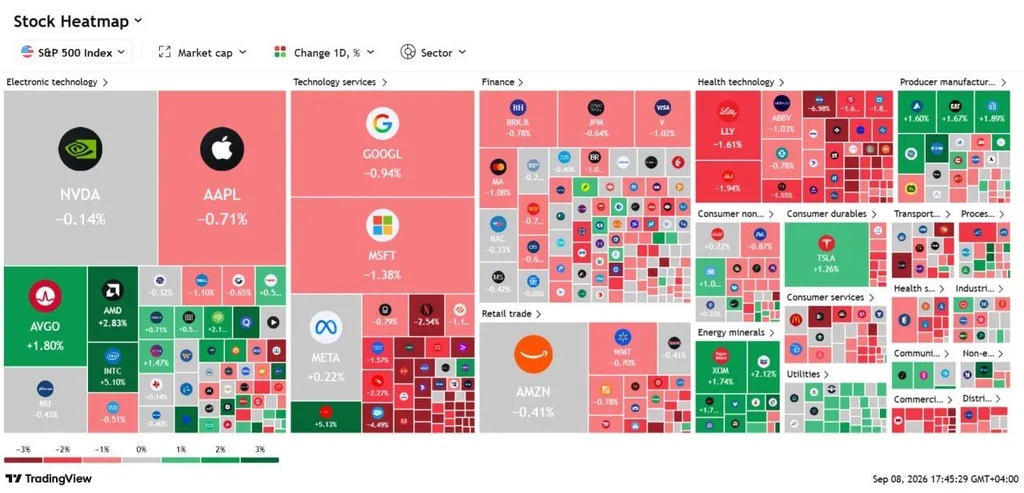
Judging from the performance of the sectors, the market is not uniformly weakening. Microsoft, Alphabet, and Apple all saw declines in the early session, while NVIDIA remained relatively stable, indicating that large tech stocks are under pressure.
However, the semiconductor sector provided some support. Intel rose by about 5.1%, AMD rose by 2.8%, and Broadcom rose by 1.8%. This indicates that as the market overall declined, funds were still selectively allocating to chip stocks related to AI. Tesla also managed to rise by about 1.3% against the trend.
This week's focus shifts to inflation data.
The market will next focus on two key inflation indicators. The U.S. PPI for August will be released on Thursday, and CPI will be released on Friday. These two data points will directly affect the market's assessment of the Federal Reserve's meeting next week.
For now, interest rate expectations remain the core factor suppressing the stock market. If inflation data continues to be strong, U.S. Treasury yields may remain high, and stock market volatility could further increase. On the contrary, if the data eases, the resilience currently shown by the S&P and the Nasdaq may continue.