





Ramp The latest tracking data shows that in August, the per-person AI expenditure of some leading companies in the United States has seen a significant decline. For AI companies that have made substantial investments in computing power and model training, this change has drawn market attention to the pace of commercialization.
This set of data comes from the enterprise expenditure management company Ramp. The report mentions that from August to October last year, the adoption of indicators by AI of Ramp also slowed down briefly, before picking up again at the end of the year. Therefore, this recent slowdown does not necessarily mean a reversal in the demand trend, but against the backdrop of continuous expansion in large model investments, any slowdown is more likely to be magnified.
Headline companies see a decline in expenditures
Economists Ara Kharazian indicate that among the top 1% of companies in the sample, the average AI expenditure in August dropped to $7,205, a decrease of nearly 10% compared to the previous month.
- The top 1% of companies have an average AI expenditure of $7,205 per person.
- August month-on-month decline: nearly 10%
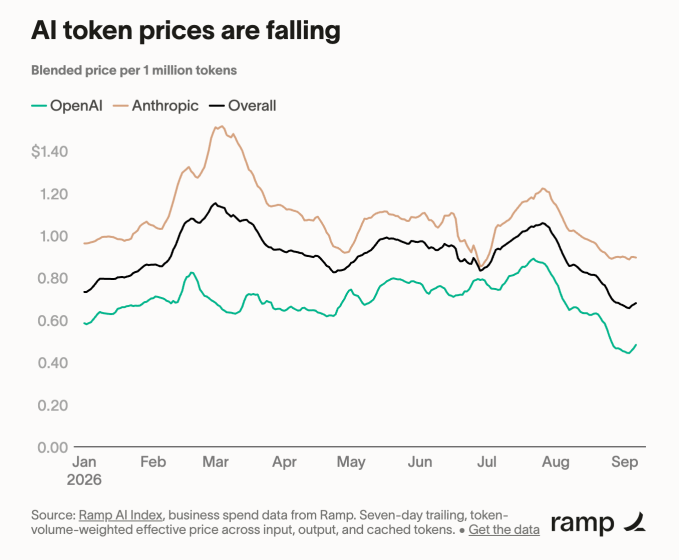
- Average token cost in March: $1.15 per million
The report suggests that summer vacations may be one of the reasons, but declining prices are also an important factor. As OpenAI and Anthropic continue to see price reductions, the average token cost has dropped to 0.68 US dollars per million, below the high of 1.15 US dollars in March.
Price cuts have not fully resulted in increased usage.
From this set of data, it appears that model manufacturers have not yet fully relied on increased call volumes to compensate for the revenue pressure caused by price reductions. Some enterprise customers are also shifting to cheaper older models, rather than continuing to use the latest and more powerful cutting-edge models.
This means that the practice of head laboratories relying on "quickly recouping some of the training costs within a few weeks after the release of new models" may face greater pressure in the future. If the adoption speed of new models slows down after they are launched, the pace of revenue realization will also slow accordingly.
The adoption rate among enterprises is still not high.
The samples of Ramp tend to be from technology companies, so they may be higher than the overall market level. A continuous survey updated by the U.S. Census Bureau as of August 23 shows that only 22% of companies indicated they are using AI.
Meanwhile, the impact of open-source or open-weight models that attract external attention on cutting-edge laboratories is not yet significant. In August, only 6.4% of AI spending enterprises used model hosting or inference platforms. Although this proportion is increasing, the growth rate is not sufficient to drive broader adoption by enterprises.
Kharazian believes that the competition between OpenAI and Anthropic is making AI more accessible to enterprises and also reducing the costs for enterprises to use it. For companies that purchase AI services, this means a decrease in expenses; however, for model manufacturers that rely on token for revenue growth and cloud computing giants, this may not necessarily be good news in the short term.
Non-technical users become the focus of competition
In this context, AI is focusing more of its efforts on non-technical users, hoping to expand the user base through products such as collaboration tools, rather than relying solely on the engineering community.
The report indicates that the data for August may also be just a temporary fluctuation caused by summer vacation factors. However, if corporate spending and call volumes do not recover simultaneously in the coming months, then discussions in the market about the returns on large-scale chip purchases and infrastructure investments are likely to heat up further.