




When the market is under pressure, funds usually turn to assets that are considered to retain their value better. An article in a foreign media commentary states that so-called "hedge assets" do not necessarily mean they will rise just because the stock market falls. More importantly, during periods of stress, their correlation with high-risk assets should weaken, or even reverse in movement.
Gold corresponds to inflation and systemic risks
The article states that gold has long been regarded as a typical safe-haven asset, and one important reason for this is that it does not depend on the fulfillment of obligations by corporations, banks, or governments; it is not a liability of any institution itself. This characteristic makes it more favored by investors during times of rising inflation, currency devaluation, geopolitical tensions, or financial system pressures.
However, gold is not always a viable defense. If the actual yield rises rapidly, the attractiveness of assets that provide interest will increase, and the price of gold may also fall. In other words, gold is more suitable for hedging against specific risks rather than covering all market shocks.
U.S. Treasuries and the U.S. dollar remain the main traditional safe-havens.
The article argues that the reason why U.S. Treasury bonds have long been regarded as core security assets is mainly due to their large market size and high liquidity. When expectations of an economic recession increase, if investors anticipate that the Federal Reserve will cut interest rates, the prices of already issued long-term Treasury bonds tend to benefit from the decline in yields.
Unlike gold, U.S. Treasury bonds also provide interest income. The dollar tends to benefit during times of increased global financial stress, as institutions need to hold dollars to repay debts, maintain cash reserves, or purchase assets denominated in dollars.
However, these two types of assets also have their weaknesses. Inflationary shocks could push down the prices of long-term U.S. Treasury bonds, and when the market bets on the Federal Reserve's aggressive interest rate cuts, the dollar might also weaken.
Bitcoin is more like a high-volatility alternative.
The article states that the arguments supporting the narrative of Bitcoin as "digital gold" mainly include a maximum supply of 21 million coins, operation that does not rely on central banks, and the ability to conduct global transfers outside of the traditional banking system.
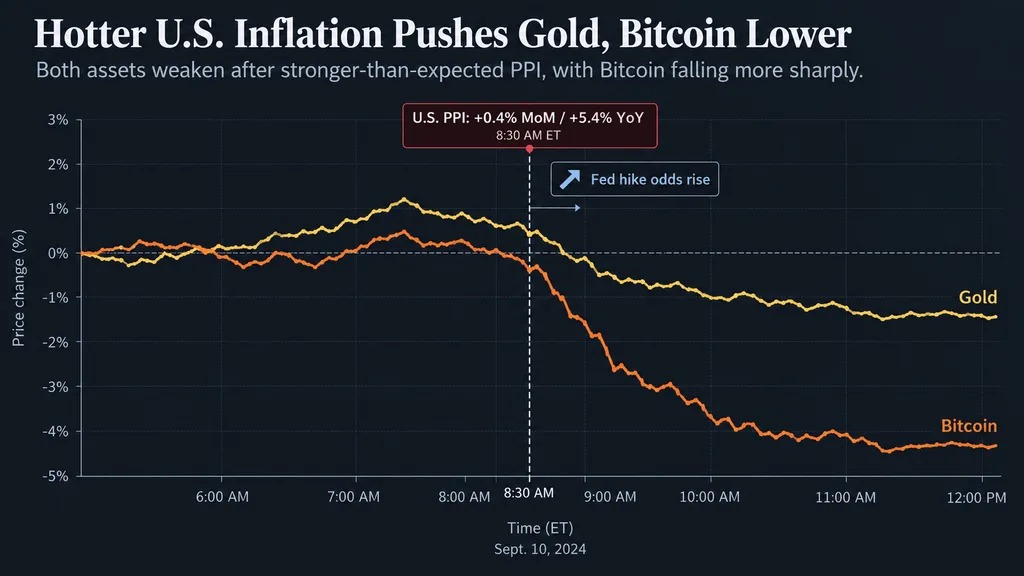
However, from the perspective of market performance, there are still clear differences between Bitcoin and gold. The article mentions that studies show that during market downturns, Bitcoin may be more akin to high-risk tech assets in the short term, and its correlation with growth stocks and software stocks weakens the argument that it serves as a stable hedge.
In addition, the volatility of Bitcoin is significantly higher than that of gold, U.S. Treasury bonds, and major currencies. Based on this, the article argues that Bitcoin is more suitable at this stage to be considered an alternative asset for long-term value storage, rather than a stable hedging tool during short-term crises.
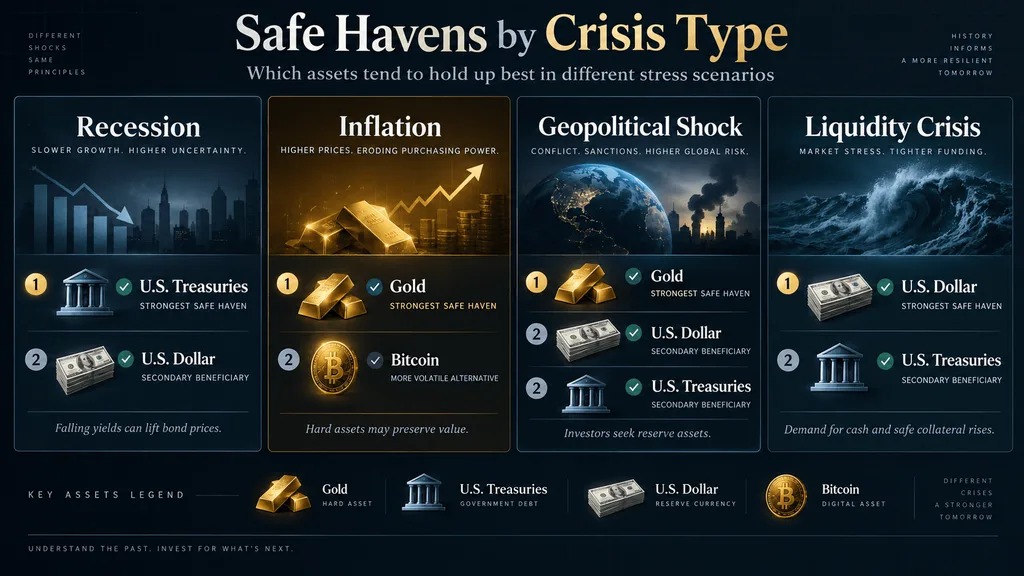
Overall, the conclusion of the article is that different assets are designed to address different types of risks: U.S. Treasury bonds are more suited for a recessionary scenario, gold is more appropriate for inflation and geopolitical shocks, the dollar benefits from liquidity tensions, while Bitcoin is still in a phase of continuous evolution.