






Circle plans to open the Arc blockchain mainnet to the public on September 16. This network has previously been running in a private environment, with over 100 institutions and ecosystem builders participating. It is positioned for stablecoin payments, tokenized assets, foreign exchange trading, and 24/7 financial markets.
The first batch of validators covers traditional financial institutions.
The list of initial validators for Arc is significantly different from that of most new public chains. The participants include BlackRock, the American Depository Clearing Corporation DTCC, Visa, MasterCard, Intercontinental Exchange, Standard Chartered Bank, Galaxy, Swift, and SBI Group; Circle is also among them.
This means that institutions that may use the Arc infrastructure in the future will also participate in verification and security maintenance during the initial stages of the network's launch. For Circle, this arrangement helps to establish institutional trust and use cases before the mainnet goes live.
Private financing corresponds to a valuation of approximately $3 billion.
Arc has completed two rounds of private token sales for ARC before going live on the mainnet. In May of this year, the first round of sales was completed at a price of $0.30 per token, raising $222 million, which corresponded to a fully diluted valuation of about $3 billion for the network. Subsequently, another $20.25 million was raised in the second delivery, bringing the total private sale amount to approximately $242.2 million.
Institutions participating in the investment include a16z, crypto, BlackRock, Apollo, ARK Invest, Intercontinental Exchange, and Standard Chartered Venture Capital, among others. For Circle, this is also a significant strategic investment beyond USDC.
Initially, an authorization verification mode is adopted.
In the initial stage of its launch, Arc will adopt Proof-of-Authority, which is an authorization verification mode, where verifiers need to obtain permission. Circle indicates that in the future, the network may transition to Proof-of-Stake or a delegated Proof-of-Stake model. If the switch is completed, ARC will take on responsibilities such as governance, network security, and operational coordination.
In terms of product design, Arc does not require users to hold Gas tokens, which are subject to large fluctuations. Instead, from the very beginning, it has supported the use of USDC to pay transaction fees. Circle also states that the network will support sub-second confirmation times, configurable privacy features, and EVM compatibility.
USDC Provides the foundation for current distribution
Arc did not start from scratch. Circle reveals that as of the end of the second quarter, the USDC circulation scale was 73.3 billion US dollars; during that quarter, the USDC transaction volume on the chain reached 14.8 trillion US dollars, a year-on-year increase of 151%; revenue and reserve earnings totaled 701 million US dollars.
This means that when Arc launches its mainnet, it will already have a mature and stable coin distribution system in place. Compared to most new chains, Circle already has an existing user base, liquidity, and corporate partnerships, which also serves as an important support for Arc in attempting to enter the stable coin financial infrastructure market.
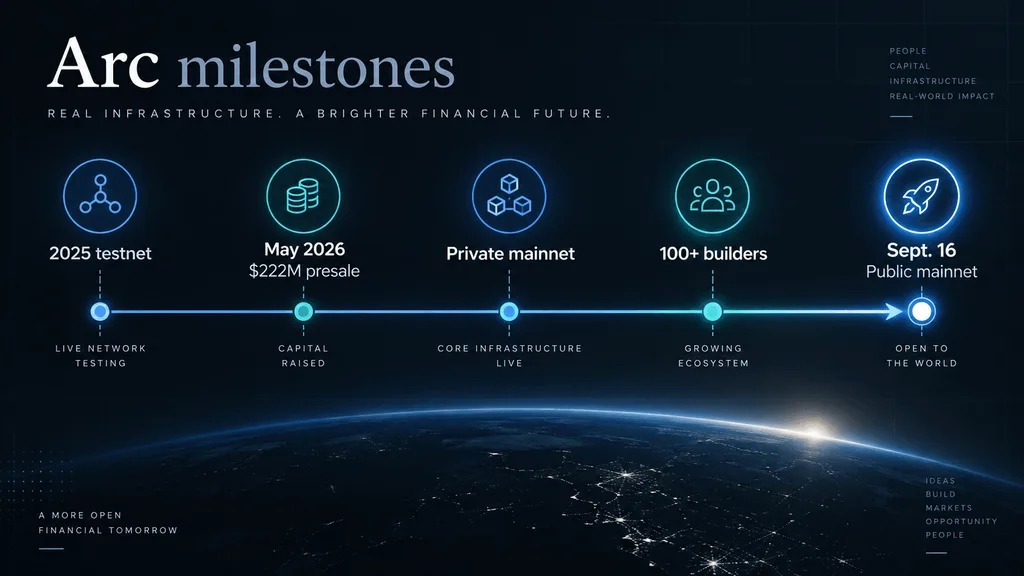
Additional information:Circle also plans to launch a tokenized real assets tool simultaneously when the mainnet goes live, as well as AI to assist in smart contract development capabilities, and a reusable on-chain application framework; institutions or projects such as BlackRock, DTCC, Aave, Morpho, Uniswap, and SBI are expected to participate in the launch event.