





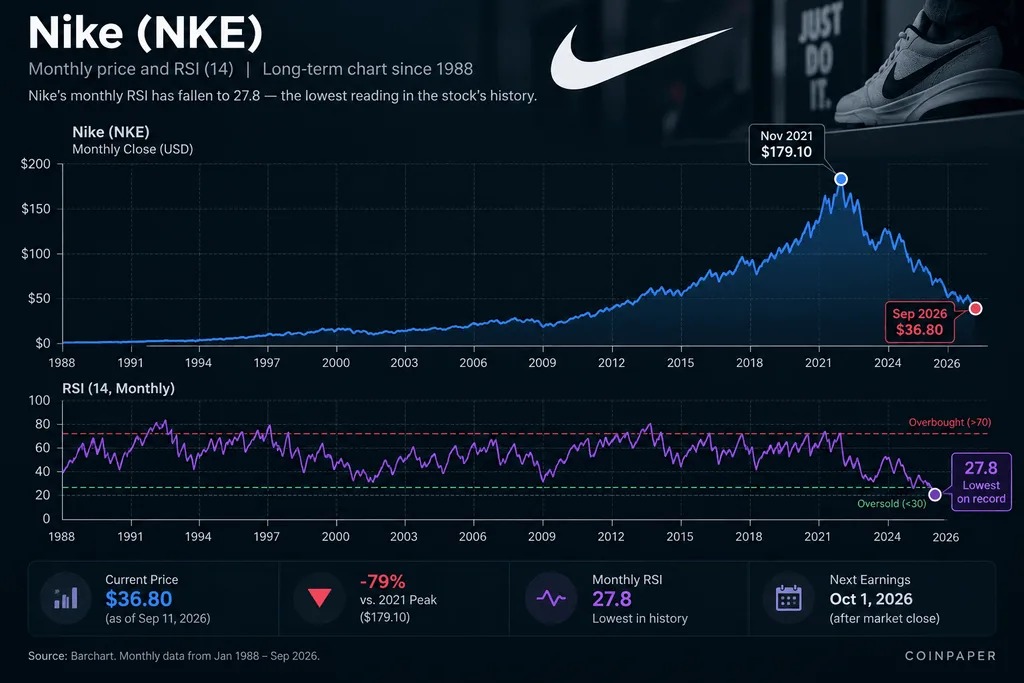
Nike's stock price continues to be under pressure. The stock closed at $36.80 last Friday, near its 52-week low. Market data platform Barchart indicates that Nike's monthly RSI is around 27.8, hitting the lowest level in this stock's long-term history.
RSI is commonly used to measure whether a stock price is overbought or oversold. Generally speaking, a level below 30 is considered an oversold area. However, such signals do not necessarily mean that the stock price will rebound immediately. For Nike, behind the weakening technical indicators, there are still issues such as slowing growth, intensifying competition, and slow progress in business adjustments.
To be removed from the S&P 100 on September 21
In addition to the decline in stock price, Nike will also lose its status as a component of the S&P 100 index. According to the arrangement, Palo Alto Networks will replace Nike and enter the index before the opening on September 21st.
This adjustment comes after Nike's stock price has been on a downward trend for several years. Since its peak in 2021, Nike's performance has been weakening, and concerns about its performance in key markets and the pace of recovery have not significantly eased. Its removal from the S&P 100 also reflects a continuing shift in the composition of major U.S. indices towards technology companies.
Wall Street remains cautious
Even though technical indicators show extreme overselling, Wall Street's outlook for Nike has not turned optimistic. Morgan Stanley recently downgraded Nike to a "reduce holdings" rating and set a target price of $31, indicating that there is still room for the stock price to fall from its current level.
- Growth in important markets such as China has been weak.
- The effectiveness of business adjustments has not yet been fully reflected.
- Direct sales and digital sales continue to face pressure
These factors also explain why, even though Nike has shown historically high oversold signals, market buying interest has not significantly rebounded. Current investors are more concerned with whether the fundamentals have improved, rather than whether a single technical indicator has reached a low level.
Technical signals cannot overcome fundamental pressures.
Judging from market performance, Nike's current over-sold state is not just a short-term fluctuation; it also reflects investors' re-pricing of the company's growth prospects. In the past few years, after the momentum in Nike's core business weakened, the company has encountered multiple times of market downgrades in expectations.
Under the combined pressure of index adjustments and fundamental factors, Nike still faces significant challenges in the short term. For the market, the key focus will be on whether the company can show clearer signs of recovery, especially in terms of major market demand and sales channel performance.