





U.S. Senator Cynthia Lummis announced the final draft of the CLARITY legislation on September 14. This 635-page document will undergo a key procedural vote in the Senate on September 15, with the final draft incorporating 126 major amendments proposed by the Democratic Party.
Final draft incorporates stricter ethical guidelines
A core change in the new version is the expansion of restrictions on encrypted holdings by public officials at the federal level. According to the bill, federal legislators, judges, and their spouses are required to sell large amounts of their encrypted asset holdings or place such assets into blind trusts.
The report mentions that Trump has agreed to accept stricter ethical restrictions. The final version also assigns a certain enforcement role to the attorneys general of each state to ensure that these rules are effectively implemented.
Stablecoins to include new provisions for intervention by the Ministry of Finance
The bill also includes a so-called "circuit breaker" mechanism. If a large amount of bank deposits flow into stablecoins, the U.S. Treasury Secretary may intervene to address the situation. The design is intended to reduce the pressure on community banks due to deposit losses and to protect small businesses and agricultural operators that rely on such banks for financing.
This adjustment shows that while the Senate is pushing for digital asset legislation, it is also simultaneously addressing the potential risks of capital transfers that stablecoins may pose to the traditional banking system.
Developer protection and market regulation go hand in hand.
The final draft also amended the relevant content of the 'Blockchain Regulation Certainty Act', under certain circumstances, blockchain developers are not required to register for fund transfer services and can obtain certain civil safety harbor protections.
However, the bill also makes it clear that such protections for developers will not weaken the authority of the Commodity Futures Trading Commission (CFTC) over the derivatives market, nor will they change the existing rules of the forecasting market.
The relevant provisions of the Agricultural Commission also increase restrictions on related-party transactions and conflicts of interest for digital commodity exchanges, brokers, and traders. The bill also clarifies that state consumer protection laws remain applicable.
Procedural voting is approaching, with an expected rebound in approval rates.
CLARITY The bill will face a crucial procedural vote on Tuesday. To proceed, it needs to gain 60 votes in support. This means that in addition to the Republican seats, it is also necessary to secure the support of some Democratic members of Congress.
Lumis stated that if the bill is not passed, the protection of the U.S. digital asset market will continue to be lacking, and it may also weaken the U.S.'s dominant position in this field.
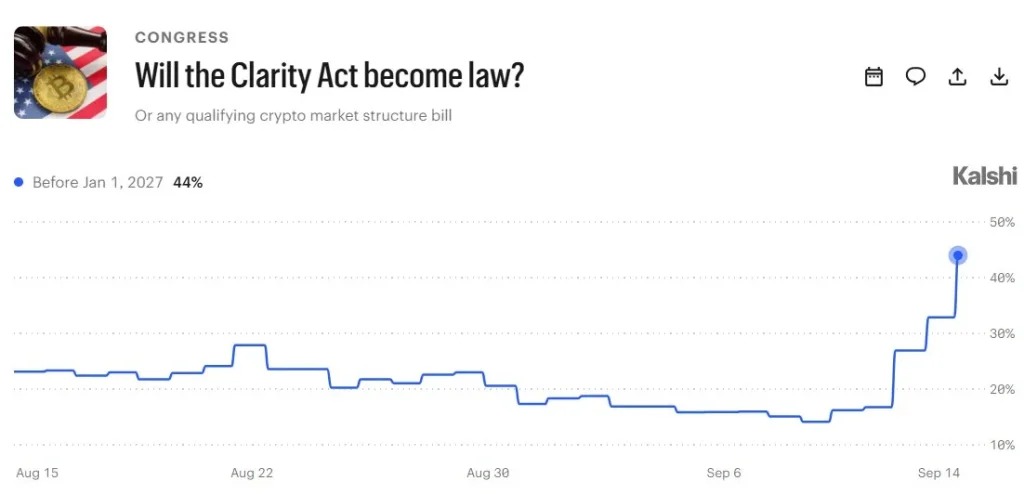
In terms of market expectations, the prediction platform Kalshi traders currently give a 44% probability of the bill passing, which is higher than the previous 18%. This change occurred after the final draft was released, indicating that the market believes there has been progress in gaining cross-party support for the new version of the text.