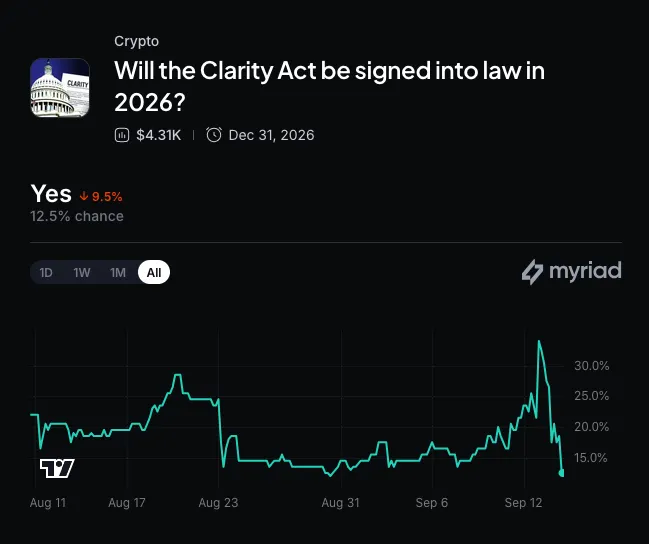





The U.S. Senate is set to conduct its first key procedural vote on the Cryptocurrency Market Structure Act, known as the “Clarity Act,” on Tuesday local time. For the bill to proceed to formal debate, it requires at least 60 votes in support. Just hours before the vote, disagreements between the two parties over the latest version of the text have widened, with the focus now shifting not only to the content of the provisions but also to whether to continue making concessions.
The Republican Party claims to have made 126 revisions.
Senate Republicans released a new version of the text on Sunday night, stating that significant adjustments have been made to the sections on ethical constraints, protection for software developers, and the Agriculture Committee, and a new “circuit breaker mechanism” for stablecoins has been added. This arrangement is aimed at addressing concerns that stablecoin yield products may draw away community bank deposits.
The Republican side stated that the new draft has incorporated 126 substantial amendments proposed by the Democratic Party. According to them, this is already the 'final version', and there is very limited room for further negotiation.
Democrats continue to tighten requirements
However, the Democratic Party has not accepted the current version. Their latest counterproposal calls for further strengthening of ethical restrictions, including more stringent constraints on large-scale crypto holdings, holdings by dependents, and paid crypto promotions.
In the relevant sections of the 'Blockchain Regulation Certainty Act', Democrats hope to continue to narrow the scope of application and clarify that this provision will not change the application of criminal law. Regarding the chapter on the Agriculture Committee, Democrats also request stricter exchange regulations, restrictions on conflicts of interest, and the addition of protections for tribal gambling laws.
The Republican Party, on the other hand, criticizes the Democratic Party for "constantly raising the bar" during negotiations. The Republican side of the Senate Banking Committee stated that since significant modifications have already been made as required, the Democratic Party should not raise similar demands again as the voting date approaches. Patrick Witt, the person in charge of encryption affairs at the White House, also indicated that if there are any further adjustments, they will likely be technical modifications or revisions at the level of punctuation.
The banking industry opposes the continued suppression of votes
In addition to the disagreements between the two parties, banking lobby groups are still exerting pressure. On Monday, eight banking organizations, including the Bankers Association of America, stated that the Republican Party's newly added "circuit breaker mechanism" for stablecoins is not sufficient to provide effective protection, as such interventions only activate after deposits have already significantly declined.
According to the current design, if there is evidence that community bank deposits are flowing on a large scale into stablecoins, the Minister of Finance may intervene. Banking organizations, on the other hand, are calling for further tightening of the reward terms for stablecoins to prevent stablecoin balances from providing returns similar to interest in a disguised form.
On the same day, the White House Council of Economic Advisers launched an interactive tool for the outside world to test the claim that "the growth of stablecoins is leading to a loss of community bank deposits." Previous analyses by this institution suggested that there was no significant relationship between the two.
The 60-vote threshold remains uncertain
Currently, whether the bill can surpass the 60-vote threshold still depends on the decisions of a few swing voters among the senators. Some Republican senators remain reserved regarding the objections raised by the banking industry. Senator from Utah, John Curtis, stated that he would support the bill to proceed to debate, but he would still vote against it in the final vote. John Cornyn and Susan Collins also indicated that they are still considering their voting positions.
One point in favor of the Republicans is that Senator Mitch McConnell, who has been absent for a long time, returned to the Senate on Monday night and stated that she would try her best to attend key votes. This means that the Republicans have gained a certain numerical boost.
From the current public statements, it seems that the deciding factor in this vote may not be the technical details of the bill, but rather the political choices made by the two parties regarding regulation, bank interests, and ethical issues related to Trump.