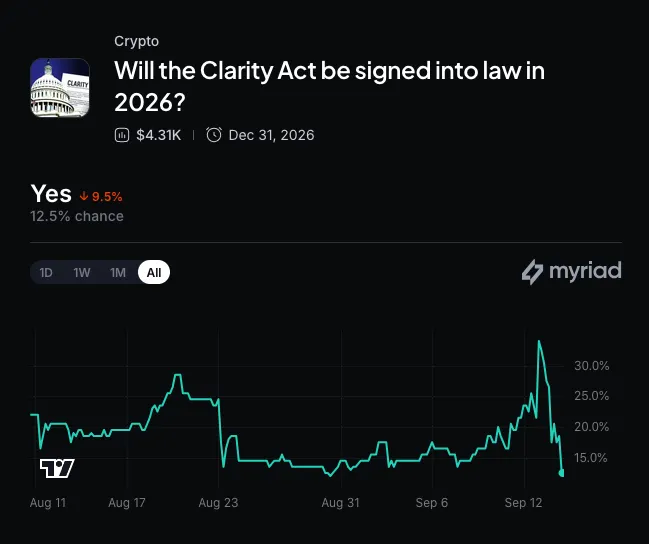





The U.S. Senate failed to pass a key procedural vote on Tuesday to advance the Clarity Act legislation, resulting in a significant setback for this crypto market bill at the Senate stage. This vote was regarding the procedural step of 'whether to proceed to consideration' and not the final vote, but the outcome has essentially halted the further advancement of the bill.
The threshold of 60 votes was not met.
The senator vetoed the application to terminate the debate on the "initiation of bill deliberation motion." According to Senate rules, 60 votes are required at this step in order to limit the debate and proceed with the formal consideration of the bill.
This means that the Senate is currently unable to proceed with the subsequent legislative process for Clarity Act. Senator Cynthia Lummis from Wyoming, who supports the bill, stated on the same day that this outcome almost certainly means that there is no longer any room for the bill to move forward.
The bill originally focused on the division of regulatory responsibilities.
Clarity Act was originally intended to establish a federal regulatory framework for the US cryptocurrency market and to clarify the respective regulatory responsibilities of the US Securities and Exchange Commission (SEC) and the Commodity Futures Trading Commission (CFTC).
According to reports, one of the goals of this bill is to provide a clearer compliance path for most crypto activities within the United States, thereby ending the long-standing disputes over regulatory jurisdiction.
Negotiations are stuck on issues such as stablecoins.
Prior to this vote, relevant negotiations had been ongoing for several months. The disputes mainly focused on three aspects: the stablecoin incentive mechanism, anti-illegal financial protection measures, and ethical restrictions related to President Trump's interests in cryptocurrencies.
The bill had previously been postponed to be dealt with after the Senate's August recess. The latest procedural vote failure means that these differences have ultimately not been resolved, and it also represents another setback for Congress's efforts to advance legislation on the crypto market this round.