

What are the legit Bitcoin trading apps? In 2026, the EU's MiCA transition period officially ended on July 1, and California's Digital Financial Assets Law took effect simultaneously, bringing the strictest compliance shake-up global crypto trading platforms have ever seen. Facing mainstream platforms like Binance, Coinbase, Kraken, and OKX, how should you choose a legitimate Bitcoin trading app? In our view, the answer is not in trading volume rankings, but in the cross-verification of three hard metrics: licensing credentials, fee structure, and security records.
Table: Key Points of 4 Major Compliant Bitcoin Trading Apps
| Name | Strengths | Ideal For |
|---|---|---|
| Binance | World's largest spot and derivatives trading volume; Monthly Proof of Reserves publication | Traders seeking liquidity and product breadth |
| Coinbase | US-licensed, clear regulatory framework | Users who prioritize compliance clarity, especially US users |
| Kraken | No customer fund security incidents since inception | Those who prioritize security record and long-term credibility |
| OKX | Lowest fees across four metrics; Monthly Proof of Reserves publication | Cost-sensitive, high-frequency or quant users; DeFi users |
Note: The above content is compiled by CoinMeta from publicly available market information.
Binance: The Liquidity King
Strengths & Features
Binance is the platform with the largest global spot and derivatives trading volume. It offers over 300 perpetual contract markets, BTC leverage up to 125x, and supports portfolio margin mode, making it suitable for high-frequency traders with cross-product hedging needs.
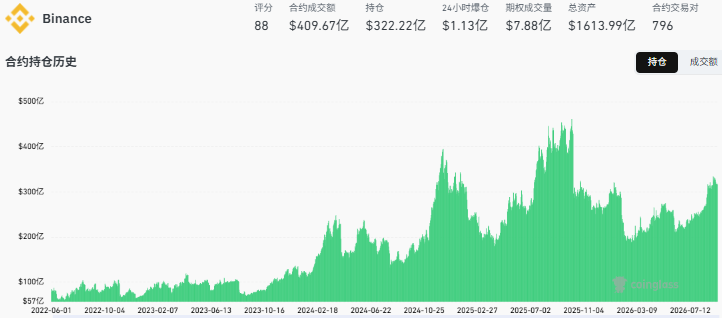
Binance trading volume
Fees
For regular users, spot maker and taker fees are both 0.10%, which can be reduced to 0.075% when paying with BNB. For USDT-margined contracts, maker fees are 0.02% and taker fees 0.05%, or 0.018%/0.045% after BNB deduction. A simple calculation: a $1,000 spot market order costs about $1 per side. That's mid-range in the industry, not the cheapest, but liquidity usually helps reduce slippage.
Security & Compliance
Binance currently holds regulatory authorizations in Asia-Pacific markets including Australia, India, Indonesia, Japan, New Zealand, and Thailand. It plans to increase its global licensed jurisdictions to over 20 within 2026. Proof of Reserves is published monthly, and the SAFU (Secure Asset Fund for Users) serves as an emergency reserve. In our view, Binance's compliance transparency is improving, but product availability in the US varies by state. Before entering, you must confirm whether your region can access the platform normally.
Coinbase: Highest Compliance Clarity
Strengths & Features
Coinbase is the platform with the clearest regulatory framework among US-licensed exchanges. Approximately 98% of customer funds are held in cold storage, sensitive data is encrypted, 2FA is mandatory, and address whitelisting is supported. The platform custodies about 12% of global crypto assets, ranking among the top in compliance clarity among similar platforms.
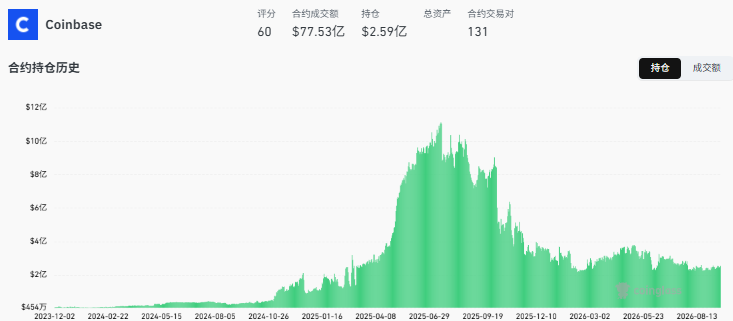
Coinbase trading volume
Fees
Coinbase Advanced Trade entry-level fees are 0.40% maker and 0.60% taker, which can drop to 0.00% maker and 0.05% taker at the highest volume tier.
In our view, relatively high fees are an obvious weakness for Coinbase. But this threshold reduction is a real benefit for mid-volume users. If your monthly trading volume is around $10,000, your costs will be noticeably lower than before.
Security & Compliance
As a NASDAQ-listed company, Coinbase is subject to continuous disclosure obligations by the US SEC, and the verifiability of its compliance transparency is second to none among centralized exchanges. You can think of it this way: its cold storage ratio and custody asset scale can all be cross-verified through public filings. In our view, this verifiability is relatively rare among centralized exchanges and is its greatest trust chip.
Kraken: The Veteran Platform with the Longest Security Record
Strengths & Features
It has been operating since 2011, and its custody wallets have never experienced a security incident resulting in customer fund losses, a record that is truly hard to find a second example of among mainstream exchanges. The platform offers over 300 perpetual contract markets. In our view, its product line covers both crypto derivatives and traditional financial futures, suitable for users who want to trade coins and also access compliant derivatives.
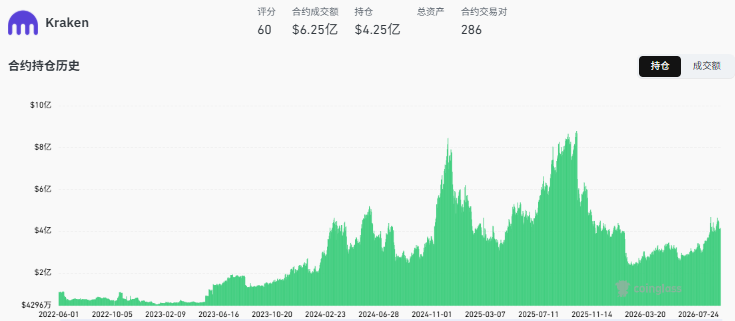
Kraken trading volume
Fees
Kraken Pro uses a tiered maker and taker model. Entry-level fees are 0.25% maker and 0.40% taker, dropping to -0.02% maker (i.e., rebate) and 0.08% taker at the highest volume tier. The Instant Buy convenience channel charges a 1% fixed fee plus spread, which is significantly more expensive than the Pro channel. Our advice: if you are used to placing limit orders, just use Kraken Pro directly and avoid Instant Buy. You'll save considerably over time.
Security & Compliance
Kraken is regulated in the EU through its Payward Europe entity under MiCA and MiFID II, and also holds compliance licenses in the UK, Australia, and Canada. Proof of Reserves is audited quarterly by CPA firm The Network Firm. In our view, Kraken's security narrative is not built on slogans, but on a long-term record of never having had an incident and independently verifiable audit processes. In an industry with extremely high trust costs, this is indeed a relatively scarce value.
OKX: Lowest Fees, Most Complete MiCA Licenses
Strengths & Features
OKX has long been known for low fees and frequent reserve disclosures. It also provides an independent Web3 self-custody wallet, with exchange accounts and on-chain wallets kept separate. In our view, this design is suitable for users who need centralized platform liquidity and also want easy access to DeFi. You don't have to put all assets on the exchange to participate in on-chain operations.
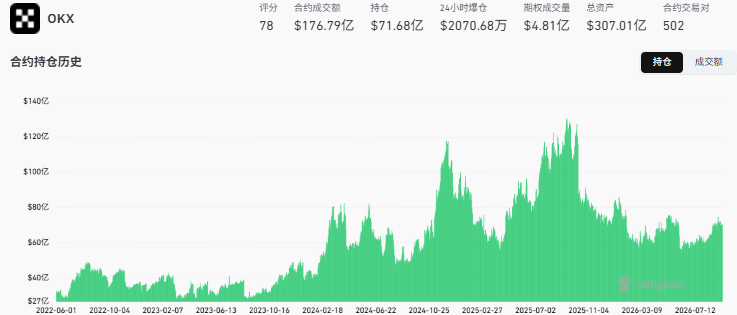
OKX trading volume
Fees
OKX standard Lv1 tier spot fees are 0.08% maker and 0.10% taker; contract fees are 0.02% maker and 0.05% taker. All four rates are the lowest among the four platforms. Holding OKB or increasing 30-day trading volume can further reduce fees, and VIP 7/8 contract maker fees can go as low as -0.002% (negative).
Security & Compliance
OKX Europe Limited has obtained a full MiCA CASP license issued by Malta, covering all 30 EEA member states. The OKX European entity simultaneously holds a MiCA CASP license, MiFID II authorization, and a payment institution license, making it the first global platform to hold all three qualifications at once. Proof of Reserves is published monthly, and compliance costs account for about 25% of revenue. In our view, OKX's compliance investment is the most aggressive among the four platforms. The combination of three European authorizations provides structural assurance for its long-term operations in the EU market.
Table: Fee Summary of 4 Major Compliant Bitcoin Trading Apps
| Platform | Spot Maker / Taker | Futures Maker / Taker |
|---|---|---|
| Binance | 0.10% / 0.10% | 0.02% / 0.05% |
| Coinbase | Entry-level 0.40% / 0.60%; up to 0.00% / 0.05% | Not mentioned |
| Kraken | Pro entry-level 0.25% / 0.40%; up to -0.02% / 0.08% | Included in Pro tiered fee schedule |
| OKX | Standard Lv1: 0.08% / 0.10% | Standard Lv1: 0.02% / 0.05% |
Note: The above content is compiled by CoinMeta from publicly available market information.
FAQ
Q1: Can a platform's Proof of Reserves fully guarantee asset safety?
It cannot fully guarantee it. Proof of Reserves reflects a snapshot of assets at a certain point in time, not a complete financial audit. Although mainstream platforms' PoR coverage exceeded 100% in 2026, users should also pay attention to cold storage ratios, withdrawal records, and whether the platform regularly updates audit reports. A combination of all three is more reliable.
 Q2: Is the spot fee gap between Binance and OKX large?
The gap is not large, but it accumulates significantly over time. Binance's base spot fee is 0.10%, or 0.075% with BNB deduction. OKX's base fees are 0.08% maker / 0.10% taker, lower than Binance at the standard tier. For high-frequency traders with annual trading volume of $100,000, the fee difference can exceed $100. We recommend choosing based on your own trading frequency.
Conclusion
Choosing a legit Bitcoin trading app in 2026 is essentially about finding a balance point that matches your own needs among fee costs, security records, and regulatory qualifications. Binance excels in liquidity, Coinbase leads in compliance clarity, Kraken maintains a 14-year zero-security-incident record, and OKX attracts cost-sensitive users with the industry's lowest fees and the most complete combination of European licenses. Whichever platform you choose, we recommend enabling 2FA, setting withdrawal whitelists, and regularly checking reserve reports. These remain irreplaceable security defenses for users.
Disclaimer: Readers are advised to strictly comply with the laws and regulations of their location. This content is based on publicly available market information and is for informational and educational purposes only. It does not constitute investment advice. For the latest updates, follow CoinMeta.