

Rising oil prices and increasing expectations of Federal Reserve interest rate hikes have pushed U.S. Treasury yields to multi-year highs, while global stock markets have fallen to one-week lows.
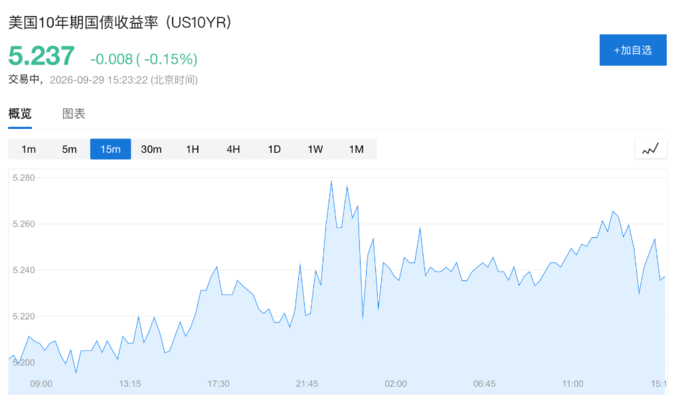
On Tuesday, the MSCI global index fell by 0.2%, hitting a new low since September 18. Nasdaq futures turned higher after previously falling by 0.5%; European stocks showed mixed movements, while Japanese and Korean stock indexes closed lower. The yield on 10-year U.S. Treasury bonds rose by another 1 basis point to 5.25% after reaching a high since 2007 on Monday; the yield on 30-year bonds also increased by 1 basis point to 5.56%.
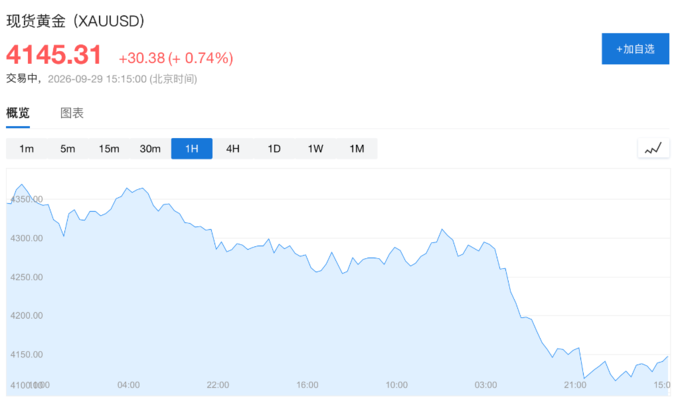
Geopolitically, according to CCTV International News, Iran's foreign minister will return to Tehran to await a response from the United States. Brent crude oil has risen for the second consecutive day, with a gain of 1.2% to $99 per barrel; spot gold has increased by 0.7% to $4,145 per ounce. Rising oil prices, stronger U.S. business activity, and concerns about high government debt have jointly triggered the largest sell-off of U.S. bonds since April 2025. The surge in yields has pushed up borrowing costs, putting pressure on economic growth and corporate profit prospects.
Chris Larkin from E* Trade under Morgan Stanley stated that due to rising yields and oil prices, the market as a whole lacks momentum. Given that the Federal Reserve is currently focused on inflation, unless there are significant surprises in this week's labor market data, market performance is likely to continue to be weaker than that of interest rates and the energy markets.
The core market trends are as follows:
- Nahui futures turned higher, after previously falling by 0.5%. US stocks in the storage concept sector saw a slight increase before the market opened; Micron Technology rose by 1.6%, while SK Hynix and Sandisk both rose by 1.4%.
- The European Stoxx 50 index opened up 0.27%, Germany's DAX index fell 0.13%, the UK FTSE 100 index rose 0.19%, and France's CAC 40 index increased by 0.06%.
- The Nikkei 225 index closed down 0.6% at 65,481.27 points. The Tokyo Stock Exchange index in Japan closed down 1.7% at 4,041.13 points. The South Korean KOSPI index closed down 0.27% at 6,870.81 points.
- The yield on 10-year U.S. Treasury bonds rose by 1 basis point to 5.25%.
- The Bloomberg US Dollar Spot Index rose by 0.1%.
- Spot gold rose 0.7% to $4,145 per ounce.
- Brent crude oil rose 1.2% to $99.
Nahui futures turn higher, and U.S. Treasury yields fluctuate at high levels.
Nahui futures turned higher, after previously falling by 0.5%. Senior market analyst Kyle Rodda pointed out that strong corporate earnings will continue to support the stock market, helping it withstand the pressure from rising bond yields and AI valuation risks.
This week, traders will closely monitor a series of U.S. economic data to determine whether the economy is still strong enough to support the Federal Reserve's further policy tightening. The Consumer Confidence Index and the August JOLTS job vacancy data will be released on Tuesday, followed by consumer spending and inflation data. On Friday, the Non-Farm Payroll report will be published.
The yield on 10-year U.S. Treasury bonds rose to its highest level since 2007 on Monday, and today it further increased by 1 basis point to 5.25%. After a recent sell-off in the bond market, some investors have begun to be bullish on the bond market.
Long-term bond investors Chris Iggo indicate that after a four-year difficult period, the bond market is about to rebound. A senior Wall Street figure Jim Bianco is bullish on U.S. bonds for the first time in six years, stating, "This is value investing. If yields continue to rise, I will continue to buy."
Gold rebounds, crude oil prices rise; Iran confirms it has conveyed its "7-day plan" to the US and is awaiting a response.
Gold prices rose by 0.7% to $4,145 per ounce. Previously, during the Asian trading session, gold prices fell below the key support level of $4,230, triggering technical selling pressure, and further dropped below the 50-day and 100-day moving averages, retreating to near the August lows.
This round of decline is driven by multiple factors: the rise in U.S. real interest rates to 18-year highs, Chinese investors closing their positions ahead of the National Day holiday, and the geopolitical uncertainty triggered by Trump's rejection of Iran's ceasefire proposal. Goldman Sachs' precious metals expert Adam Gillard pointed out that these factors combined to create a "one-way downward pressure" on gold. The market's focus will continue to be on ETF capital flows, which is the key variable in resisting interest rate pressures at present.
Brent crude oil rose 1.2% to $99. Geopolitically, according to CCTV International News, citing reports from Iran's Mehr News Agency today (September 29), Iranian Foreign Minister Ali Khamenei stated in a media interview one of the main objectives of his visit to New York to attend the 81st United Nations General Assembly: to convey Iran's position on the issue of war, particularly regarding the Strait of Hormuz.
Alaghi also confirmed that he met again with Qatar, which acted as a mediator on that day, and conveyed the '7th Day Plan' to the United States through Qatar. He is now waiting for an official response from the US side via the mediator. When asked whether he would stay in New York to await the US response, Alaghi stated that he would set off for Tehran. Once Qatar receives a response, they know how to convey it to the Iranian side.