Recently, several institutions have disclosed the shipment volumes of humanoid robots globally in the first half of this year.
According to the latest report released by IDC, in the first half of 2026, the global shipment volume of humanoid robots approached 25,000 units, a year-on-year increase of 432.1%. The Chinese humanoid robot market continued to grow rapidly, with shipments exceeding 19,000 units, accounting for approximately 77.9% of the global market.
Another institution, Smart Analytics Global ( SAG ), reported that in the first half of this year, the global shipments of humanoid robots increased by 272% year-on-year, reaching approximately 19,100 units; Chinese manufacturers contributed more than 97% of the global shipments of humanoid robots.
Although there are differences in the statistical data of the two institutions, China is undoubtedly still at the center of the humanoid robot boom. In addition, there have also been changes in the market rankings of robot manufacturers.
Reports from both IDC and SAG indicate that in the first half of this year, Zhiyuan's humanoid robot shipments surpassed those of Yushu Technology, placing it in first place. IDC statistics also show that Zhiyuan's humanoid robots had a higher revenue scale than Yushu Technology during the same period. Meanwhile, the SAG report indicates that last year at this time, Yushu Technology had higher shipment volumes and market share than Zhiyuan.
On September 30, a reporter from Yicai learned from Zhiyuan that in the first half of this year, Zhiyuan's shipments exceeded 8,600 units, accounting for 35% of the global market and over 45% of the Chinese market, achieving tenfold growth and moving from mass production to multi-industry deployment.
Previously, at the 2026 Zhiyuan Partners Conference, Zhiyuan launched its "Seven Deployment States of Productivity Solutions" for the first time, stating that it would implement embodied intelligent productivity in scenarios such as material loading and unloading on production lines, industrial handling, logistics sorting, guided tours and shopping assistance, service retail stations, security inspections, and industrial and commercial cleaning.
The application scenarios of Yutu Technology's humanoid robots are different. According to the report from SAG, despite strong growth, Yutu Technology has dropped to second place, with its shipments increasing by 170% year-on-year to approximately 5,900 units, accounting for 31% of the global market share. Among these, the main model G1 has performed outstandingly. Applications related to research, education, and performance remain important components of Yutu Technology's deployment scenarios.
Overall, two Chinese robotics manufacturers, Zhiyuan and Yushu Technology, account for more than half of the global market share. Several other Chinese manufacturers have also joined the ranks of those leading in global shipments. According to the IDC report, companies such as Accelerated Evolution, UBTECH, Galaxy General, and Leju are among those with significant shipment volumes.
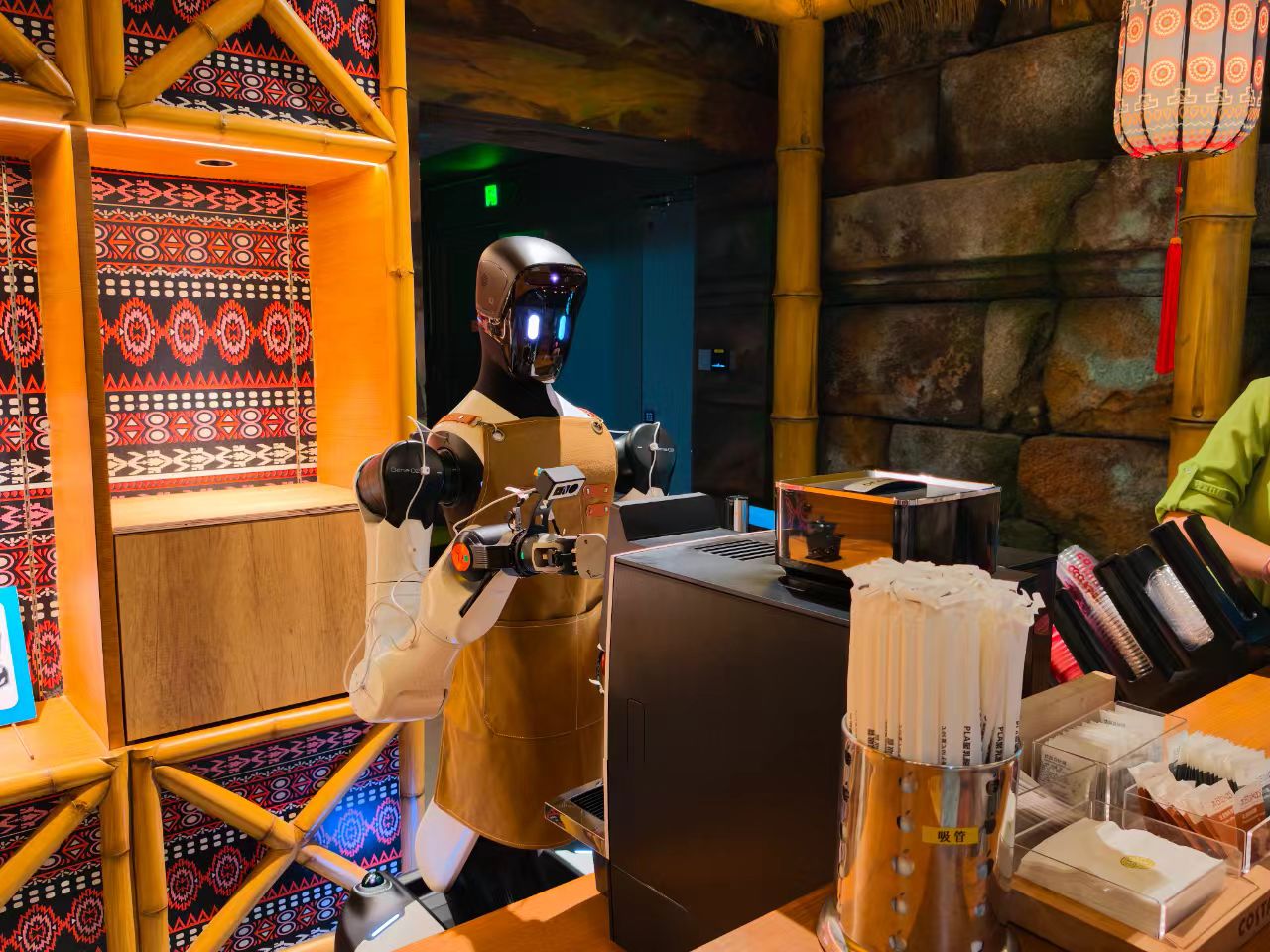
IDC believes that the rapid development of humanoid robots in the Chinese market is, on one hand, due to the continuous promotion of policies. Since 2026, local governments, industrial parks, and state-owned enterprises have continuously increased their support for the humanoid robot industry, and by building innovation platforms, releasing application scenarios, and advancing procurement and deployment, they have accelerated the transition of humanoid robots from technology research and development to practical applications.
On the other hand, China has a relatively complete industrial chain for humanoid robots and an active ecosystem of manufacturers. Manufacturers of complete robots, component companies, AI model enterprises, and system integrators are accelerating their collaboration to drive continuous iteration in core robot components, robot manufacturing, and intelligent capabilities, resulting in ongoing improvements in product costs and mass production efficiency.
With the advancement of humanoid robot technology, the boundaries of market applications are also continuously expanding.
IDC reports that in the first half of 2026, the combined shipment volume share of application scenarios such as scientific research and education, performance displays, and government (data collection centers) has decreased from 83.8% for the entire year of 2025 to 69%, indicating a further diversification of application structures. The scenario of scientific research and education continues to expand, extending from university-level research to vocational colleges and artificial intelligence education in primary and secondary schools; the share of applications for performance displays has declined; however, the construction of government data collection centers remains an important direction for current shipments.
Both reports from the two institutions also mention that industrial manufacturing is an important direction in the current exploration of humanoid robot applications. SAG states that manufacturing, logistics, warehousing, and other structured business environments are becoming the main pathways for commercialization. In these scenarios, robots can perform more specific tasks, demonstrating measurable productivity and economic value.
Author:Hu Shujuan