

French President Macron called for coordination among G7 to address rising diesel prices and proposed a large-scale strategic reserve release plan. As a result, international oil prices tumbled significantly, and market risk appetite clearly rebounded.
According to CCTV News, on October 2 local time, French President Emmanuel Macron called for coordinated actions by the G7 to avoid imposing export restrictions and jointly curb rising fuel prices. Meanwhile, according to Reuters, during a call among EU member governments on Friday, parties discussed a proposal put forward by France: European countries would release 50 million barrels of diesel, while members of the International Energy Agency would release 50 million barrels of crude oil.
After the news spread, international crude oil prices tumbled accordingly – WTI crude oil fell below the $90 per barrel mark, reaching $89.38 per barrel, with a daily decline of 3.76%; Brent crude oil also fell below $100 per barrel, at $99.69 per barrel.

As the market awaits the U.S. non-farm payroll report in September, risk assets have generally strengthened. The Stoxx 50 index in Europe, France's CAC40 index, and Germany's DAX index all saw increases of over 1%; U.S. stock index futures also rose in tandem, with Nasdaq 100 index futures up 0.9% and S&P 500 futures up 0.5%.
Fed Vice Chairperson Philip Jefferson stated that policymakers should take more time to assess before deciding whether to raise interest rates further. This dovish signal caused the market to significantly reduce its bets on a rate hike in October, with the probability plummeting from around 70% earlier this week to about 27%.
At the same time, the political deadlock in France and the deteriorating debt prospects have increased European fiscal risks. Risk-averse funds have continued to flow into U.S. Treasuries, causing the yield on 10-year U.S. Treasuries to fall from a 24-year high to around 5.21% on Friday. The European bond market has rebounded somewhat: the yield on German 10-year government bonds dropped by 10 basis points to a three-week low of 3.41%. Meanwhile, the risk premium on French bonds rose to 150 basis points, the first time such a level has been seen since 2012.
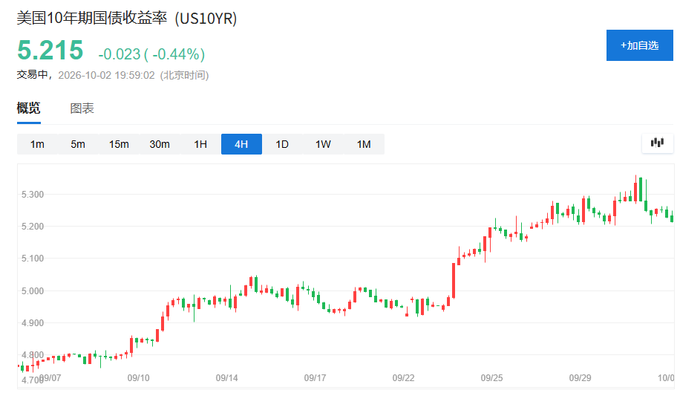
Although market risk sentiment has improved, analysts warn that this rebound reflects more of a technical correction and short-term hedging needs, rather than a fundamental shift in fundamentals. Structural factors that drive yields higher remain: oil prices remain above $100 per barrel, the expansion of the U.S. federal deficit and investment in artificial intelligence continue to fuel economic growth, and inflation this year has already exceeded 3% year-on-year. Economists expect non-farm employment to increase by about 90,000 in September, lower than the previous month's 162,000. These data trends will largely influence the market's judgment of the Federal Reserve's next steps.
The United States exerts pressure through export bans, leaving Europe in a dilemma.
According to CCTV News, the United States is urging Europe to further utilize its fuel reserves, particularly calling on France and Germany to release their diesel emergency reserves. According to U.S. sources, the U.S. hopes that the EU will release 120 million barrels of diesel into the market over the next six months, while not ruling out restricting U.S. diesel exports in order to alleviate domestic price pressures.
Due to the embargo on Russian petroleum products and disruptions in supplies from the Middle East, Europe's dependence on US diesel has increased significantly. France consumes about 600,000 barrels of diesel per day, with about half of that coming from imports. If the US imposes restrictions on exports, it could further drive up fuel prices in Europe and exacerbate the cost pressures on the transportation and agricultural sectors.
According to Reuters, the Trump administration is particularly dissatisfied with France and Germany. U.S. officials believe that the two countries did not go far enough in their previous commitments to release emergency oil and petroleum product reserves and failed to fulfill their promises.
U.S. Energy Secretary Chris Wright said in an interview with Fox News on Thursday that he is "highly optimistic" about Europe's use of emergency diesel reserves to stabilize oil prices. "It is currently the harvest season, and we are about to enter the peak period for winter heating oil consumption. Now is the time to increase diesel supply to the market," Wright said. "These diesel reserves are readily available, and I think there will be positive news to come."
U.S. Treasury Secretary Janet Yellen stated on the social media platform X that the United States has fulfilled its obligations under the International Energy Agency (IEA) member agreement from March of this year by releasing 172 million barrels of crude oil. "The United States has done its part," Yellen wrote, "and we look forward to our allies translating their commitments into action."
However, for the European Union, releasing reserves on a large scale is not an easy task. According to Reuters, the EU needs to find a balance between keeping domestic fuel prices low and maintaining sufficient reserves to cope with potential crises – especially against the backdrop of uncertain prospects for negotiations between Trump and Iran. A U.S. official reportedly said, "Cooperating with the United States to increase the supply of refined oil products and reduce consumer costs is in Europe's own interest."
France is actively promoting coordinated actions among major economies on energy supply issues. The Elysee Palace stated that French President Macron has spoken with both Trump and Canadian Prime Minister Trudeau regarding energy and fuel prices. Macron made it clear that G7 should take coordinated actions and that export restrictions should not be imposed. He will also convene leaders of G7 to specifically discuss oil supply and price issues.
EU holds emergency consultations; France proposes a compromise solution
In the face of pressure, various European parties have engaged in intensive coordination. According to Reuters, quoting an EU official, the European Commission held a teleconference with the energy working group composed of 27 member states on Friday morning to discuss the current situation. The day before that, the European Commission had already held preliminary talks with Germany, France, Italy, the United Kingdom, and Ireland to assess whether it was necessary to release diesel reserves.
During the Friday teleconference of governments of EU member states, various parties discussed a proposal put forward by France: European countries would release 50 million barrels of diesel, while members of the International Energy Agency (IEA) would release 50 million barrels of crude oil. Sources familiar with the matter revealed that the countries also reached a consensus on a key prerequisite: any agreement regarding further release of reserves should be conditional upon the United States' commitment not to unilaterally impose a diesel export ban.
Meanwhile, G7 leaders may hold a video call on Friday afternoon to discuss the next steps. An official from the Elysee Palace said that Macron plans to convene a G7 leaders' video conference to coordinate on rising fuel prices and global supply of refined products, and to promote joint action with the International Energy Agency to release reserves.
It is worth noting that the official also revealed that during their meeting in New York at the United Nations General Assembly last week, Macron and Trump did not discuss this topic.
There are clear divisions within the Federal Reserve, and the threshold for employment data is quite high.
Federal Reserve officials do not speak with one voice, and internal divisions have come to light. Federal Reserve Vice Chairman Jefferson and New York Fed Chair Williams tend to be more cautious, emphasizing that there is no urgent reason to take further action after the interest rate hike in September; however, Dallas Fed Chair Logan holds a distinctly different view, clearly stating that the Federal Reserve must continue to raise interest rates, and it is estimated that the target range for the federal funds rate needs to be raised by at least another 50 basis points.
This divergence has significantly increased the market's sensitivity to non-farm data. BMO, the head of capital market interest rate strategy at Ian Lyngen, pointed out that if the data shows early signs of pressure in the labor market, the market reaction could disproportionately favor an increase in bond prices; conversely, if the data meets or even slightly exceeds expectations, yields may pick up again.
T. Rowe Price, the head of investment grade at the Steve Boothe group, stated that for U.S. Treasuries to benefit from employment data, employment growth needs to be close to zero or even negative, and salary data must also be significantly lower than expected. 'The threshold for the labor market to act as a catalyst for a rebound is actually quite high.'
Although futures traders have slightly reduced their bets on interest rate hikes and pushed back the expectation for the next hike to December, they still anticipate at least three more 25-basis-point increases before July next year. Krishna Guha indicates that the Federal Reserve's current baseline expectation still points to a limited number of "small-cycle interest rate hikes," with two to three more expected. Currently, there is no belief that demand is strong enough to pose a significant risk of overheating. Evercore
Asian and Pacific bond markets followed the upward trend of U.S. bonds, while European bond markets saw a partial rebound.
The dovish signals from the Federal Reserve, combined with the demand for safe-haven assets, have helped stabilize U.S. Treasury bonds. This has also led to a general increase in government bond prices across the Asia-Pacific region, with prices of Japanese, New Zealand, and Australian government bonds all rising.
On the European side, the yield on 10-year German government bonds fell by 5 basis points to 3.46%, and the yield on UK bonds of the same maturity dropped by 6 basis points to 5.34%. However, French government bonds ( OAT ) once again lagged behind and continued to face pressure.
Bloomberg macro strategist Skylar Montgomery Koning pointed out that France's fiscal problems are unlikely to be resolved in the short term, and OAT has become a "problem bond" in the European government bond market. Market concerns about its negative spillover effects are gradually shifting from government bonds to the euro exchange rate. She stated that the European Central Bank's further tightening of policies is having a diminishing effect on boosting the euro, and the added pressure of sovereign issues is further weakening the attractiveness of the euro.
The sharp widening of sovereign bond spreads in the eurozone slowed down on Friday, as traders bet that the European Central Bank (ECB) would be forced to reduce the frequency of interest rate hikes in order to support member states with heavier debt burdens within the region. Traders began to take into account the impact of the soaring borrowing costs for peripheral countries in the eurozone on the overall economy, which prompted them to significantly cut their bets on the extent of ECB interest rate increases.
The current money market expects that the European Central Bank will raise interest rates two to three times by the end of next year, whereas earlier this week, the market was still fully anticipating four rate hikes. In addition to concerns about inflation driven by energy prices, there has also been a resurgence in concern regarding France's ability to control spending amidst political divisions. The budget proposal submitted by the French government on Thursday was described by the country's financial watchdog as "optimistic."
Gold remains within a narrow range of fluctuations under the influence of multiple forces, still hovering below the $4,200 mark.
Vantage Global Markets Senior Market Analyst Hebe Chen stated that gold appears "calm on the surface, but there are turbulent undercurrents within." She pointed out that more modest inflation data, reduced expectations for a rate hike in October, and declining oil prices have provided some respite for gold prices, but persistently high U.S. Treasury yields and a strong dollar still pose significant upward pressure, keeping gold prices trapped around $4,100. Gold fell by about 6% in September, and this week's cumulative decline is still around 2%.
The Bloomberg US Dollar Spot Index fell slightly by 0.1% on Friday, but the dollar continued its longest weekly upward trend since January last year. The euro ended a four-day decline and rebounded slightly by 0.1% to $1.1256; the pound remained virtually unchanged at $1.3210.
The Japanese yen strengthened slightly by 0.3%. Rising core inflation data in Tokyo reinforced expectations that the Bank of Japan will continue to raise interest rates, providing some support for the yen, although the increase was limited.
The Mabrouk Chetouane of Natixis IM indicates that investors are viewing strong data as a positive signal and a promising precursor to third-quarter profits, 'and the market is pricing in economic growth and the Fed's interest rate hike path accordingly.'