

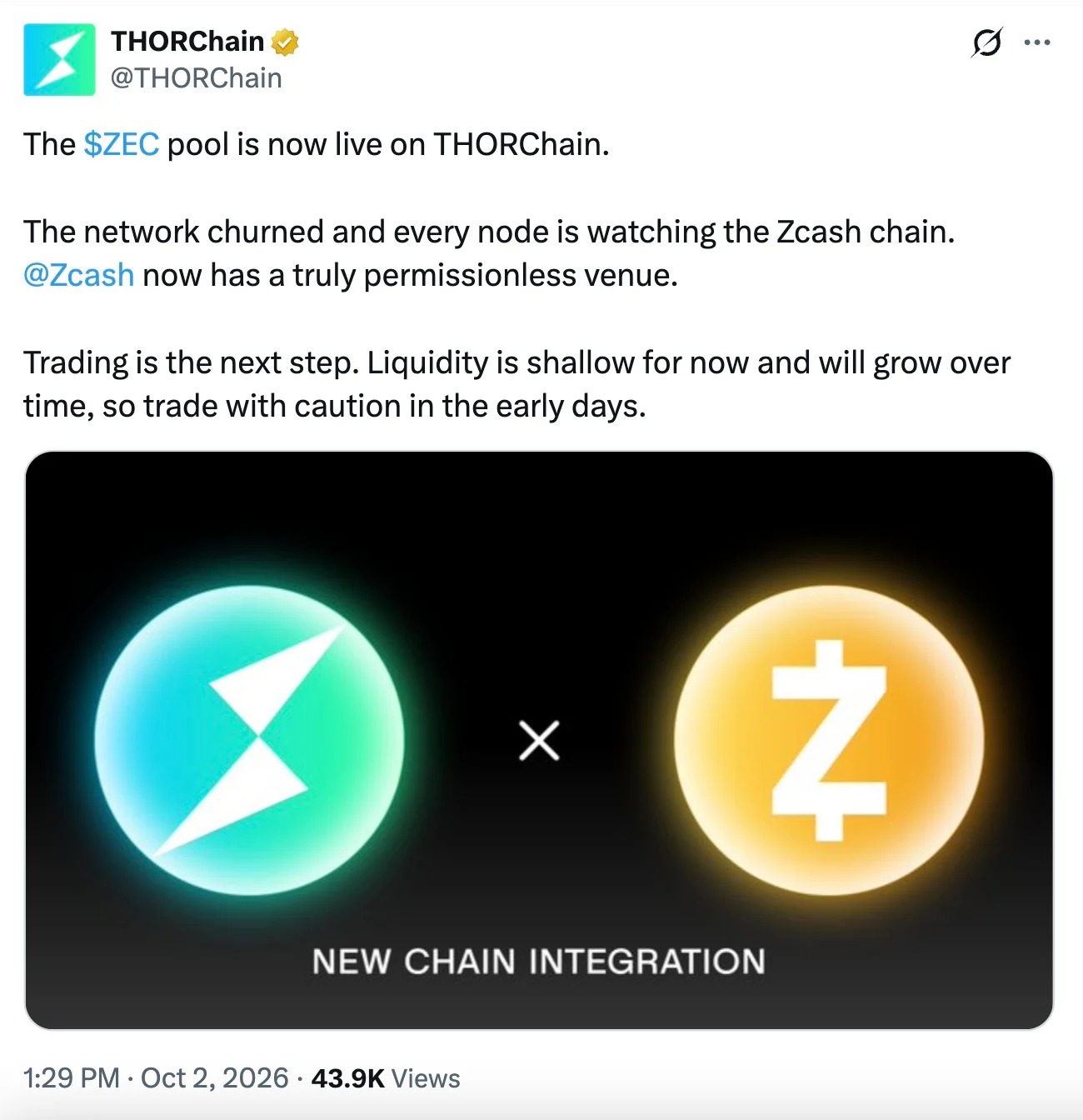
The cross-chain protocol THORChain has enabled a liquidity pool for Zcash ( ZEC ). After a scheduled network rotation, all network validators have successfully synchronized with the Zcash blockchain.
The main achievement of this release is the launch of the first decentralized platform that supports direct, permissionless exchange between Bitcoin ( BTC ) and native ZEC tokens. There is no need for intermediaries, KYC, or “encapsulation” of assets.
Developers also immediately issued a warning: at the initial stage of its launch, the depth of this fund pool was still extremely shallow, therefore there is a significant risk of price slippage for large orders.
How does this integration fill the historical gap envisioned by Satoshi Nakamoto?
The article states that this integration actually endows Bitcoin with the privacy features that it initially lacked. As early as 2010, Satoshi Nakamoto acknowledged that Bitcoin needed absolute privacy, but made trade-offs in order to achieve transparent protection against double-spending.
Between 2013 and 2014, cryptography researchers from Johns Hopkins University and the Massachusetts Institute of Technology solved this dilemma, proving that zk-SNARKs (zero-knowledge proof) could confirm the validity of transactions while completely hiding the details of those transactions. Due to the complex architecture and the risks associated with the "trusted setup" ceremony, Bitcoin core developers did not adopt this solution.
Subsequently, the Zooko Wilcox team forked the Bitcoin code and launched Zcash on October 28, 2016. It fully retained Bitcoin's monetary model—21 million total coins, proof-of-work mechanism, and halving schedule—while also introducing address shielding (shielded pool, namely the shielding pool).
The article cites supporters' views that today, the release of THORChain has made the two complement each other naturally: the transparent BTC maintains its status as a global reserve asset, while Zcash meets the end-to-end privacy needs on the blockchain, thus realizing the vision that Satoshi Nakamoto was unable to accomplish back then.
At the time this fund pool was launched, there were also significant changes in the performance of these two assets over the past year:
- Zcash ( ZEC ):The trading price ranges from $1,330 to $1,390, with a market capitalization of $23 billion to $24.5 billion, ranking 9th to 10th. In the past 12 months, the token has risen by over 1,000%, from around $450 in September to a high of $1,700, followed by weekly corrections of 8% to 14%. The proportion of this token in Bitcoin’s market capitalization has also increased from less than 0.1%, which is negligible, to about 1.5%. ZEC
- Bitcoin ( BTC ):The price ranges between $85,000 and $86,500, with a market value of $1.72 trillion, which is approximately 28% lower than the historical high of around $126,000 in October 2025.
The article states that the driving factors, as well as a "shadow factor," include: Grayscale Zcash ETF ( ZCSH ) attracted regulated funds in, despite a recent outflow of $30 million; at the same time, the community approved funding of $8.4 million, and Network Upgrade 7 ( NU7 ) updates are currently being tested online, with plans to adjust the block generation time to 25 seconds.
Meanwhile, in late September, the address related to the $387 million hacker attack on the Bitget exchange quickly transferred approximately $4 million of ZEC directly into the Orchard shielding pool.
The article points out that cases of hackers using funds for laundering have made channels like THORChain, which do not require permission, a sensitive topic of concern for regulatory authorities. Regulators have been closely monitoring this protocol for a long time. Nevertheless, this decentralized gateway is now live, officially providing the market with a tool that allows for the direct conversion of “digital gold” into “absolute anonymity.”