
Why is NASDAQ still rising while the U.S. stock market is generally declining?
Coinpaper
48m ago
Ai Focus
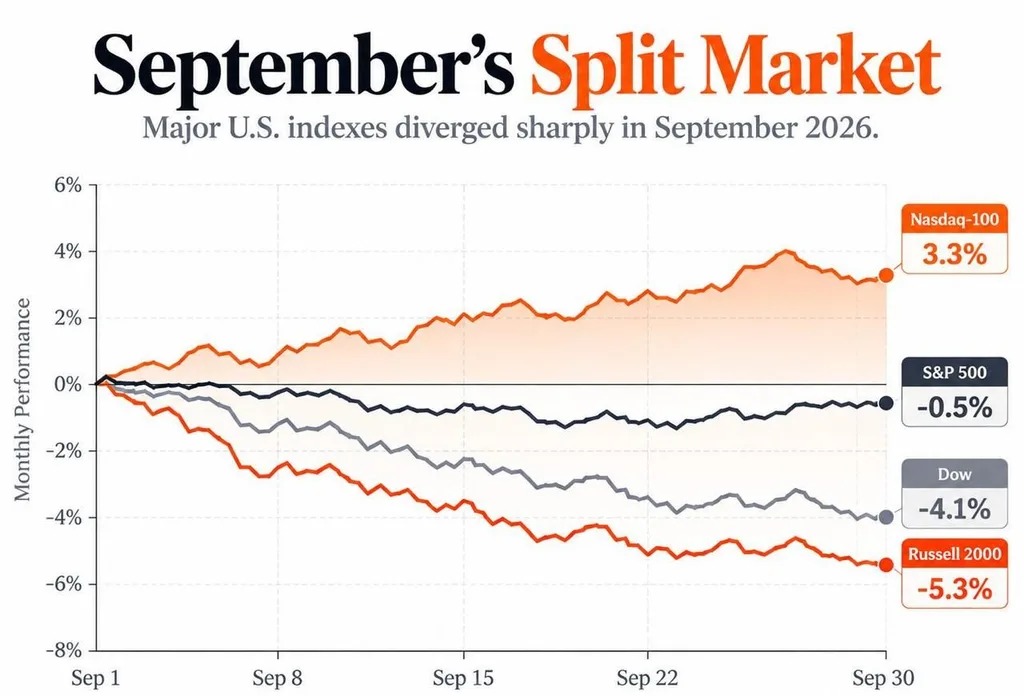
A review of September on NASDAQ shows that despite the weakness in most sectors of the U.S. stock market, the NASDAQ 100 index still rose by 3.3% in September. The strong performance of large technology stocks and communication service stocks, especially the leading companies related to AI, offset the weakness in the broader market; at the same time, the yield on 10-year U.S. Treasury bonds soared to 5.29%, putting greater pressure on smaller stocks that rely more on external financing.
Helpful
No.Help

The Nasdaq 100 index rose by 3.3% in September, despite the opposite trend of most sectors in the U.S. stock market during the same period.

The Russell 2000 Index fell by 5.3%, and the Dow Jones Industrial Average dropped by 4.1%. Nine out of 11 major market sectors closed lower, with 78% of the components of the S&P 500 Index also experiencing declines that month. However, according to Nasdaq's September review, the strength of large-cap tech stocks and communication services stocks was sufficient to drive the Nasdaq 100 Index higher.

This differentiation highlights an increasingly important feature of the U.S. market: the indices that investors follow on a daily basis are being driven more and more by a smaller group of companies, rather than by the broader market as a whole.

AI and large-cap stocks are supporting the Nasdaq

The technology sector rose by 4.5% in September, and the communications services sector rose by 4.3%. These are the only two major sectors that achieved significant gains.

Due to the Nasdaq 100 index's high exposure to the largest technology and growth companies, the strength of stocks related to AI is sufficient to offset the weakness in other sectors.
The 5% yield on U.S. Treasury bonds has a greater impact on smaller companies.

The other aspect of this differentiation comes from the bond market.

The yield on 10-year U.S. Treasury bonds rose by 54 basis points to 5.29% in September, marking the largest single-month increase in four years. Nasdaq stated that persistent inflation, higher energy prices, tighter monetary policy, and the large-scale issuance of bonds by governments and corporations are all factors contributing to this increase in yields.

Higher interest rates often have a greater impact on smaller companies, as they are typically more reliant on external financing, and the borrowing terms are usually less favorable than those for larger companies.

This helps to explain why the Russell 2000 Index recorded its worst single-month performance since March 2025, while the large-cap growth stocks maintained their resilience.

Emir Abyazov

Editor-in-Chief Coinpaper, responsible for expanding data-driven editorial operations, content discovery oriented towards SEO, as well as prioritizing audience-oriented encryption, AI and fintech narratives.

Tip
$0
Like
0
Save
0
Views 17
WalletJYS reminds readers to view blockchain rationally, stay aware of risks, and beware of virtual token issuance and speculation. All content on this site represents market information or related viewpoints only and does not constitute any form of investment advice. If you find sensitive content, please click“Report”,and we will handle it promptly。
Submit
Comment 0
Hot
Latest
No comments yet. Be the first!
Related
Trump claims that if Republicans control Congress after the midterms, adults from both parties could receive $5,000
Trump once again promised that if the Republicans win both chambers of Congress in November, he will distribute a $5,000 "Trump dividend" to every adult American citizen. The White House previously described this plan as a cash distribution linked to the performance of the U.S. economy, but the source of funding has yet to be resolved; based on an estimated 240 million adult citizens, the total cost would be about $1.2 trillion.
Coinpaper
·2026-10-04 01:22:44
17
Bitcoin crash warning goes viral on X, post points to the "Berna Cycle"
A post circulating on X claims that the Federal Reserve is in a policy dilemma: raising interest rates could push up borrowing costs and long-term U.S. Treasury yields, thereby dragging down growth, while maintaining or lowering interest rates could exacerbate inflation. The post also mentions long-term U.S. Treasury yields, the approximately $40 trillion in U.S. debt, and a "Japanese-style" policy dilemma, and suggests that tightening liquidity could lead to forced sales of assets, including Bitcoin.
Coinpedia
·2026-10-04 01:22:42
19
OpenAI has banned PewDiePie twice; they are actively developing a censorship-free AI Ajax that can run on personal computers.
PewDiePie stated in a new video that OpenAI banned his account twice during the period when he was building Ajax. Ajax is a small AI model designed to run on local computers, based on Alibaba's Qwen 3.5. PewDiePie claimed that he used GPT-5.6 and Sol to generate training data, and with the help of open-source tool Heretic, he removed the model's ability to refuse responses.
Decrypt
·2026-10-04 01:12:11
18
OpenAI Security Employee Resigns, Claiming the Company's "Culture Has Failed"
David Robinson published an article in The Atlantic Monthly stating that he was responsible for writing the security reports accompanying the major product releases of OpenAI. He has now resigned because he believes that the company's "culture has failed." A spokesperson for OpenAI stated that the company is continuously improving its security measures.
TechCrunch
·2026-10-04 00:41:38
21
View More