


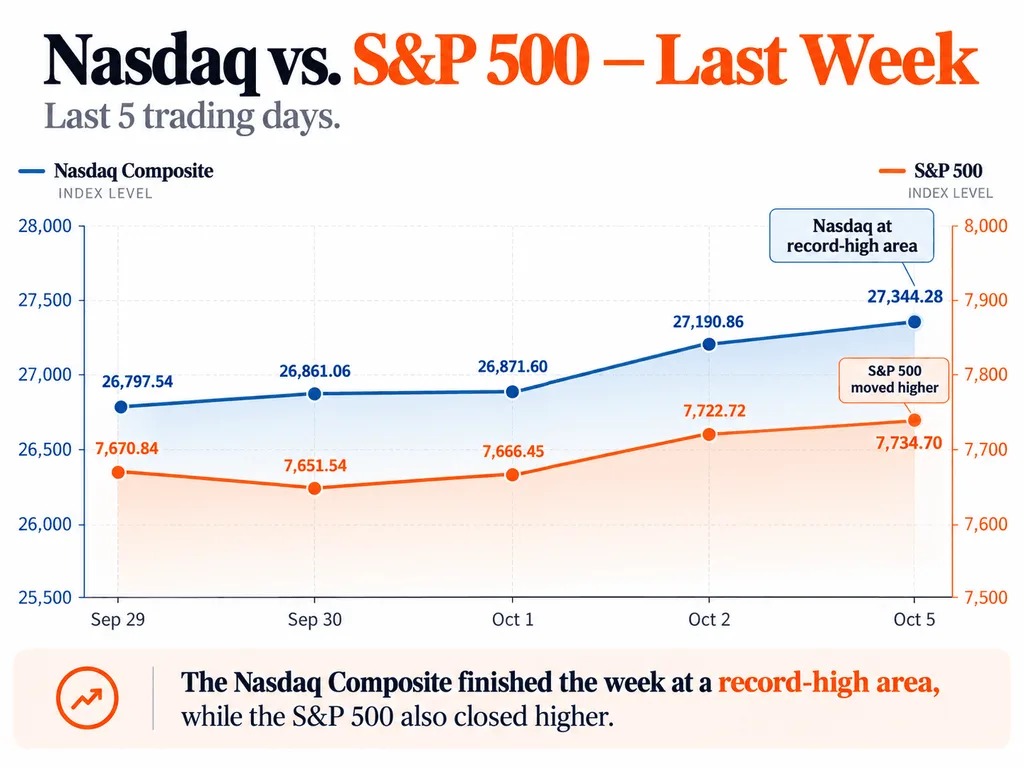
The S&P 500 index rose by about 0.4%, while the Nasdaq Composite Index increased by around 0.7%, setting a new record high. In contrast, the Dow Jones Industrial Average fell by approximately 0.2%, highlighting the divergence between technology leaders and the more traditional sectors of the market.
NVIDIA, Meta, Microsoft, and Tesla all rose by more than 1%, and software stocks also performed better than the broader market. This strength continues the same round of artificial intelligence market trends, which have helped the S&P 500 maintain its resilience despite rising borrowing costs on multiple occasions.
Large tech stocks are still supporting the market.
Although the leading indices remain strong, the underlying fundamentals for growth below them are far less convincing.
MarketWatch reports that stocks in the technology and communications services sector provided the main support for Monday's gains, with Alphabet and Meta playing a particularly prominent role within the latter sector. Some other sectors in the market struggled to keep up with the pace.
This divergence became more apparent in September. Although the S&P 500 index itself remained near record highs, approximately 78% of the S&P 500 constituents fell that month. Our observation of the market breadth shows that a few very large-cap companies were able to maintain high positions in the market capitalization-weighted index, while most individual stocks were weakening.
The Russell 3000 index also shows a similar situation. MarketWatch cites a Morgan Stanley study which states that more than half of its constituent stocks have fallen by at least 20% compared to June levels.
5.3% U.S. Treasury yield rate poses another challenge
This round of gains has also occurred against the backdrop of an exceptionally difficult bond market.
The yield on 10-year U.S. Treasury bonds has risen to around 5.30%, approaching the highest level since 2002, due to investors continuing to factor in persistent inflation, heavy government borrowing, and high energy costs.
Normally, higher yields are particularly unfavorable for growth stocks, as they reduce the present value of future profits. The yield guidelines for Coinpaper explain that technology companies with higher valuations are usually one of the market sectors most sensitive to interest rates.
Emir Abyazov
Editor-in-Chief Coinpaper, responsible for driving data-driven editorial operations, content discovery guided by SEO, and creating narratives that prioritize the audience interests in cryptocurrency, artificial intelligence, and fintech.