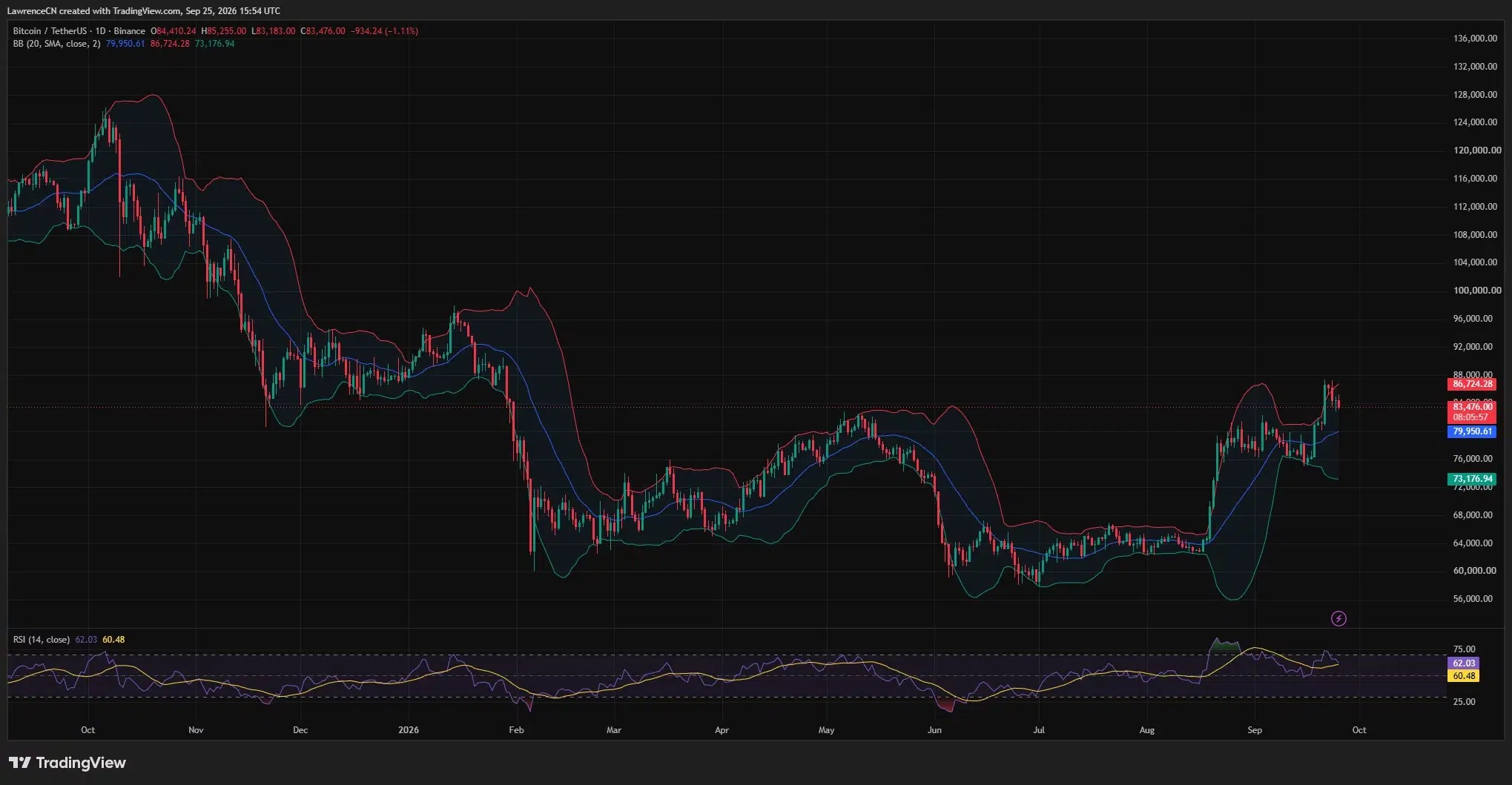


Bitcoin, Ethereum, XRP, and Solana fell by 4.3% to 6.3% respectively within the past 24 hours of October 7th, with the overall crypto market capitalization declining by 3.8% to 2.925 trillion US dollars.
- Calculated using the rounding method of CoinGecko, a 3.8% decline in market value means an evaporation of approximately $115.5 billion in market value.
- Bitcoin fell by 4.3%, while Ethereum, XRP, and Solana recorded even larger declines within 24 hours.
- Early reports, citing data from CoinGlass, indicated that long positions were liquidated for nearly $487 million in the past 24 hours.
- Dan Khus described this decline as a leveraging clearing process while awaiting the minutes of the Federal Reserve meeting.
CoinGecko Data shows that Bitcoin is at $82,855.50, down 4.3%; on the individual asset page verified by this report, Ethereum has fallen 5.8% to $2,564.48. XRP has dropped 6.3% to $1.42, and Solana has fallen 4.9% to $115.80.
Among other major tokens, the tracker shows that Cardano has fallen by 8.5%, and Dogecoin has fallen by 8.2%. According to the CoinGecko page, BNB has fallen by 2.5%, while Chainlink and Hyperliquid have both fallen by 5.2%, and TRON has fallen by 0.3%.
Calculated based on the rounded market capitalization and percentage changes provided on the main page, the market size was approximately $3.041 trillion a day ago. The estimated reduction of $115.5 billion measures the change in token valuation, rather than investors withdrawing an equivalent amount of cash.
Forced liquidation accelerated the downward trend of BTC and ETH.
Data provided by CoinGlass in a report on the wave of liquidations in the crypto market on October 7th indicated that a total of approximately $554.8 million in positions were forcibly closed within the past 24 hours, including $487 million in long positions. Within one hour, the same report recorded $403.58 million in long liquidations, accounting for 97% of the total $415.33 million.
LVRG Research Chief Analyst Dan Khus stated in a comment provided to crypto.news that this wave of decline is due to the forced liquidation of crowded trades that were betting on an upward trend. He described this event as a leveraged liquidation, rather than the beginning of a downward trend.
The decline in encrypted prices is more like a leveraged liquidation than a downward trend, stemming from crowded bets on higher prices being forced to exit, and most of the liquidations came from long positions.
According to this settlement report, the decline in prices forced exchanges to close bullish leveraged positions, which led to an increase in sell orders during the downward trend. A snapshot from CoinGlass shows that the one-hour settlement amount accounted for approximately 0.27% of the total number of open contracts, and after the initial decline, the derivatives exposure remained quite substantial.
According to other reports, Ethereum positions accounted for approximately $174 million of a total liquidation amount of $547 million. Futures trading volume increased by 16% to $182.85 billion, while the number of open contracts decreased by only 1% to $152.6 billion.
Tanker attacks and rising oil prices have brought additional downward pressure.
CoinDesk linked the drop of Bitcoin below $84,000 to the escalation of Iran's attacks on oil tankers in the Strait of Hormuz, while Brent crude oil prices rose above $101 per barrel, and U.S. Treasury yields and the dollar both increased simultaneously.
In a report on October 5th, Reuters stated that shipping intelligence service provider Marisks recorded at least seven tanker incidents in the preceding week. Marisks indicated that tanker Kazimah III was attacked on October 1st, and tanker Lipsi was attacked on October 4th; it was reported that the crew members on both ships were safe.
The same report pointed out that the Strait of Hormuz accounted for about 20% of the global supply of crude oil and liquefied natural gas before the war. Reuters also reported that, despite ongoing shipping risks, crude oil exports from the Gulf region exceeded pre-war levels in 14 days in September.
In the morning trading on Wednesday, market reports cited data from Reuters stating that the yield on 10-year U.S. Treasury bonds was 5.307%, and the U.S. Dollar Index was at 102.07, up 0.16%. The reports also mentioned that the market was preparing for an auction of 10-year U.S. Treasury bonds worth $39 billion.
For Bitcoin investors in the United States, Senior Researcher Tim Sun has previously identified long-term yield, US spot ETF capital flows, and derivatives leverage as key factors that need attention. In a report on the risks of another round of Federal Reserve interest rate hikes on September 29th, Sun stated that higher long-term interest rates and tighter dollar liquidity could weaken demand for Bitcoin.
Fed meeting minutes to make another interest rate hike a focal point
Khus indicates that traders are watching the minutes of the Federal Reserve meeting to be released on Wednesday, in search of signs as to whether policymakers still intend to raise interest rates once more this year. He also considers next week's inflation data and whether Bitcoin can hold its position in the mid-$85,000 range as tests to determine whether forced selling will recur.
The Federal Reserve announced in September that it would raise the target interest rate range by 25 basis points to 3.75% to 4.00%. In reports on the Fed's unanimous decision to raise rates on September 16, all 12 voting members supported the first rate hike since July 2023.
Reports in September also indicated that among the 18 policymakers, 16 expected at least another 25 basis points of interest rate hikes within the year. According to that report, Goldman Sachs Asset Management's Kay Haigh regarded December as the baseline scenario for another rate hike, with inflation data and energy prices affecting this decision.
As of October 1st, reports regarding the interest rate hike on Jefferson cited data from Polymarket which indicated that the probability of a rate hike in October was 23%, compared to around 70% a week earlier. The same report also stated that Goldman Sachs had adjusted its forecast for the next rate hike to December.
In his speech on October 1st, Federal Reserve Vice Chairman Philip Jefferson stated that future policy changes should depend on economic data, prospects, and the balance of risks. He supported the interest rate hike in September, but indicated that officials may need more time to make the next decision, and cited geopolitical developments and stronger demand as upward risks to inflation.
Four Hyperliquid wallets went short before the decline in Bitcoin prices.
In the monitoring on October 7th, conducted by token issuer Bench, it was identified that 4 newly created wallets deposited a total of 1 million US dollars USDC into Hyperliquid before opening short positions in Bitcoin. These positions amounted to a total of 148.49 BTC, and according to blockchain tracker data, they are valued at approximately 12.5 million US dollars.
A review of the token issuance Bench shows that these short opening positions were between $85,475 and $85,577. It is also mentioned that at the time of data collection, Bitcoin was near $83,942, resulting in an unrealized profit of about $235,000. The publication states that the existing records do not show the complete margin arrangements, other positions, or hedging situations for these wallets.