

Taipei, October 7th / PRNewswire / -- As AI computing continues to expand, the challenges faced by infrastructure are shifting from processors to power supply. The increasing power demands at the rack level are forcing data center operators, server manufacturers, and semiconductor suppliers to rethink how power is transmitted from the power grid to AI computing systems.
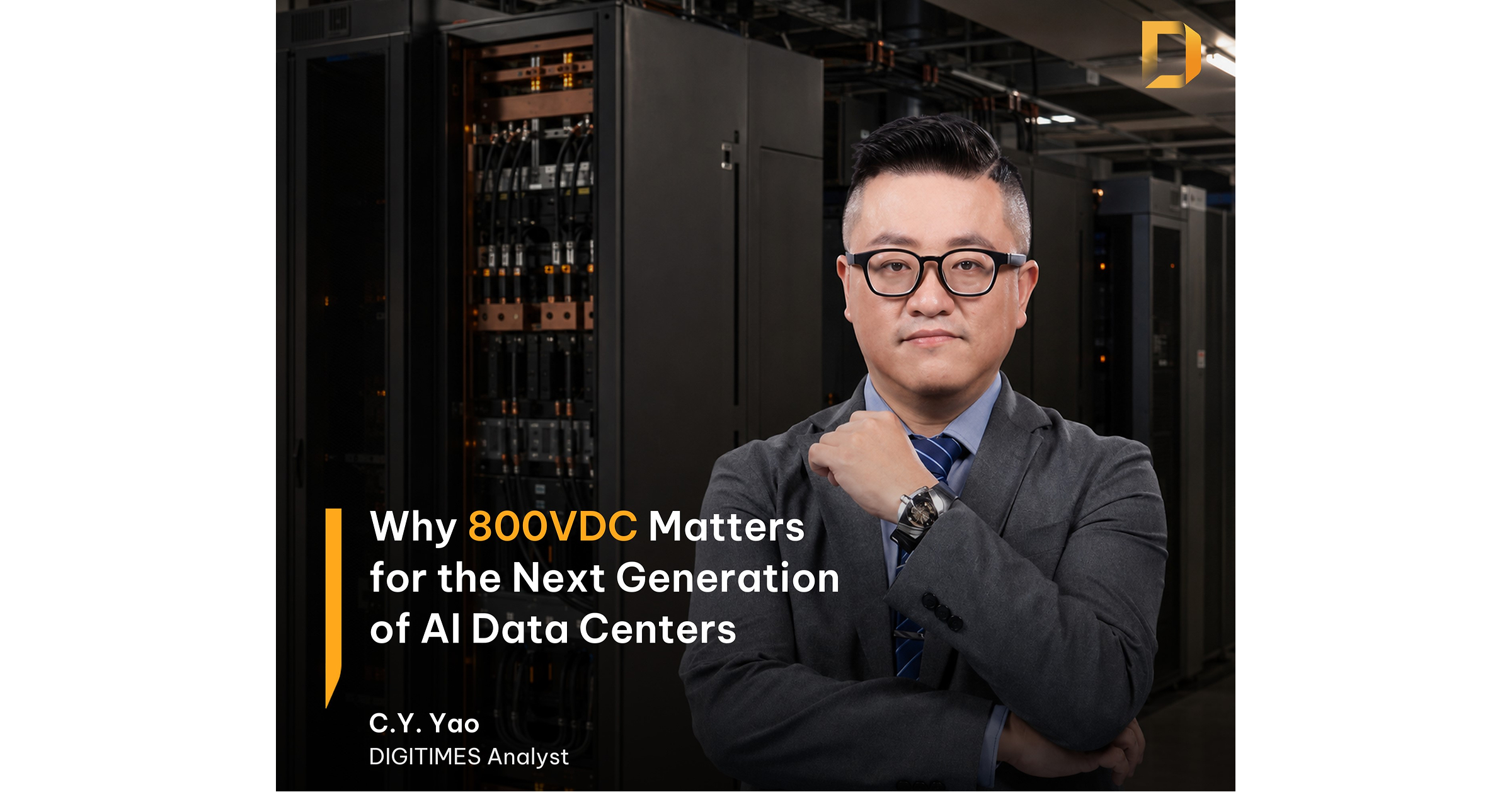
A new report released by DIGITIMES Intelligence titled " AI Data Center 800VDC Power Architecture Takes Shape ; Future Hurdles Require Balancing Multiple Key Factors " explores how the emerging 800VDC architecture is reshaping the power supply methods for the next generation of AI data centers, and how this transformation brings new strategic challenges to the semiconductor and infrastructure ecosystems.
Electricity is becoming a part of the AI performance equation.
As the computational intensity of the AI system continues to increase, power supply has become a system-level design issue, rather than just a consideration at the facility level. The higher density of AI racks requires the industry to re-examine conversion efficiency, power density, system footprint, heat dissipation management, as well as the overall path that electricity takes before reaching the GPU and other accelerators.
DIGITIMES points out that the industry's transition towards higher-voltage DC architectures is accelerating changes in the power transmission chain. This impact extends not only to data center design but also to power semiconductors, server systems, power conversion equipment, and the broader AI infrastructure supply chain.
800VDC is shaping a new competitive landscape in power semiconductors
This transformation is also changing the role of power semiconductor technology. Analysis by DIGITIMES indicates that there is no single “winner” technology; different device architectures play their respective roles at various stages of the AI power supply chain, depending on factors such as voltage, switching frequency, power density, efficiency, and system requirements.
This makes the evolution of GaN and SiC particularly noteworthy. As the power supply architecture of the AI servers continues to evolve, the technical characteristics of these two technologies are influencing how semiconductor suppliers plan their product offerings at different stages of the power system.
Competition will go beyond device performance.
As the architecture gradually matures, it is expected that competition for DIGITIMES will no longer be limited to individual device specifications. The ability to collaborate with servers OEM and ODM, to participate in system-level design, to maintain stable supply, and to quickly respond to the rapidly changing demands of the AI platform will become increasingly important.
Supply Chain Changes Worth Paying Attention To
For data center operators, server manufacturers, power semiconductor suppliers, and investors tracking the AI infrastructure, the shift to 800VDC is not just a change in voltage. It represents a broader reconstruction of the power transmission methods in the AI infrastructure and may also imply a reallocation of supply chain values.
DIGITIMES Intelligence provides an in-depth analysis of the evolving 800VDC architecture, the role of key power semiconductor technologies, emerging supplier strategies, and the competitive factors that may shape the next phase of AI data center infrastructure.
Read the full article:
DIGITIMES Intelligence 800VDC Report
https :// dgt.ms /report800VDC_prnewswire
About DIGITIMES
DIGITIMES is a decision-making intelligence platform rooted in the global technology industry, providing first-hand industry intelligence, forward-looking research, and AI-driven analysis to help decision-makers cope with changes and formulate strategies. Through its intelligence, research, and corporate services, DIGITIMES connects technological trends with the supply chains and companies that shape the next steps of the industry.