Tesla has launched its first batch of Semi Megacharger stations in the southeastern United States: one site with 8 chargers located south of Atlanta, and another with 6 chargers on the outskirts of Savannah, with each charging spot having a maximum power of 1.2 megawatts.
The Savannah site is also the first Megacharger within the Pilot truck service area. This deployment was originally planned to be launched this summer. Together, the two sites provide the first public charging corridor outside of California for Tesla Semi.
Two stations on the same freight route
Tesla Semi announced the launch of these sites on X on Thursday, along with a route map, stating that more sites in the southeastern region will also go live.
The Atlanta location is situated in Conley in Georgia, about 10 miles south of the city center, near I-285 and I-675. Tesla's website indicates that this station is located at 1820 Rock Cut Road and is equipped with 8 Megacharger, with a maximum power output of 1.2 megawatts.
The other end is located at Ellabell, about 20 miles west of Savannah, near I-16. On the same day, it was confirmed that this is the first site to be activated under its cooperation agreement with Tesla Megacharger: Pilot #1390, which is located at Interstate Exchange Way and has 6 parking spaces.
The two sites are approximately 220 miles apart along I-75 and I-16. For any version of truck, this is a easy one-way journey. Tesla claims that the standard range version of Semi has a range of 325 miles, while the long-range version can cover 500 miles with a load capacity of 82,000 pounds; the company also states that Megacharger can recharge up to 60% of its battery in just 30 minutes.
Therefore, standard-range trucks can depart from the Savannah port area, drive to Atlanta, charge during the driver's rest time, and then drive back. However, if there are no charging stations at either end, this 440-mile round-trip journey would be difficult for a truck with a range of 325 miles.
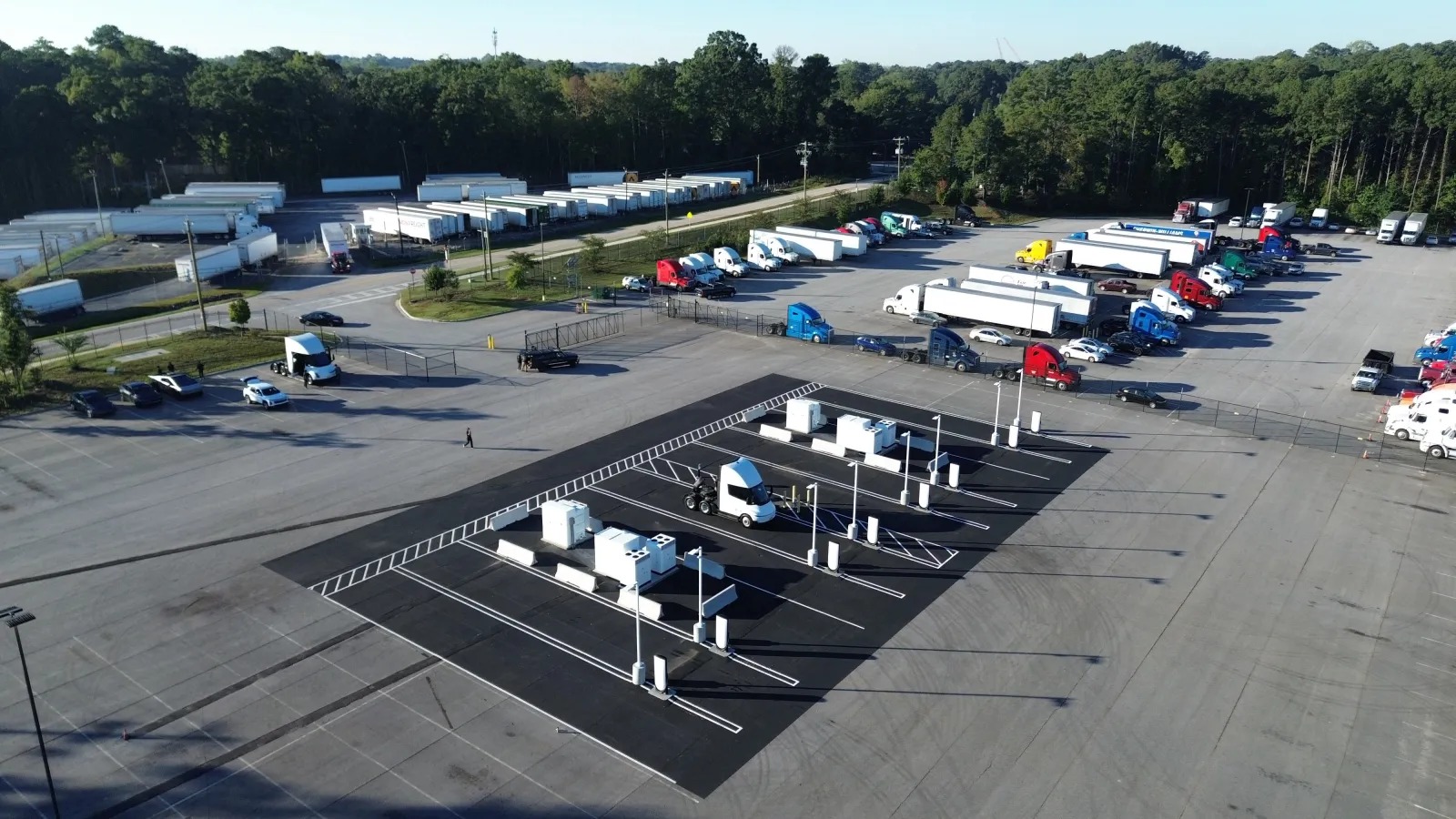
An aerial photograph from one of the sites released by Tesla shows that the parking spaces are designed to be passable, located in the center of the truck yard, with a Semi tractor parked in one of the spaces.
The first Megacharger of Pilot came a season later than planned.
In January of this year, on Pilot, Tesla announced a partnership, and it was initially planned that the first batch of sites would go live this summer. The first site was launched on October 8th.
Additionally, three more sites marked with Pilot are also in preparation: the one in California Tulare will be launched today; followed by the one in Texas Fort Stockton and then the one in Nevada North Las Vegas. Pilot indicates that there are another 9 sites under construction, with each site equipped with 4 to 8 parking spaces.
The last location is in the same area of the Las Vegas Valley, where Tesla has just submitted a permit application for a Semi service center.
There have also been changes to the list of states. The announcement in January listed California, Georgia, Nevada, New Mexico, and Texas; this time, New Mexico was removed from the list, and Indiana was added.
Shannon Sturgil in charge of the Pilot alternative fuel business stated that these initial sites make fleet electrification an "easier option for long-distance transportation."
Megacharger How is the progress of the network?
Tesla's publicly available Megacharger list currently shows three locations: Vernon and Bloomington in California, each with 6 parking spaces, as well as Conley. Ellabell has not yet been added to the list. Including these two locations, there are a total of 4 customer-facing sites and 26 parking spaces in total.
This is still far from what was planned. In Tesla's fourth-quarter report for 2025, it was indicated that the company aimed to build approximately 37 Megacharger sites in 2026; the company also stated its hope to reach 46 by the beginning of 2027. In February, there were 66 Megacharger locations listed on Tesla Maps, 4 of which are in Georgia.
And trucks have also begun to arrive. Tesla's factory in Nevada, built with the capacity to produce 50,000 trucks per year, started mass production of Semi two weeks ago; just a few days ago, the company was also designated as the main supplier for a order of 2,500 trucks.
Views of Electrek
The deployment of Megacharger is likely to be a good way to measure progress, as it is crucial for the implementation of Tesla Semi.
But Tesla is clearly falling behind its own schedule. The company originally planned to build about 37 sites this year, yet by the second week of October, only 4 had been constructed. The situation is not optimistic, but Tesla may still be able to advance deployments more efficiently in the next two months, which could bring some surprises.
If you drive an electric vehicle or are considering purchasing one, the logic behind megawatt-level truck charging also applies to home scenarios: generating your own electricity is better than having to buy fuel. With electricity prices rising by nearly 10% last year and expected to continue to climb, installing solar power is one of the best ways to counter these increasing costs. Through leasing and the PPA program, you can also install solar panels with zero down payment and start saving money immediately. If you're looking for the best option, you might want to check out EnergySage. This is a free service where hundreds of selected installers will compete for your order, so you can save 20% to 30% compared to searching on your own. There will be no sales calls before you choose an installer. Click here to get a free quote.
FTC: We use automated affiliate links that can generate income. For more information.