

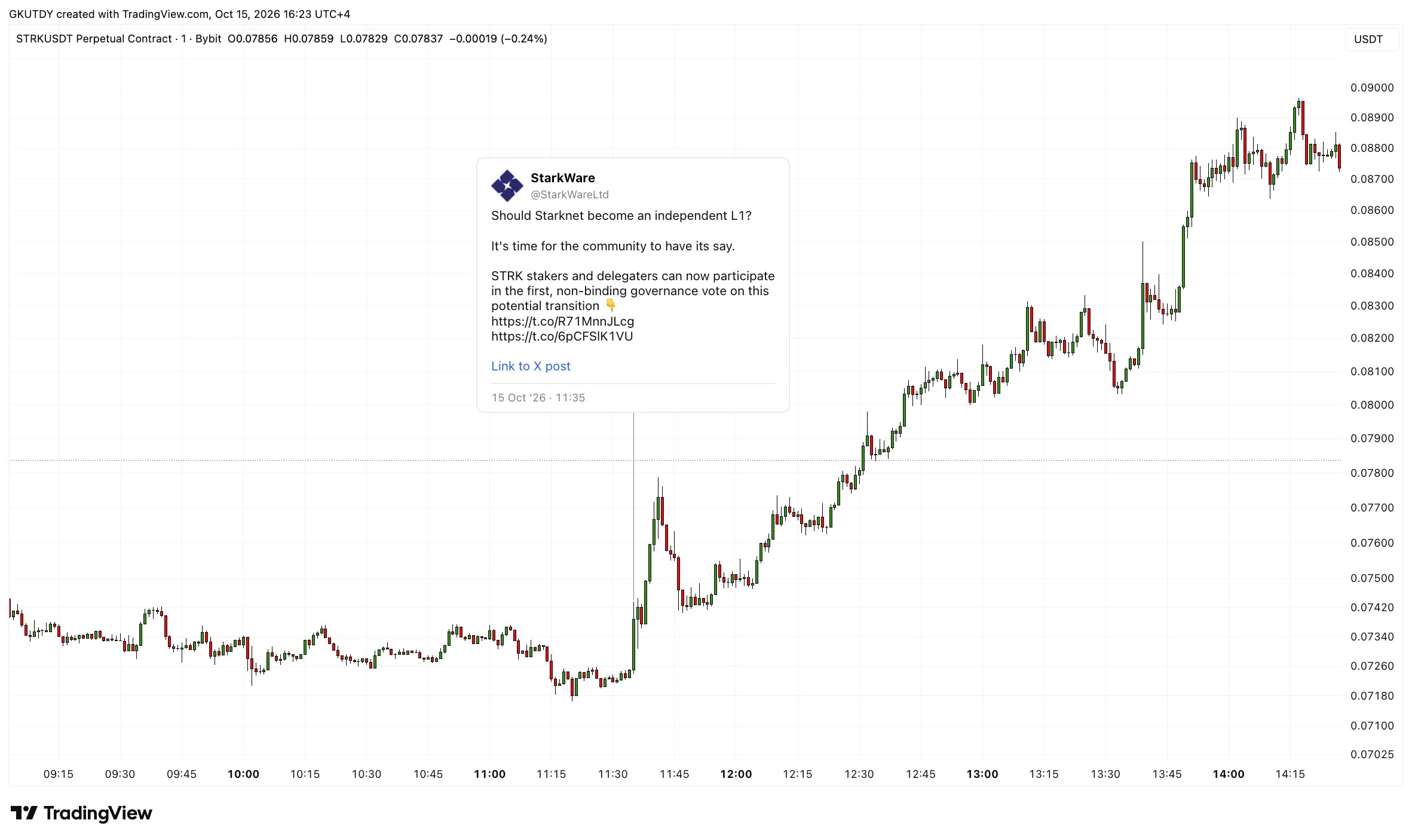
The encryption project Starknet was initially created as a technical overlay layer to expand Ethereum, but now it has announced plans to become a completely independent blockchain. StarkWare The team posed a radical question to the community: should the project break free from the control of mainstream altcoin networks and move towards autonomy? Layer 1.
The market reacted strongly to the prospects of this “division,” viewing it as a powerful financial catalyst. In the weeks leading up to October, the STRK native token soared by 200%, only to then fall back along with the entire industry. However, on the very day the official voting commenced, the price rose again, increasing by 25% at one point.
Trading activities have almost completely shifted to derivatives: The daily trading volume in the futures market reached 894.84 million US dollars, which is nearly eight times that of the spot market at 116.38 million US dollars. The market is actively processing these orders, as well as the 127 million tokens that were unlocked for early investors today.
Behind this decision lies calm mathematical calculation: Starknet is trying to withstand future quantum computers. The project leaders, Eli Ben - Sasson, believe that the development of artificial intelligence has brought machines capable of cracking modern encryption techniques one step closer to reality.
Starknet could technically deploy a quantum-resistant solution as early as 2027. However, the issue is that it is currently closely tied to Ethereum, which is progressing slowly, and Ethereum plans to upgrade its security only by the end of 2029. To avoid wasting two years, Starknet hopes to take full control into their own hands.
99% "approval" comes with a significant risk: how high is the cost of decoupling from Ethereum?
The voting conducted on the Snapshot platform will continue until October 22nd, and the current results are almost one-sided: the "in favor" option has already received 99.88% of the votes. Meanwhile, the token economics of the project will not change: STRK will still be the only settlement asset on the network, and the bridge between it and Ethereum will also continue to operate.
However, investors should understand that this referendum is only preliminary and non-binding; it merely serves as a green light for the research work. The actual technical migration will still require several months of preparation and further voting processes.
The main cost of this independence is security. Currently, Starknet transactions are protected by Ethereum and its billions of dollars in pledged validators. Once it operates independently, the project will have to establish its own security system, and the reliability of that system will depend entirely on the market value of the STRK tokens.
Currently, the market value of STRK is 580.24 million US dollars, which is much smaller compared to Ethereum. However, developers are willing to accept this trade-off in exchange for a technological advantage.
Success!