

On Friday, tech stocks faced selling pressure, with the Nasdaq index falling by about 2.2%. This was due to investors re-evaluating their enthusiasm for artificial intelligence. Concerns about the cost of expensive data centers, high valuations, and the sustainability of large-scale tech spending are weighing heavily on companies that are closely associated with the AI craze.
Among the most notable names are Micron Technology ( NASDAQ : MU ) and CoreWeave ( NASDAQ : CRWV ). Both companies have reaped significant benefits from the AI craze. As a leading supplier of advanced storage chips, Micron's shares fell by about 5.5% on Friday; meanwhile, the new cloud service company CoreWeave saw its shares drop by 12%, as concerns over its debt and financing costs continue to rise.
Wall Street believes that Micron has received a unanimous rating of "strong buy," while CoreWeave may carry higher risks, but it also offers greater potential returns. After all, higher risks often mean the potential for higher returns as well.
Micron's record-breaking performance still fails to satisfy investors
With the soaring demand for high-bandwidth memory, Micron has become one of the biggest beneficiaries. High-bandwidth memory is an essential component of advanced AI processors. Companies such as NVIDIA rely on these specialized chips to support complex computing systems, which creates highly attractive opportunities for memory chip manufacturers.
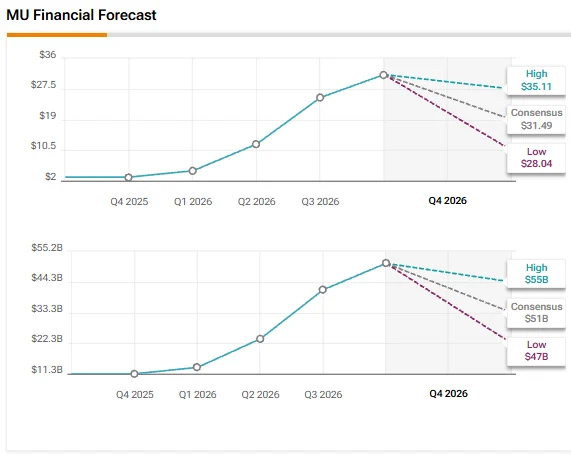
The company's latest financial report shows just how profitable this opportunity has become. In the fourth quarter of fiscal year 2025, the company's revenue reached $54.23 billion, a significant increase of 379% compared to the same period last year; the adjusted earnings per share were $33.42. Looking ahead, Micron expects its revenue in the first quarter of fiscal year 2026 to be between $60 billion and $63 billion, indicating that customer demand remains strong.
However, recent developments on the Chinese side have added another layer of concern for investors. China's memory chip manufacturer, ChangXin Memory Technology Corporation, has announced progress in designing more compact DRAM chips, which is expected to increase storage density. At the same time, the company plans to launch a new server memory product by the end of the year. This news has raised concerns in the market that Chinese competitors may eventually challenge existing manufacturers and undermine the favorable pricing environment that supports their profits.
However, analysts remind that the technological progress of ChangXin Memory does not necessarily mean an immediate threat to Micron. There is still uncertainty as to whether the company will be able to commercialize these advanced chips, and its latest developments do not directly challenge the high-bandwidth storage products used in leading AI systems.
Nevertheless, this news has further exacerbated broader concerns in the market regarding future storage supply and the sustainability of current high profit margins. After Micron's significant price increases over the past year, investors seem less willing to ignore potential risks, especially against the backdrop of ongoing pressure on semiconductor stocks.
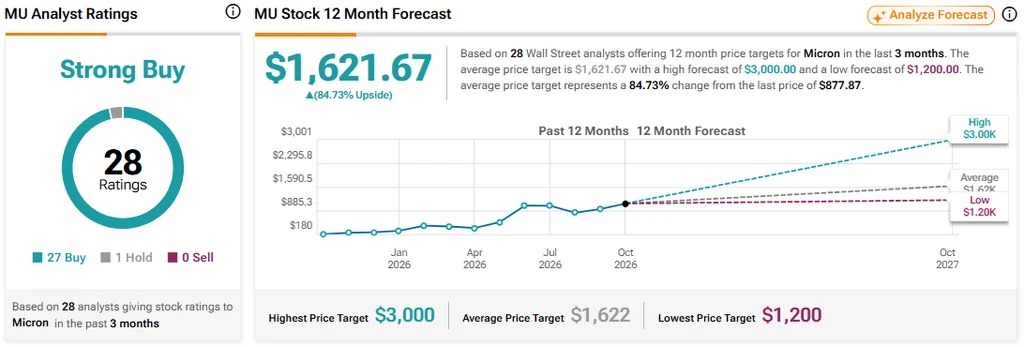
However, despite recent sell-offs, Wall Street remains bullish on Micron's prospects. The MU stock has received 27 buy ratings and 1 hold rating, forming a unanimous "strong buy" rating in 28 of the latest analyst recommendations. At the same time, the 12-month average target price is $1,621.67, which represents approximately an 85% upside from the current level. (See MU stock forecast)
The expansion of CoreWeave comes at a high cost.
CoreWeave faces a different kind of challenge, which is the substantial financial commitment required to build the computing infrastructure for AI. This new cloud service provider, supported by NVIDIA, provides computing power for tech giants such as Microsoft, OpenAI, Meta, and Anthropic, and is an important participant in the industry's expansion.
Customer demand remains strong, and as of the end of June, the backlog of contracted revenue reported by CoreWeave amounted to approximately 104 billion US dollars. However, fulfilling these agreements requires expensive data centers, advanced processors, and substantial financing, which raises concerns among investors about its future profitability.
With rising borrowing costs and investors demanding higher returns on loans, the debt burden of CoreWeave is particularly concerning. According to data cited by Reuters from LSEG, its debt is estimated to be around $50 billion, and the yield on some of its bonds has reached 15% to 16%, which puts its financing strategy under increasing scrutiny.
However, analyst Brett Knoblauch has recently defended CoreWeave, claiming that the market has overlooked its longer-term prospects.
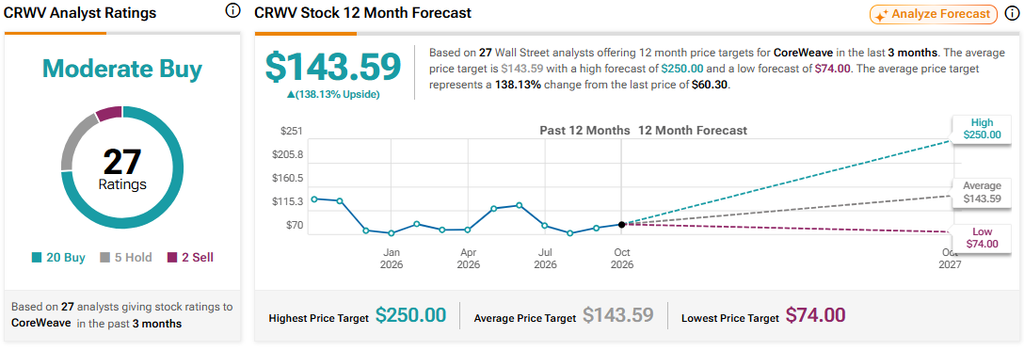
Wall Street forecasts indicate that CoreWeave may see a greater increase than Micron over the next year. Its 12-month average target price is $143.59, which means there is about a 135% upside potential from the current level. However, analysts' opinions on this new cloud service provider are not unanimous: among the 27 latest recommendations, there are 20 buys, 5 holds, and 2 sells. As a result, CRWV has received a consistent “neutral buy” rating, which is weaker than Micron’s more favorable recognition. (See CRWV stock forecast)
Disclaimer and Disclosure
Report an issue
Micron Technology News More