Key Points
- Saudi crude oil exports increased by 7.9% month-on-month to 4.451 million barrels per day.
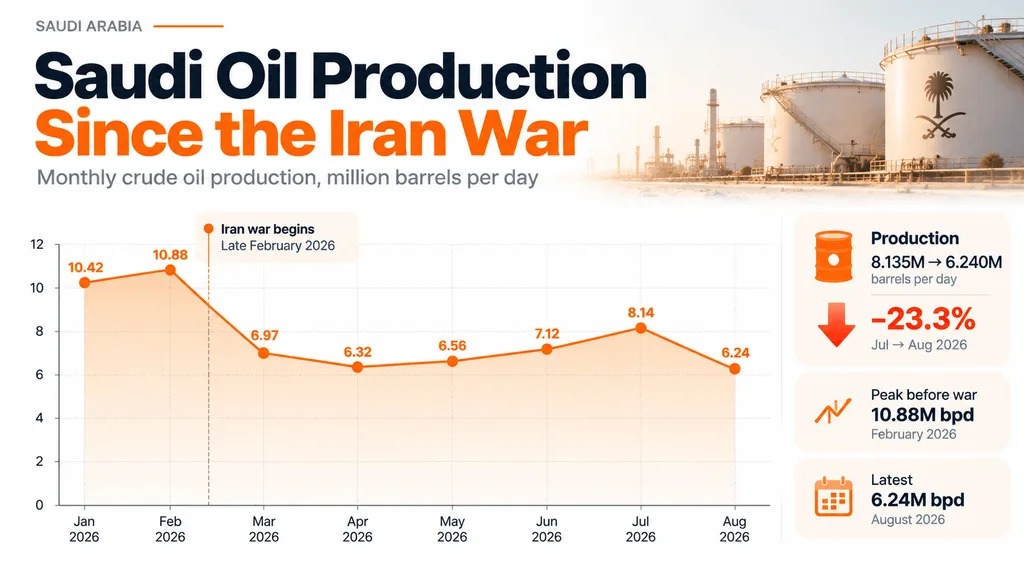
- Crude oil production decreased by 23.3% to 6.24 million barrels per day.
- Weaker refinery activities coincide with the resumption of overseas shipments.
Saudi Arabia's crude oil exports rose to a five-month high in August, while production fell to a record low, highlighting a rare divergence in the energy sector of this oil-producing country against the backdrop of ongoing supply disruptions in the Middle East.
According to the data published on October 21st under the code JODI, Saudi crude oil exports increased by 7.9% compared to July, reaching 4.451 million barrels per day, the highest level since March.
However, production decreased from 8.135 million barrels per day to 6.24 million barrels per day, a reduction of about 1.9 million barrels per day. Data shows that despite the significant decline in domestic production, Saudi Arabia still maintained stronger exports overseas.
Saudi crude oil production plummeted by 23.3%, while exports have recovered.
Saudi Arabia's production declined in August, following months of regional unrest triggered by the conflict between Iran, Israel, and the United States, which began in late February.
Despite the lower production, crude oil exports still increased by about 326,000 barrels per day compared to July, continuing the trend of recovery in overseas shipments.
UBS Analyst Giovanni Staunovo attributes this improvement to Saudi Arabia's simultaneous utilization of export terminals along the coasts of the Persian Gulf and the Red Sea, which has allowed shipments to resume despite ongoing regional tensions.
However, the alternative transportation routes have not eliminated the risks faced by Saudi Arabia's energy infrastructure. Recent attacks near Riyadh have put pressure on the regional financial markets, and threats to oil field facilities continue to exacerbate concerns about future supply disruptions in the market.
A decline in refinery activities helps to explain the increase in crude oil exports.
A decrease in domestic refining activities is another reason that explains the discrepancy between production and exports.
Saudi refineries reduced their crude oil processing capacity by 181,000 barrels per day in August, from 2.478 million barrels per day to 2.297 million barrels per day.
A reduction in refinery feedstock may allow more crude oil to be used for overseas shipments, but the data that has been released does not indicate how much of the increase in exports comes from drawing from inventories or other adjustments.
At the same time, the consumption of crude oil burned directly increased by about 43,000 barrels per day to 604,097 barrels per day, partially offsetting the impact of the decline in refinery demand.
These changes are particularly important as the global fuel market is still experiencing a shortage of refined products.
In September, global diesel exports decreased by about 700,000 barrels per day, while wholesale diesel prices in several major markets exceeded $200 per barrel.
The International Energy Agency also warns that due to damaged refineries and disrupted shipping routes limiting international supply, fuel shortages may continue until 2027.
What does the resumption of Saudi exports mean for oil prices?
As signs of a recovery in supply in the Middle East emerge, international crude oil prices remain high.
After the tanker attack and the renewed threat to regional energy infrastructure, the price of Brent crude oil recently rose to a five-month high of $111.75 per barrel.
Physical shipments have resumed, but this does not eliminate the additional costs brought about by dangerous shipping routes, rising insurance premiums, and ongoing geopolitical uncertainties.
What makes the situation particularly special is that the International Energy Agency expects global oil demand to decline by 2.6 million barrels per day in 2026.
Nevertheless, supply disruptions and declining inventories continue to support oil prices, even as global consumption is weakening.
Previous fluctuations in crude oil prices have shown how quickly developments in the Middle East's security situation can exceed market expectations for new supply.
Author Information
Ethan Mercer is a financial journalist who covers cryptocurrency, stocks, and the global economy. He studied economics and finance before turning to market reporting, with a particular focus on Bitcoin, stocks, monetary policy, and investor sentiment. His work focuses on explaining daily market fluctuations and the broader trends behind them.