

After months of user complaints, Pump.fun is set to bring cross-chain transactions back under internal management and is challenging a service provider still used by its competitor, FOMO.
Pump.fun has launched Pump Bridge and set this new product as the default path for cross-chain transactions within its application, replacing the previously shared Relay with its competitor's social trading platform FOMO.
The company claims that the new bridging product has a buying speed that is twice as fast, transaction errors have been reduced by 92%, and traders can also buy more tokens with the same amount of money. Pump.fun also indicates that Pump Bridge currently does not charge any additional bridging fees.
Pump.fun, co-founder, and Alon stated that this move stems from users' complaints over the past few months regarding slow Relay transactions, failed purchases, and poor execution results.
The platform launched cross-chain exchanges in May 2026, entering this market later than its competitors. Today, the company has developed its own infrastructure to address the issues it identified.
Pump.fun Reports faster buying and fewer errors
Pump.fun conducted a random test within its application from September 28 to October 7, during which two service providers were compared. The test covered cross-chain transactions related to Robinhood, BNB Chain, Base, Arc, and Ink. Users were assigned to different service providers multiple times during the test.
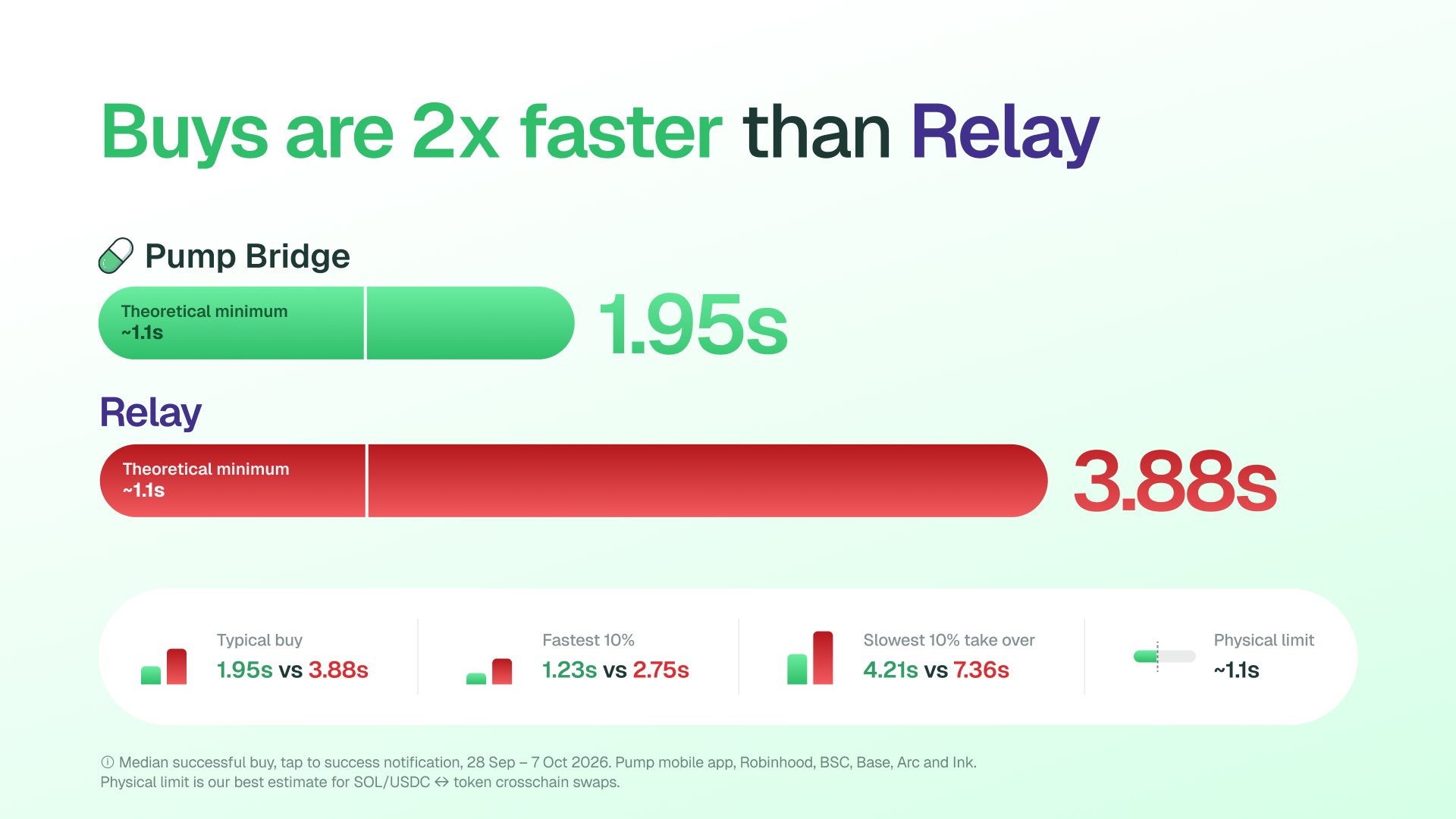
The company claims that Pump Bridge outperforms Relay in terms of speed, reliability, and execution quality. According to the report, the fastest 10% of purchases on Pump Bridge are completed within 1.23 seconds, whereas on Relay it takes 2.75 seconds; the typical purchase time for Pump Bridge is 1.95 seconds, while Relay is close to 4 seconds.
Pump.fun indicates that 90% of its transactions are completed before the typical Relay transactions are finished. The error rate for Relay is 11.2%, whereas for Pump Bridge it is only 0.9%, which means there is a reduction of about 92% in errors, or approximately 12 times less errors. Pump.fun also states that under Pump Bridge, the gap between the tokens actually received by traders and the spot price is about 17% smaller.
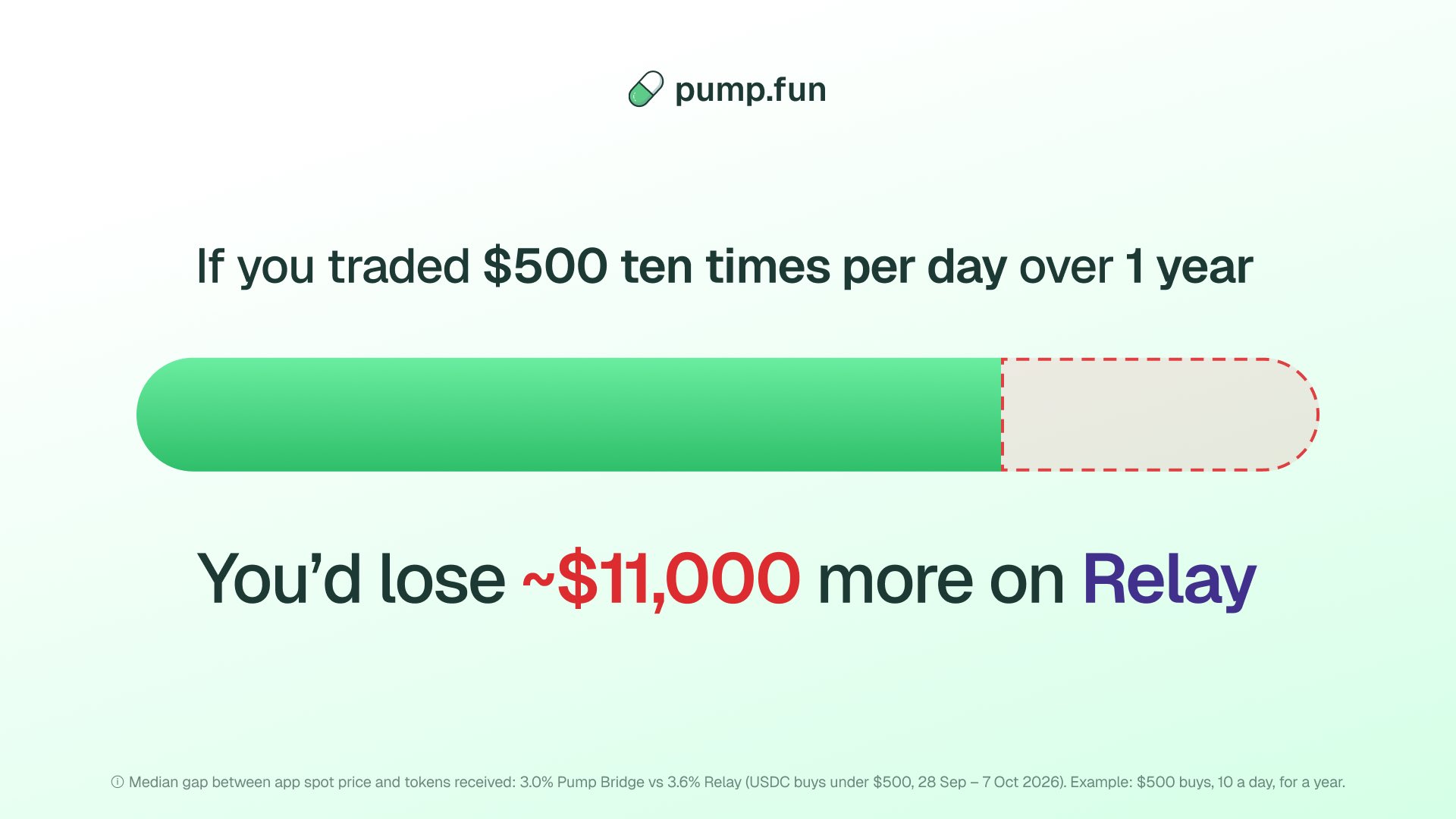
The company estimates that if someone buys tokens worth $500 each 10 times a day, then based on the observed execution differences, using Relay would result in approximately $11,000 more losses in a year compared to using Pump Bridge.
According to Pump.fun, its speed test covered 383,326 transactions, the error rate test covered 416,669 transaction results, and the execution quality test covered 35,333 completed USDC purchases of less than $500.
All of this data comes from Pump.fun's own tests. Independent verification will help to confirm whether these results are also applicable in a broader trading environment.
Pump.fun Why Build One's Own Infrastructure?
Pump Bridge is another step in Pump.fun's continued control over more transaction links. The platform was launched in Solana in January 2024, initially focusing on creating and trading memecoin. In May 2026, it expanded to cross-chain exchanges, allowing users to trade assets between different ecosystems without the need for manual fund bridging. Just earlier today, Pump.fun further introduced EVM limit orders, claiming that this is the first time a social trading application has supported limit orders based on the EVM chain. Pump.fun, co-founder Alon, reiterated in a post that the platform is "dedicated to providing you with the best possible on-chain trading experience at all costs."
Building a custom bridging service allows Pump.fun to better control transaction routing, execution quality, and future product improvements, while also reducing the platform's dependence on external suppliers in key aspects of the transaction experience.
This is not the first time that this memecoin launchpad has built its own infrastructure. Pump.fun launched its own automated market maker, PumpSwap, in March 2025. After the product went live, token migration and liquidity deployment were handled internally, reducing the platform's reliance on Raydium in that part of the ecosystem.
What does this mean for traders?
For traders, fewer failed transactions and better execution may reduce friction when buying assets across chains. However, the improvements reported still need to be independently verified, and the absence of additional bridging fees does not mean that other transaction costs or price slippages will disappear.
The more direct impact lies in the competitive landscape. Pump.fun now directly controls a service that FOMO still obtains through Relay, which gives it greater freedom in optimizing executions and launching upgrades.
Pump.fun indicates that efforts will continue to compress the transaction time to the fastest theoretical limit of about 1.1 seconds.