

According to Bloomberg, SpaceX is in discussions with major tower operators, including Crown Castle, to ensure the infrastructure needed to complement its Starlink satellite network. The potential agreement could involve leasing commitments worth billions of dollars, which has raised concerns among the market that the three major wireless operators in the United States may face another national competitor.
It has only been two weeks since SpaceX announced its agreement to acquire 800 MHz nationwide wireless spectrum from Grain Management. The transaction is valued at approximately $8 billion and still requires regulatory approval. If the deal is completed, SpaceX will obtain frequency bands that can be used to provide mobile coverage within buildings and over a larger geographical area.
The combination of spectrum acquisitions and reported negotiations for cell towers indicates that SpaceX is expanding from satellite connectivity services to wireless networks, aiming to create a network that integrates both satellites and traditional base stations. Although building such a network may take several years and cost billions of dollars, investors have already begun to consider the impact that another national competitor could have on existing operators.
T-Mobile Faces Competition from Its Own Satellite Partners
T-Mobile found itself in a particularly complex position, as it had previously collaborated with SpaceX to directly connect satellites to smartphones. Initially, this partnership was aimed at improving coverage in remote areas, allowing customers to remain connected in places that were unreachable by traditional cellular networks.
However, SpaceX plans to establish its own wireless network, which could ultimately turn this cooperation into a competitive issue. T-Mobile has already removed the Starlink brand from its satellite service promotions, and the three major US operators have recently joined forces to expand satellite connectivity services through another arrangement.
Competitive threats have prompted analysts to re-evaluate their forecasts. UBS Securities ( Scotiabank ) recently lowered its target price for T-Mobile from $217 to $212, but maintained a "outperform the market" rating. This adjustment reflects market concerns that as SpaceX's technology and coverage expand, it may eventually compete with wireless customers.
For T-Mobile, the challenge lies in continuing to maintain customer growth and network advantages while preparing to face potential competitors, who already possess a considerable scale of satellite infrastructure as well as additional rights to use wireless spectrum.
Wall Street has not yet given up on AT &T
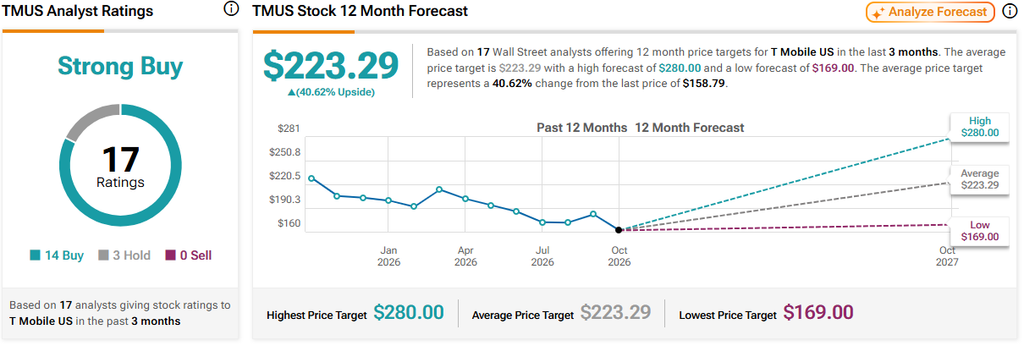
However, Wall Street has not yet completely turned bearish on AT &T. The stock maintains a consistent rating of "moderate buy," with 10 buys, 6 holds, and 1 sell rating offsetting each other. Analysts expect the average target price for the stock to be $28.16 over the next 12 months, which implies a potential increase of about 24% from Thursday's closing price. (See TMUS Stock Forecast)
Verizon Filing of financial reports approaches, competition intensifies
The upcoming performance results will further illustrate whether Verizon is able to retain customers while increasing wireless and broadband revenues. Investors will particularly pay attention to the number of new users, customer churn rates, and whether the company can maintain its profitability in the face of intensified competition.
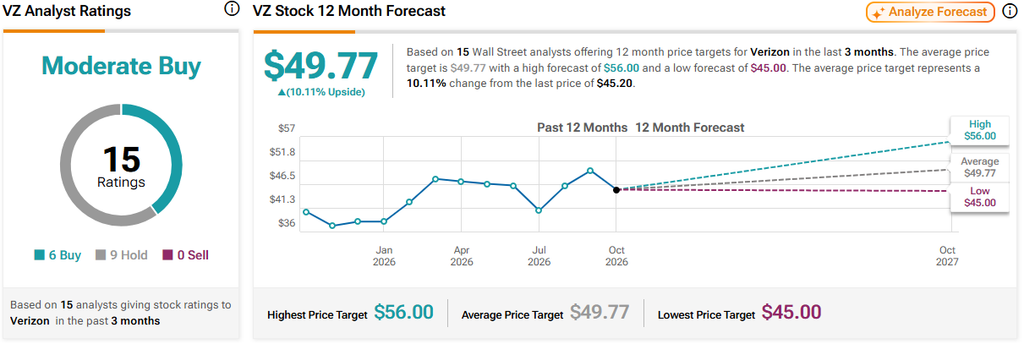
Wall Street still has significant disagreements regarding Verizon. The stock currently maintains a consistent rating of "moderate buy," based on 6 buys and 9 holds ratings. Analysts' average target price is $49.77, which implies there is about 10% room for growth in the coming year. (See VZ stock forecast)
AT &T's financial report exceeded expectations, but failed to soothe investors
AT &T has released its third-quarter results, but these figures have hardly alleviated market concerns about the wireless industry. Despite the company's revenue exceeding Wall Street's expectations and an upward revision to its full-year adjusted earnings guidance, its stock price fell by 6.5% after the announcement on Wednesday.
This telecommunications giant announced quarterly revenues of approximately $32.3 billion, driven mainly by the continuous growth of its wireless and fiber optic services. AT &T added 379,000 postpaid mobile users and 442,000 fiber optic users, with free cash flow reaching $5 billion. The company expects adjusted earnings per share to be around $2.40 in 2026, and free cash flow to exceed $18 billion.
AT &T continues to expand its fiber optic network, with the goal of covering over 60 million locations by the end of 2030. If it can provide both internet and wireless services to customers at the same time, this strategy may help to strengthen customer relationships, but the company still needs to prove that these investments will yield attractive returns in an increasingly competitive market.
Wall Street believes that the upside potential for AT &T is greater than that of Verizon. The stock also maintains a consistent rating of "moderate buy," based on 10 buys, 6 holds, and 1 sell rating. Analysts' average target price is $28.16, which implies approximately 24% upside potential over the next 12 months. (See T stock forecast)
Disclaimer and Disclosure Report Issues
Verizon News More