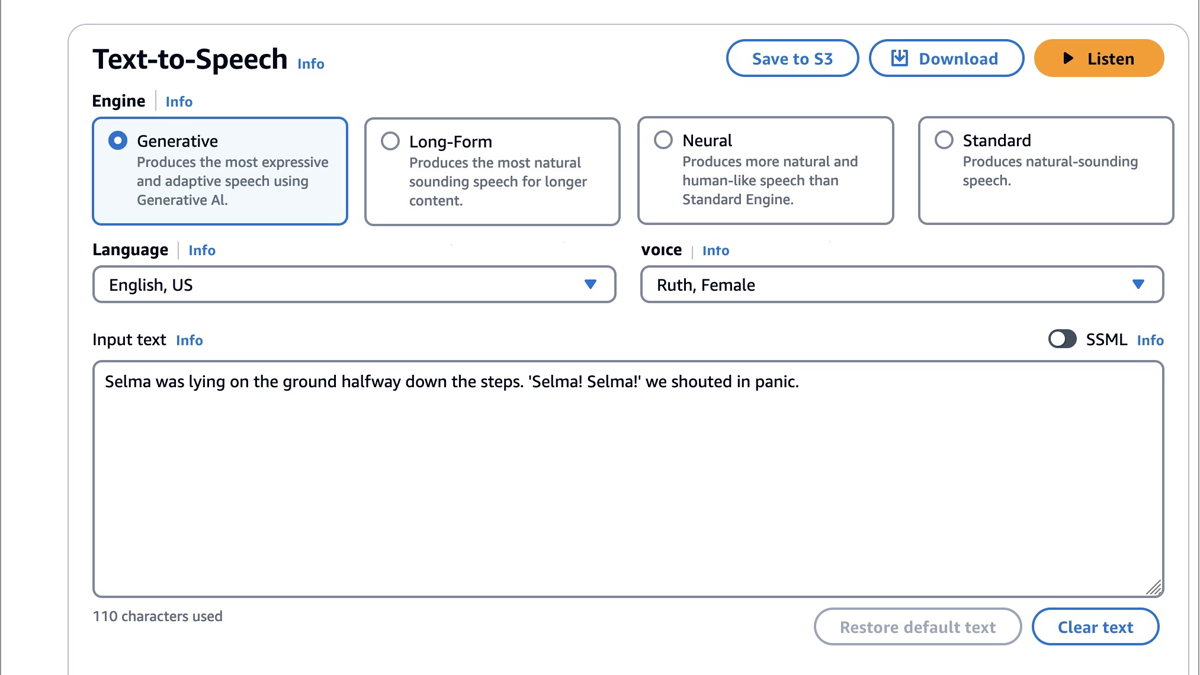


When customer service voices read out order numbers, amounts, and addresses, it is easiest for users to detect any flaws in the machine's performance. On October 22nd, Amazon Web Services announced an upgrade to its generative voice engine, claiming improvements in naturalness of expression, pronunciation of numbers and currency, as well as reduced latency. The official list of product changes includes the addition of 14 new voices covering languages from nine regions; Hindi and Finnish generative voices are now officially available for the first time. The names of the existing generative voices and the method of calling them via API remain unchanged, so applications that have already integrated these voices do not need to modify their code due to this upgrade. The term "officially available" refers to the upgrade of this service (Polly), and it does not mean that each customer's voice interaction has automatically reached the level of a human speaker.
Text-to-speech has long gone beyond simply reading web pages aloud. In call centers, the system must pronounce order numbers, times, prices, and addresses accurately; in audio content and online education, a stiff tone can directly affect whether listeners are willing to continue listening; in the AI agent applications, whether text responses can be generated quickly and clearly also determines the response time experienced by users. Therefore, what truly deserves attention in this update is not the marketing slogan “more voice,” but rather the accuracy in different contexts, the latency in continuous conversations, and whether the upgrade will disrupt the existing production systems.
Beyond new voices, compatibility is the first hurdle in producing a system.
AWS states that the new version is a direct upgrade from the existing generative voices, with the voice names and API calls remaining unchanged. For a company that has already integrated Polly into its call center, this means there is no need to redevelop the entire application chain just to improve the timbre. However, "no need to modify code" does not equate to "no need to test." The same voice, after being able to handle pauses and accents more naturally, may change the length of telephone menu announcements, and may also affect subtitle alignment, voice prompt continuity, or automatic quality inspection rules. Before going live, it is still necessary to test each item using real scripts, especially in scenarios involving amounts, dates, proper nouns, and mixed languages.
AWS provided voice samples in the announcement, showcasing greetings, order confirmations, as well as expressions related to numbers and addresses. These samples can help purchasers distinguish differences at first hearing, but they cannot replace blind tests with their own corpora. Customer service systems often need to read long strings of mixed characters; educational content may contain formulas and terminology, and cross-border e-commerce transactions may involve switching between names, place names, and currencies. A pre-recorded short sample that sounds natural is not sufficient to prove that the system will perform similarly stably with longer texts, repeated playbacks, and high-concurrency scenarios. Enterprises should at least compare the original version with the upgraded version using the same text, playback devices, and a group of listeners for testing, and then record the error rates and subjective preferences.
14 new voices have been added to cover nine locale. It's also important to understand this from a product perspective: locale does not equate to nine completely new languages; regional variants and the number of languages are not the same thing. With Hindi and Finnish generative voices now officially available, developers for these languages have more options to choose from. Market entrants are concerned not only with whether there are voices available but also with whether numbers, currencies, abbreviations, and local terms are pronounced according to local customs. Therefore, the commercial value of multi-language coverage should be judged by the quality of the language in specific customer processes, and one cannot calculate global market share based on the total number of voices available.
The cost of speech generation cannot be determined solely by the quote per million characters. In real-world applications, additional costs such as caching, retries, segmentation of long texts, audio storage, and network transmission must also be taken into account when calculating the total cost. For fixed prompts, pre-composing and caching them may be more economical; however, for dynamic responses that contain different order numbers each time, the quality and speed of real-time generation are of paramount importance. If a large amount of manual recording or script preprocessing is required to avoid mispronunciations, the supposed savings from automation will be reduced. Teams should include these additional costs, along with the final audible experience, in their evaluations during trials.
How to transform voice quality into verifiable business results
A reasonable verification sequence would be to first establish a list of error types before considering ways to save manpower. Samples should be categorized into ordinary narratives, amounts and dates, numbers and addresses, proper nouns, cross-language transitions, and emotional expressions. Record the number of pronunciation errors, misunderstandable pauses, and instances where users request repetitions. For telephone scenarios, it is also important to observe the actual time taken from connection to the first segment of speech, rather than just the average delay of a single synthesis interface. The waiting time heard by users includes the generation by upstream models, queries to business systems, and the synthesis and transmission of speech; each of these steps can become a bottleneck.
The definition of "natural" varies in different scenarios. Marketing videos strive for emotional impact, while bank notifications place greater emphasis on clear numbers, a steady tone, and compliance traceability; accessible reading requires continuous clarity and ease of understanding, rather than excessive embellishment. Mixing these purposes in a single satisfaction survey can easily result in an attractive but useless average score. It is best for purchasers to conduct evaluations separately according to the scenario and to maintain the option for manual intervention or voice replacement. Especially when dealing with significant amounts of money and medical information, the minimum standard for accuracy is more important than the degree of pleasing timbre.
It is also important to note the boundaries of the evidence provided in this announcement. AWS has only published information about the upgrades and examples of its own products, without providing independent comparative tests covering all customers and all languages. Nor has it promised that any enterprise applications will be able to reduce call durations by a fixed percentage as a result. The addition of new voices available for use does not mean that the billing and data retention conditions are the same in all regions. For specific available regions, prices, and service limitations, it is necessary to refer to the latest product documentation and console according to the actual deployment areas of the enterprises.
This update brings an old issue back to the forefront for businesses: whether voice recognition technology is good enough cannot be determined by just a piece of pleasant audio from a press conference. What's more important is whether it can accurately recognize commands under complex orders, on real devices, and during peak concurrent usage times, thereby reducing user confusion and the need for manual intervention. The new version of Polly offers a wider range of voice options and compatibility with older versions; however, the next step in proving its effectiveness still relies on customers using their own data to validate it.